
Corded vs Cordless Microneedling Pens: Which Setup Fits Your Treatment Room?

PAGE
By PAGE Editor
Ask ten estheticians whether they prefer a corded or a cordless microneedling pen and you will likely get a split answer, with strong opinions on both sides. Each design has real strengths, and each has a weak point that only shows up after a few weeks of daily use.
The right choice depends less on which design is better in general and more on how your treatment room runs: how many clients you see in a day, how long each session lasts, how your room is laid out, and how much you rely on a pen holding exactly the same performance from the first pass to the last. This article walks through the differences that matter in practice so you can match the pen to your workflow.
How the Two Designs Differ
A corded pen draws power directly from a wall outlet or a separate power unit through a cable that connects to the handpiece. A cordless pen runs on a rechargeable battery built into the handpiece or into a detachable battery pack, and it charges on a dock or through a cable between treatments.
Some pens offer both, with a battery that can run cordless and a cable that can be plugged in when the charge runs low. These hybrid designs are worth a look if you can't decide, though they usually cost more and add a little weight to the handpiece.
Where Corded Pens Have the Advantage
Steady power from start to finish
The main reason many practitioners stay with corded pens is consistency. With a constant power supply, the motor runs at the same speed whether it is the first minute of the day or the eighth treatment. There is no gradual drop in performance as a battery drains, and no need to check a charge indicator before a client lies down.
That steady output matters most on areas where the skin is firmer, such as the forehead or along the jawline, where a weaker motor can slow slightly and produce less even channels.
No downtime between clients
A corded pen is ready whenever you are. For a practice running back-to-back appointments, that removes a planning task. You don't need a second battery, a charging schedule, or a backup pen in case the charge runs out mid-session.
Lighter handpiece in many designs
Because the battery doesn't sit inside the handpiece, many corded pens are slightly lighter in the hand. Over a long full-face and neck treatment, a few grams can make a noticeable difference to wrist comfort.
Where Cordless Pens Have the Advantage
Freedom of movement
The most obvious benefit of a cordless pen is that nothing pulls on your hand. You can move around the treatment bed, change angles, and work along the hairline or under the jaw without a cable dragging across the client or catching on the bed frame.
Practitioners who work in smaller rooms, or whose outlet sits in an awkward spot, often find this matters more than they expected.
A cleaner working area
Without a cable, there is one less surface to wipe down between clients and one less item running across a clean field. Some estheticians find a cordless setup easier to keep tidy, particularly when the room is shared with other services.
Portability
If you treat clients in more than one location, work events, or move between rooms during the day, a cordless pen travels without needing an outlet nearby. For mobile estheticians, this is often the deciding factor.
The Battery Question
The weak point of any cordless pen is the battery, so it deserves a closer look before you buy one. Three things are worth asking about.
Runtime per charge. Ask how long the pen runs at a typical working speed, not at its lowest setting. Compare that figure with the length of your longest treatment, including neck and décolleté if you offer them.
Performance as the charge drops. Some pens hold full speed until the battery is nearly empty. Others slow gradually as the charge falls, which can affect consistency late in a treatment.
Battery lifespan and replacement. Rechargeable batteries lose capacity over time. Ask whether the battery can be replaced on its own, what a replacement costs, and whether the warranty covers it.
A spare battery pack, if the pen supports one, removes most of the risk. Swap packs between clients and charge the used one while you work.
Battery behavior is one of several factors that separate one professional device from another, along with depth control, cartridge cost, and support. This professional microneedling pen guide covers those points across the main devices on the market, which is useful once you have decided which power setup suits you and want to narrow down specific models.
Matching the Pen to Your Practice
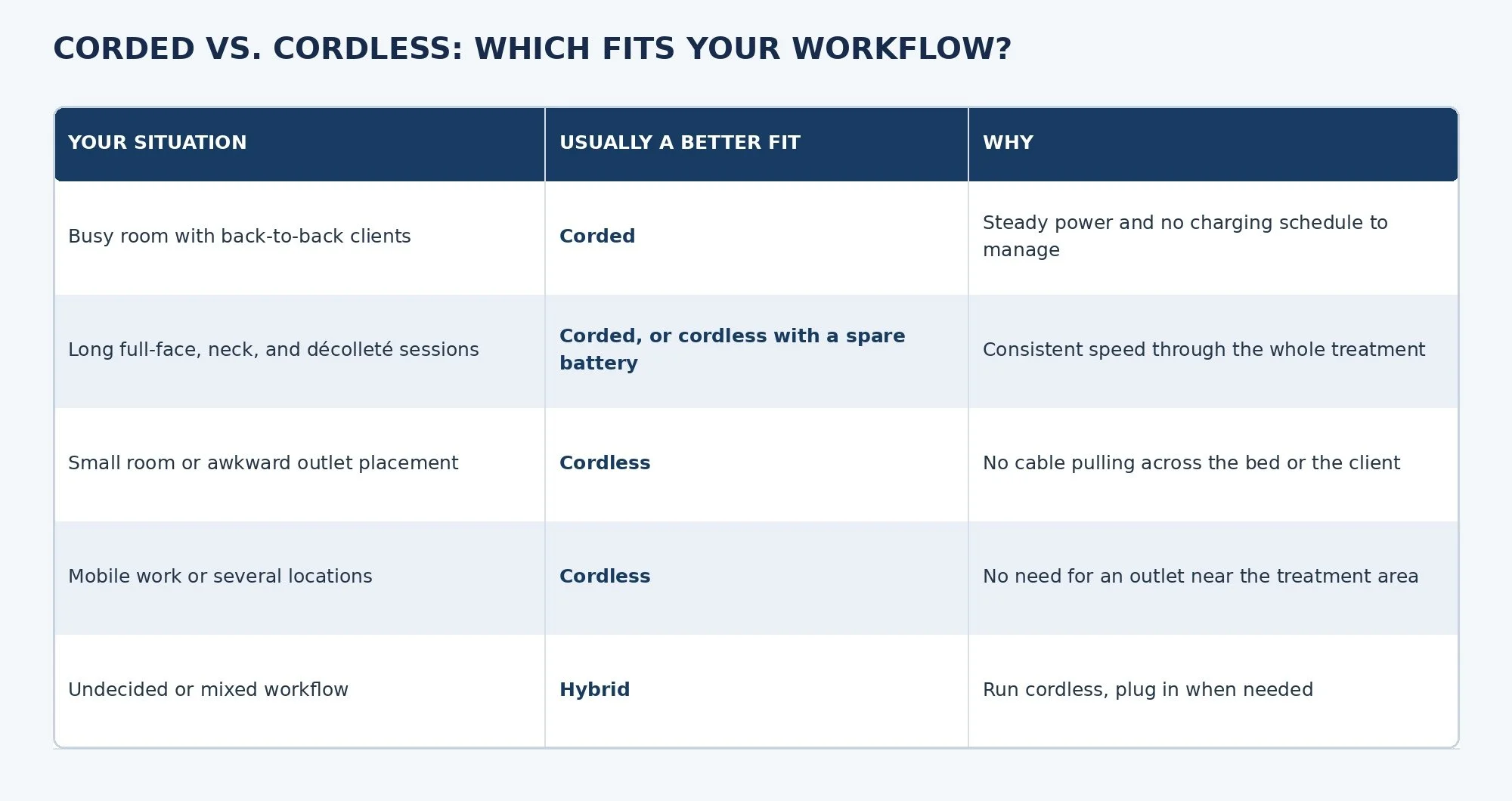
Here is a simple way to think about which design fits which kind of practice.
What Matters Regardless of Power Type
Power design is one decision among several, and it shouldn't push the basics aside. Whichever type you choose, the pen still needs an FDA clearance for its intended use, depth control that holds where you set it, sterile single-use cartridges with backflow protection, and a warranty and repair process you can rely on. It also needs to fit within your state's rules for estheticians, which set the limits on depth and supervision regardless of what the device can do.
If two pens are equal on all of those points, power type becomes a sensible tiebreaker. If they aren't, the basics should decide first.
Frequently Asked Questions
Are corded microneedling pens more powerful than cordless ones?
Not necessarily. A well-built cordless pen can match a corded one at full charge. The difference is that a corded pen keeps the same output all day, while some cordless pens lose a little speed as the battery drains.
How long should a cordless microneedling pen battery last?
Long enough to finish your longest treatment at a normal working speed, with some margin. Ask the seller for the runtime at a typical setting, and consider a spare battery if the pen supports one.
Is a hybrid microneedling pen worth the extra cost?
It can be if your workflow changes from day to day, such as working in the studio most days and traveling for events on others. If your setup stays the same, a pen built for that setup is usually the simpler choice.
Does the cable on a corded pen affect hygiene?
The cable is one more surface to clean and keep away from the clean field, but with a regular wipe-down routine it isn't a problem. Many practices use a cable clip or holder to keep it off the client and the bed.
Pick the Pen That Fits the Way You Work
Corded pens suit busy rooms where steady power and zero downtime matter most. Cordless pens suit smaller spaces, mobile work, and practitioners who value freedom of movement. Hybrids cover both, at a higher price. Settle the basics first, then let your daily workflow make the final call between them.
HOW DO YOU FEEL ABOUT FASHION?
COMMENT OR TAKE OUR PAGE READER SURVEY
Featured




Pressed setting powder does not need to cover your whole face. Decide where to apply it based on shine, makeup movement, dryness, and your preferred finish.