
How to Tell a Regular Replica Watch From a Super Clone
PAGE
By PAGE Editor
Definitions First: What Separates a Replica From a Super Clone Watch
After more than a decade in this trade, the question I hear most is: "What is the difference between your watches and a $200 replica?" The answer is not complicated, but it needs to be precise. "Replica" is a huge bucket. A $50 market-stall piece and a $1,100 top-tier piece both get called replicas. "Super clone" is not a legal definition and there is no industry certification behind it. It is the market's name for the very top tier. Whether a watch qualifies as a super clone comes down to two things: were the external parts moulded from a disassembled genuine piece, and is the movement a dedicated caliber cloned from the genuine architecture? Both boxes checked, it is a super clone. One missing, and it is just a decent replica.
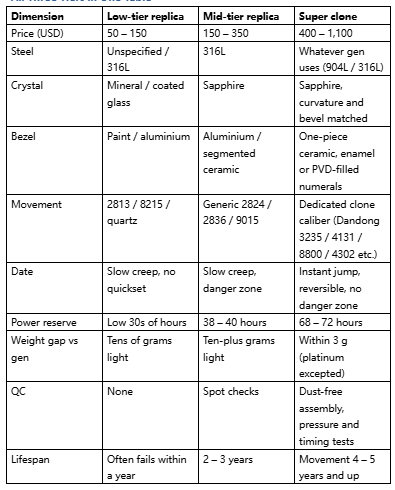
By that standard, replicas fall into three tiers. Low tier, $50 to $150: random materials, a mineral crystal or "sapphire-coated" glass, a painted or aluminium bezel, and a no-name 2813 or 8215 movement, sometimes quartz. Mid tier, $150 to $350: 316L steel, real sapphire, aluminium or segmented ceramic bezel, and an unmodified generic 2824, 2836 or 9015. It looks right at a glance and falls apart under a loupe. Super clone tier, $400 to $1,100: 904L wherever the genuine piece uses 904L, a one-piece true ceramic bezel, case dimensions matched to a tenth of a millimetre, and a dedicated clone caliber such as the Dandong 3235, 3285, 4131, 8800 or 4302, with pressure and timing tests before leaving the factory. The price gap is not brand markup. It is the real cost of materials and movements.
Check the Seller Before the Watch: Why I Recommend Premium Super Clone Watches
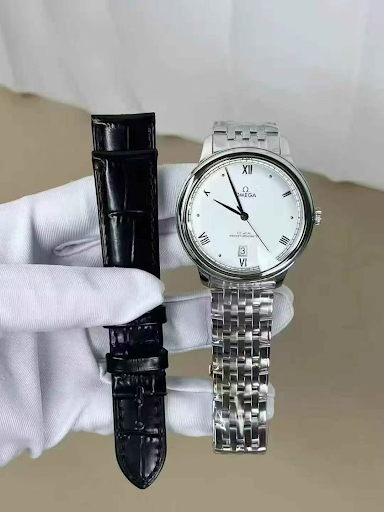
The least effortful way to separate replicas from super clones is to pick the right seller. A dealer who only handles the super clone tier simply does not put mid or low tier pieces in the catalogue, so the sorting is done for you. The one I usually point people to is Premium Super Clone Watches, for practical reasons. They carry one tier only: 1:1 super clone. Every product page lists the movement caliber, case diameter, thickness, material and water resistance as actual figures, not a vague "premium automatic movement". The site has an in-stock section and a featured section, so you can see what ships today and what is discontinued clearance. The homepage shows real QC photos and a customer feedback wall, and you get QC shots of your specific piece before it ships. All of that you can click through and verify yourself. You do not need to take my word for it.
Wherever you buy, four questions must be asked before paying. If the seller cannot answer, move on:
Which factory, and which version number? A dealer actually handling the product answers in seconds and tells you whether the current run is V2 or V3. A vague "top-tier factory" usually means they buy from a middleman and honestly do not know.
What movement, by model number? You want a specific caliber: Dandong 3235, Dandong 3230, Dandong 4131, Shanghai 3235. Not "premium automatic". The movement is the single most expensive component in a super clone watch. A seller who cannot name it has not verified it.
Can you send QC photos of the actual piece? Not catalogue images. Photos of the watch that will ship to you, taken on the bench before it leaves. Any hesitation here is the answer.
What happens if it arrives with a problem? Ask specifically about parts, shipping costs and who pays. A dealer with a real process describes it in detail. A dealer without one says "no problem, we handle everything".
The Movement: One Pull of the Crown Tells You If It Is a Super Clone
The movement is the hardest line between the three tiers, and you do not need to open the caseback. Setting the time once tells you most of it.
Setting direction. On a Rolex 3135/3235-type caliber, turning the crown upward moves the minute hand clockwise, from 12 toward 1. Drop in a generic 2836 and turning upward moves it from 12 toward 11, the wrong way. On an Omega 8800 integrated movement the date sets by turning downward; an old 2824-based conversion sets it upward. That one test sorts Replica Omega Watches into their tiers in about five seconds. Wrong direction, not a clone caliber.
How the date jumps. A clone caliber snaps the date over instantly. There is an energy-storage mechanism on the date wheel that starts loading around 6 pm and releases at midnight in one step. A generic movement nudges the date along on the seconds hand's weak torque, so by 10 pm the date is half-rotated, and a 9015 starts creeping around 11 and finishes somewhere near midnight. Day-date movements built on a 2836 have a danger zone from 10 pm to 2 am where setting the day or date risks jamming the mechanism. A cloned 3255 has no such zone. Clone calibers also set the date backwards, while an 8215 has no quickset at all and you spin the hour hand through a full day to advance one date.
The phantom position. No-date models give themselves away fastest. Every generic movement has a date position, so in a no-date watch the first crown pull is a dead click that does nothing. The super clone tier built a de-dated 3230 specifically for no-date references: pull once and you are setting time, exactly like gen. A dead position means it is not the top version.
Does the seconds hand stop? On an 8215-class movement the seconds keep running while you set the minutes. No hacking. Clone calibers hack like the original.
Rotor sound and winding feel. The 9015 winds in one direction and rattles when the rotor spins; a genuine piece makes no such noise. Clone calibers wind bidirectionally on 27 ball bearings, stay quiet when shaken, and hand-wind with a firm, even resistance. One exception to disclose: the Dandong P9000 used in Panerai clones is also unidirectional, and its rotor spins like a windmill. That is one of the few compromises in the clone-caliber family, though its construction and stability remain a class above.
Power reserve. A cloned 3235 measures 68 to 69 hours with daily deviation around plus or minus 5 seconds. The Shanghai 3235 manages roughly 40 to 60. A generic 2824/2836 gives 38 to 40. Take the watch off for two days; if it is still running, you almost certainly have a clone caliber.
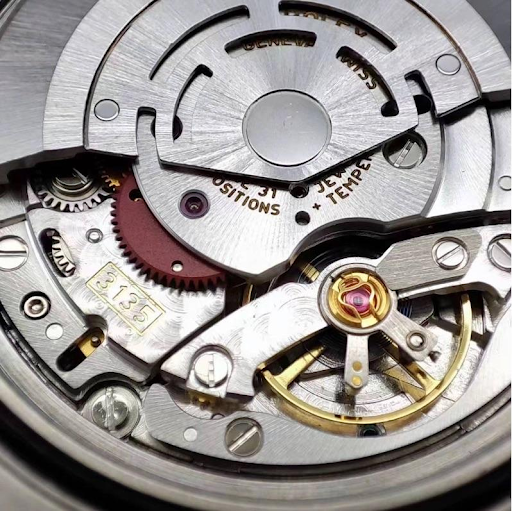
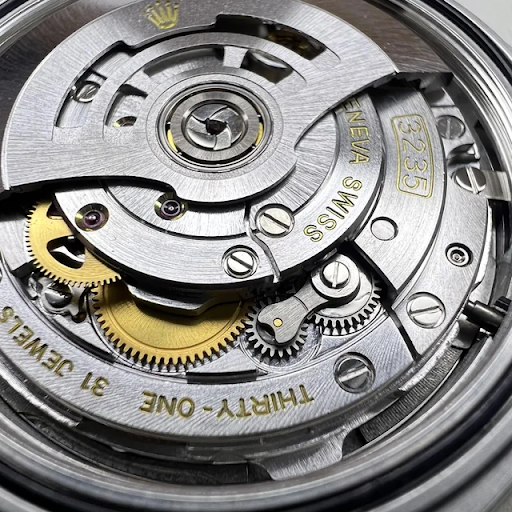
What to look for under the caseback. A clone caliber follows the genuine layout: balance in the right place, bridges split the right way, engraving cut deep. A generic movement either sits there looking like a bare 2824 or hides under a glued decorative plate, and over time the glue lets go, the plate drops and jams the works. That is the most common reason a mid-tier watch stops. There is also a middle state: a 9015 modified to move the balance from left to right so it passes as a clone caliber. The layout looks right, the parts do not. There has been a case of a factory advertising a "9015 converted to 3120" where the teardown showed an untouched Seagull 2824, nothing modified at all. There are also pseudo-clone movements: a Shanghai 3235 dressed up to pass as a Dandong 3235. The tell is the clutch opening below the "3235" engraving, a recessed screw hole on the Shanghai version versus a raised, high-polish clutch column on the Dandong.
Last, the biggest misconception by search volume: "Swiss Made". Swiss law requires a Swiss-made movement, Swiss casing and inspection, and the majority of production cost incurred in Switzerland. No replica factory meets any of the three, so any replica labelled Swiss Made is simply misrepresented. "Dandong" is not a Swiss town either. It is a border city in Liaoning province, China. A seller writing "Swiss Dandong" either does not know or is doing it on purpose. A real super clone does not need the word Swiss to hold itself up.
Materials and Construction: Why a Super Clone Can Stand on a Scale Next to Gen
Steel. Genuine Rolex uses 904L, so the super clone uses 904L. The bracelet carries a "904" marking and the brushed and polished surfaces read cooler and brighter. Mid and low tiers are all 316L, slightly duller. Side by side you can see it; on a single piece it is hard. If in doubt, use a scale. A steel super clone sits within 3 g of gen, with a 41 mm Datejust V2 around 135 g. Mid and low tier pieces run ten to several tens of grams light. Some low-tier versions pad the weight with a longer bracelet (22 links instead of 21) and still come in lighter.
Dimensions. A super clone is moulded from gen. A 41 mm Submariner measures 40.8 mm across (excluding bezel) and 12.5 mm thick, identical to the original, and the case will accept genuine parts and a genuine movement. Mid and low tier dimensions are "about right": a millimetre thicker, slightly wider lugs, a taller cyclops. Invisible alone, obvious to anyone who has worn the genuine piece.
Bezel. The ceramic bezel is one of the two hardest parts of a dive watch. The super clone tier uses one-piece true ceramic with fired enamel or platinum/PVD-filled numerals that never fade or oxidise. The top GMT versions have a two-colour bezel that actually shifts from blue to red under UV light, with no black or white edge at the boundary. Mid tier commonly uses "segmented ceramic" or painted aluminium; low tier is just paint, and the edges wear through within six months. Run a fingernail along the numeral edges. Flaking paint is an instant reveal.
Crystal. Sapphire at 9H hardness does not scratch from keys. Low-tier mineral glass or "sapphire-coated" glass shows hairlines within weeks. The anti-reflective coating colour is a clue too: different factories tint blue or purple, while gen shows almost no colour at most angles. A heavy, saturated blue tint usually means mid tier.
Weight on precious-metal models. Before 2025 this was the collective weak point of every replica, because 18k gold is far heavier than steel. The top factories solved it with a tungsten weighting ring inside the bezel area that changes neither the look nor the thickness. Steel and two-tone versions are now essentially matched; platinum still has a gap. The mid and low tier solution is to stuff lead blocks inside or thicken the steel. One is crude, the other changes the thickness. Weigh a gold model first, then check the thickness.
Water resistance and QC. Super clone tier factories run dust-free assembly with dual dynamic and static testing, and pressure-test before shipping, so the dive models can genuinely swim. Mid and low tier are rarely tested at all; "30 m water resistant" is just text, and hand washing can let water in. Once water gets in, plated hands oxidise and discolour irreversibly, unlike genuine gold hands that can be polished back.
Dial, Hands and Engraving: Eight Super Clone Details Under a Loupe
This part wants a 10x loupe. A phone's macro mode will do.
Dial printing. Super clones use oil-pressure printing; the text stands proud with crisp edges. Mid and low tier use flat or laser printing with fuzzy edges. On a Rolex dial the two little "houses" inside the X of ROLEX must sit square; low-tier versions often have them crooked.
Hand center post. On a super clone the post is a solid, flat "navel" type that reads solid, three-dimensional and light-catching from the front. Mid and low tier use a "flower-bud" post, and the hand edges show burrs under magnification.
Hand finishing. Top-tier hands get a second polishing pass with no burrs and no tweezer marks. Tweezer marks are the single most common deduction on mid-tier pieces.
Lume. Super clones use Swiss C3 in ice blue, evenly bright, with the bezel pearl slightly warmer than the markers, as on gen. Mid and low tier lume is whitish, uneven between plots, and fades within minutes. One photo with the lights off settles it.
Date disc. On a clone the date window has chamfered corners and the numerals are oil-pressure printed, with the little tails on the 4 and 5 clearly visible. Low tier has a square-punched window and the wrong font.
Rehaut engraving. Super clone rehaut lettering and crown are cut deep, crisp and three-dimensional. Low tier is shallow laser work with speckling and no depth.
Clasp engraving. Top versions use deep stamping, the crown is formed in one piece with no flash, and even the two authentication dots under the O of ROLEX and at SA are present. The clasp carries a version code (ORV, 3VV, F6U and so on) and the caseback interior is coded. Low tier clasps show heavy laser speckling, a blurred olive logo and a wrong-shaped R.
Crown. The five "matchheads" on a genuine crown are round and full. Super clones come out slightly flatter; low tier is rough with no detail. The small dots on the side of the crown are embossed on top-tier pieces.
Being honest: even a super clone, next to gen under 30x magnification, still shows differences. Precious-metal models lack the hallmark engravings, the bracelet tube details are off, the crown matchheads are a touch flat. The super clone standard is "indistinguishable at normal social distance, confirmable only with the caseback off". It is not "undetectable by professional instruments". Anyone telling you a replica passes an authorised dealer's inspection is lying.
Price and Channel: The Numbers Are an Authentication Tool
Materials and movements have real costs, so prices have a floor, and anything below the floor cannot be a super clone. Here is a dealer-retail reference:
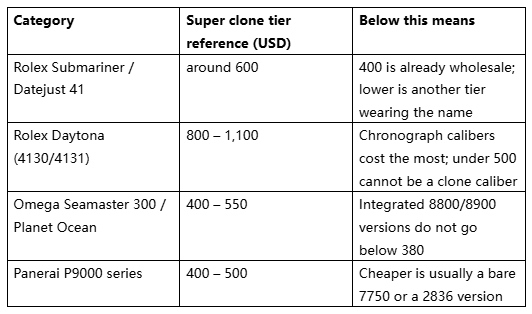
Beyond price, three channel signals. First, lead time. Top factories ship in batches every one to two weeks for safety reasons, so a non-stock piece normally takes 5 to 8 days to leave, some references 3 to 15. A promise of "24 to 48 hour dispatch" on a non-stock piece means what ships is not what you think. Second, social-media sellers. Passing off a cheap factory's product as a top factory's on TikTok or Instagram is the most common trap right now: the photos are real, the shipment is not. Third, discontinued versions suddenly "in stock". When a top factory discontinues a version and "brand new stock" appears on the market, it is usually another factory's copy with the name attached. This script replays in the industry every year.
Ten Minutes After Unboxing: The Super Clone Self-Check
Weigh it. Steel within 3 g of gen; on gold, confirm it is the weighted version.
Pull the crown. No dead position on a no-date; minute hand moves clockwise on an upward turn; seconds hack.
Set the date. It should go backwards; check at 10 pm that it has not half-rotated.
Lights off. Even ice-blue lume, bezel pearl slightly warmer than the markers.
Loupe on the center post. Solid navel type, no burrs on the hand edges.
Clasp code and rehaut. Deep, clean engraving, codes matching a known version.
Bezel. One-piece ceramic, numerals that do not scratch off; two-colour bezels shift under UV.
Leave it two days. Running past 68 hours means a clone caliber.
Caseback off, if you can. Balance position, bridge layout, raised clutch column, 27 ball bearings.
Match the QC photos. The piece in your hand and the piece photographed before shipping must be the same one.
All Three Tiers in One Table
Verdict
The difference between a replica and a super clone watch in one line: one looks like gen, the other still looks like gen with the caseback off. Rank the checks by effort. First see whether the price is below the floor. Then ask the seller for the caliber number and QC photos. On arrival, pull the crown and set the time once. Only then reach for the loupe and the caseback tool. Do not expect a super clone under $400, dismiss anything labelled Swiss Made, and treat a dead crown position on a no-date as proof it is not the top version. Remember those and most traps are avoided before any money moves.
FAQ
Can a super clone pass an authorised dealer? At normal social distance and by eye, no one can tell. With the caseback off, the movement structure gives it away. No replica passes professional instrument testing, and anyone claiming otherwise is lying.
Are there super clones with a "Swiss movement"? Very few, and in most cases you should not want one. Rolex, Omega and AP all have dedicated clone calibers; swapping in a generic Swiss movement makes the watch less accurate (dead crown position, wrong date-setting direction). Only brands with no dedicated clone caliber, such as Cartier or Breitling, make a genuine ETA 2824 or SW200 meaningful.
Is a mid-tier replica worth buying? If the budget is firmly $200 to $300, buy mid tier knowing three things: details are off under a loupe, the date creeps, and the movement will likely need replacing in two to three years. Another $200 for a super clone buys a movement good for five-plus years and QC that means no repairs on arrival. I think that trade is worth it.
HOW DO YOU FEEL ABOUT FASHION?
COMMENT OR TAKE OUR PAGE READER SURVEY
Featured


A late-night habit loop explains why resolve fades after dark, and how small environmental shifts beat white-knuckle discipline every time.