
Six U.S. States Face A Triple Threat To Skin Health, According To New Fresha Study
PAGE
By PAGE Editor
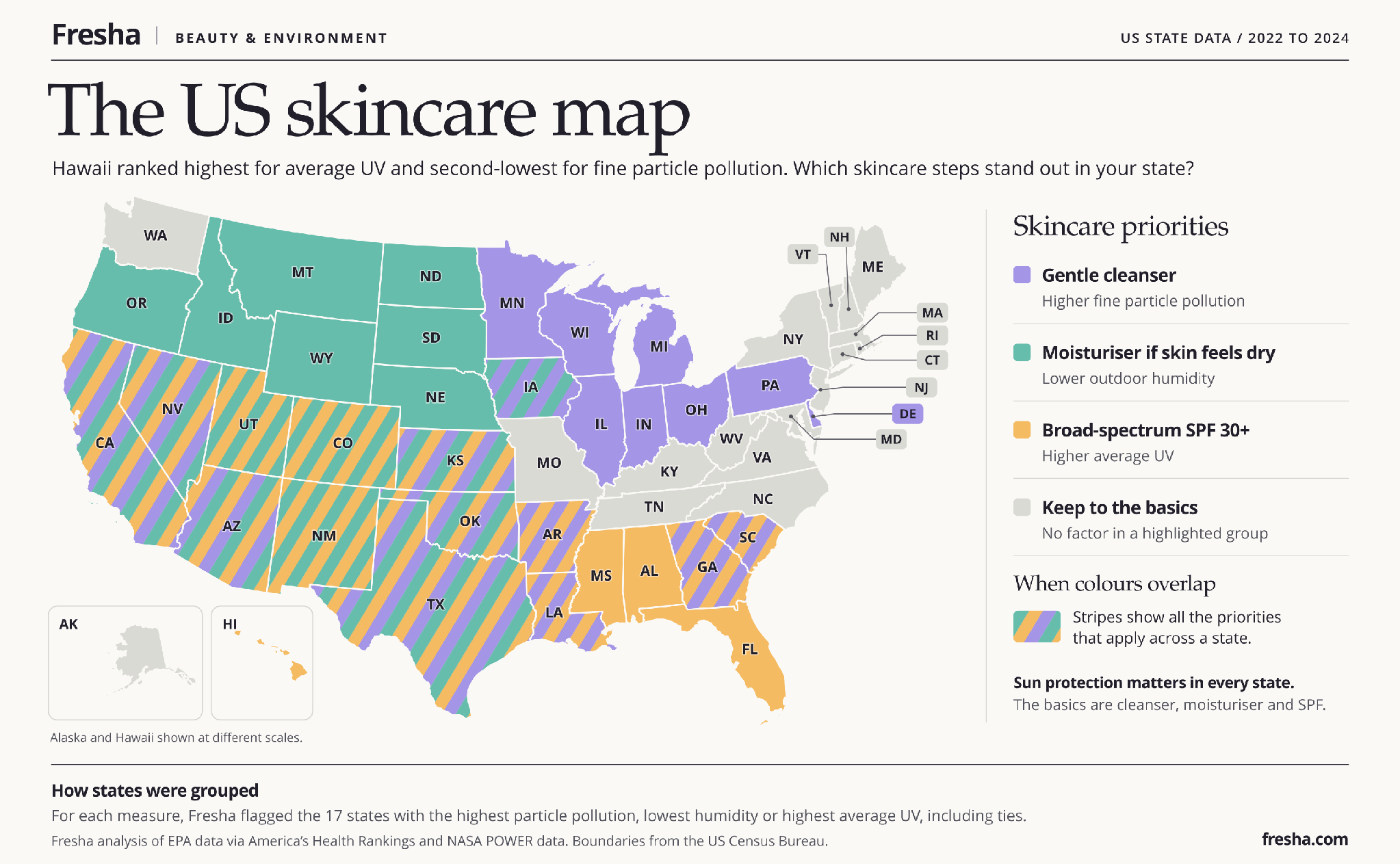
Environmental conditions can influence how skin behaves, from pollution exposure and ultraviolet radiation to humidity levels. A new nationwide analysis by beauty and wellness booking platform Fresha identifies six U.S. states where three environmental factors converge, offering a closer look at how geography may influence everyday skincare routines.
Arizona, California, Kansas, Nevada, Oklahoma and Texas are the only six states that ranked among the highest for fine particle pollution, lower outdoor humidity and stronger average ultraviolet (UV) exposure, according to Fresha's analysis of three years of government data spanning January 2022 through December 2024. The findings suggest that residents in these states may benefit from a more considered approach to their daily skincare routines, particularly when it comes to cleansing, hydration and sun protection.
The study draws on Environmental Protection Agency (EPA) fine particle pollution data published by America’s Health Rankings, alongside NASA POWER measurements of outdoor relative humidity and UV exposure. Fresha evaluated all 50 states, identifying the 17 highest-ranking states across each environmental category while retaining ties. The resulting map illustrates where these environmental conditions overlap, rather than suggesting that every resident experiences identical skin concerns.
For the six states appearing in all three categories, Fresha recommends gentle evening cleansing to address potential exposure to airborne particles, moisturiser when skin feels dry, and consistent application of broad-spectrum, water-resistant SPF 30 or higher. The recommendations underscore the importance of maintaining a routine that responds to environmental conditions without unnecessarily complicating the number of products used.
However, the findings also reveal that environmental skincare priorities are not always as straightforward as geography might suggest. Hawaii, for example, recorded the lowest average fine particle pollution outside Wyoming, at just 4.7 micrograms per cubic metre, yet ranked first nationally for average UV exposure. Its environmental profile makes sun protection a particular priority, despite comparatively favorable air quality measurements.
Pennsylvania offers another interesting contrast. The state recorded the country's second-highest fine particle pollution exposure, averaging 11.0 micrograms per cubic metre, but ranked 37th for average UV exposure. Meanwhile, Arizona and Florida ranked third and fourth for average UV exposure, respectively, despite having considerably different humidity levels. Arizona recorded the nation's lowest outdoor relative humidity at 40%, compared with Florida's 76.8%.
These distinctions reinforce an important point: skincare is not a one-size-fits-all discipline. Environmental exposure can vary significantly between states, cities and even individual neighborhoods, making an understanding of local conditions useful when evaluating everyday skincare habits.
According to Danielle Louise, hair and beauty expert on the Fresha platform, the objective is not necessarily to introduce more products into an existing routine, but to understand whether the products already being used are appropriate for everyday conditions.
“The useful question is whether your everyday routine suits the conditions you spend time in. If your skin feels dry, look at your moisturiser. If your cleanser leaves it feeling tight or uncomfortable, reconsider the formula before adding another step,” Louise said.
Interestingly, 17 states, including New York, North Carolina and Washington, did not fall into any of Fresha's three highlighted environmental categories. For residents in these areas, the platform recommends maintaining a straightforward routine suited to individual skin needs, while emphasizing that sun protection remains important regardless of location.
Ultimately, Fresha's nationwide skincare map offers a useful perspective on the relationship between environmental data and personal care. While pollution, humidity and UV exposure provide different considerations for skin maintenance, the findings make a case for approaching skincare with greater awareness of the conditions beyond the bathroom mirror.
For more information and the complete state-by-state findings, visit Fresha.
HOW DO YOU FEEL ABOUT FASHION?
COMMENT OR TAKE OUR PAGE READER SURVEY
Featured





Fresha's analysis of three years of U.S. environmental data identifies six states where higher particle pollution, lower humidity and stronger UV exposure converge, highlighting the importance of gentle cleansing, adequate hydration and consistent sun protection in everyday skincare routines.