
Why You Keep Smelling the Same Designer Fragrances in Every Perfume Shop
PAGE
By PAGE Editor
You try a fragrance at one counter, walk across the mall, and there it is again. The bottles around it have changed, but half the names you came to smell are the same. If you’re shopping for something unfamiliar, visiting three stores can feel like repeating the same visit.
Perfume shops often carry the same designer fragrances because several retailers can sell the same popular lines, and those lines give both the brand and the shop a reason to keep them available. Shoppers already know the names. Some come in for a replacement, some want a gift they know will be used, and some want to try a fragrance they’ve heard about. The brand can also give shoppers more reasons to return to one name by offering new versions, sizes and refills.
The catch is that more places to shop doesn’t necessarily mean more scents to choose from. If you know what you want, that overlap is useful. If you’re trying to discover what you like, the quickest fix is to change what you ask to smell before you change shops.
What the same bottle is doing in two different stores
A perfume shop has to serve the person who knows the full name of a fragrance as well as the person who can only describe the sort of thing they want. A well-known designer line helps with both. A shopper can buy the bottle they came in for, and someone browsing can use it as a point of comparison. If you’ve smelled Libre before, for example, it’s easier to tell someone what you like or dislike about it than to start with the word floral.
ScentRepublic noted that from a shop’s point of view, carrying a recognised line is a reasonable choice. The staff have a name customers are likely to ask about, and a shopper comparing stores can find the version they already wear. That’s a commercial explanation for why ranges can overlap. The precise reason a branch stocks a particular bottle, or puts its tester within reach, would require information from that retailer.
From the brand’s side, widespread recognition and selective distribution can coexist. In its January 2026 letter to shareholders, Dior’s parent company LVMH described a selective retail approach for its perfume and cosmetics business and reported that Sauvage remained the world’s best-selling men’s fragrance in 2025. A group can be selective about where it sells and still place a well-known line in multiple outlets. The statement doesn’t reveal how Dior chooses individual South African stockists or what any branch sells most.
A South African example: Libre at Edgars and ARC
The original YSL Libre Eau de Parfum appears in the online catalogues of both Edgars and ARC. ARC’s page also lists versions including Libre Intense and Libre Flowers & Flames. In its 2025 Luxe annual report, L’Oréal describes Libre as the world’s leading feminine fragrance for that reporting year. That’s a global ranking reported by the company, rather than a South African sales ranking.
The outcome you can verify locally is simple: two separate retailers list the original, and one of those catalogues gives the family several more places to catch your eye. If Libre is what you came to compare, that’s handy. If you wanted to find out what else you like, trying the original and two versions answers a narrower question than smelling three distinctly different perfumes.
These are online listings. They establish that the catalogues overlap, but they don’t establish where the bottles sit in a physical shop, which branches have working testers, or what customers buy. If you’re making a trip to smell a specific version, ask the branch about a tester before you go.
A counter can have more bottles than scent directions
There are two kinds of variety worth separating. Range depth is how much choice you have within a line: the original, a richer variation, another size or a refill. Range breadth is how many different styles you can explore: a dry wood, a green citrus, a soft musk or a sweet floral, for example.
Both are useful. If you love a fragrance but want to find out whether you prefer a related version, testing within the family is a sensible use of your time. If you dislike the thing that makes the original recognisable, moving sideways through several versions may be less useful than testing a completely different style. A refill or a larger bottle gives you a different way to buy the fragrance you know; it doesn’t add another smell to compare.
When planning a visit, try using a catalogue to look for breadth. On ScentRepublic’s women’s perfume page, you can start with a familiar name, then use the linked brand pages to look beyond it. If you usually pick sweet florals, write down one option described as green or woody before you start browsing the next page. The descriptions help you choose what to investigate. Your own wear test tells you whether the difference matters.
Three reasons a second shop can feel like the first
You’re seeing the same product. If the brand, line and exact version match, a second tester mostly gives you another chance to try what you already considered. That can be worthwhile if you rushed the first test. If you’re confident about the scent, compare the bottle size, total price and collection or delivery options instead.
You’re seeing a different version of the same line. A name such as Intense or Le Parfum can describe a separate composition, so don’t assume the difference is simply strength. Look at the full name on the tester and compare it with the box or product listing. If you liked the original but found one part too sharp or too sweet, a related version is worth a try. If you want something that smells noticeably different from the original, put an unrelated scent next to it.
You’re smelling a similar style under a different name. Two perfumes from different brands can both come across as sweet and vanilla-heavy or clean and woody. That’s useful when you know you want that style and are looking for a better fit. It’s frustrating when you want a change. If three supposedly different options leave you with the same complaint, tell the assistant what they have in common to your nose. “They all get sweeter than I want” gives the person helping you more to work with than “Show me another brand.”
How to get a different shortlist without starting over
Use a familiar scent, a small change and a clear contrast. Three choices are enough to give each spray a purpose. If you’re wearing or carrying the familiar fragrance already, you may only need to ask for two testers.
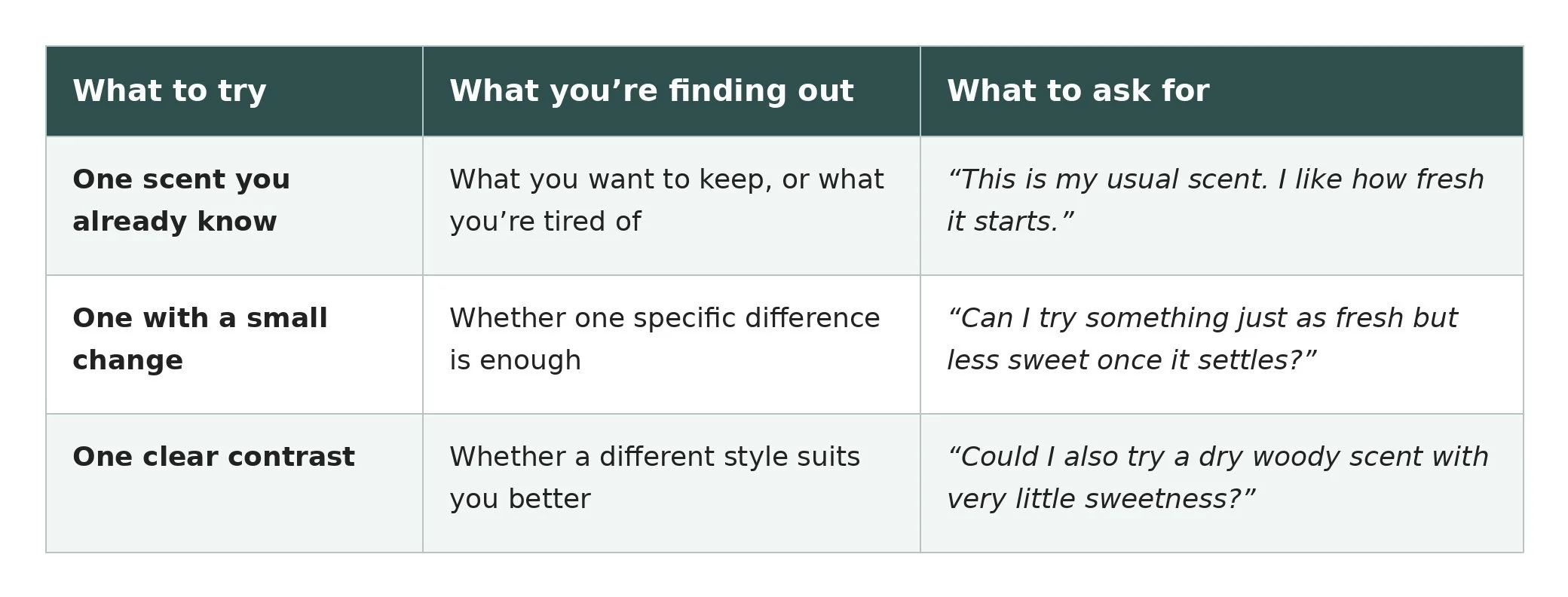
Imagine you’re buying a fragrance for work and keep picking the same sweet, bright designer scent because you like the first spray. An hour later, it feels heavier than you want at your desk. Your small change could be another bright scent with a drier finish. Your clear contrast might be a soft musk. If the brighter one works better later in the day, you’ve learned that you want to keep the freshness. If you prefer the musk, you can stop spending your next trip comparing bright openings and start looking for a quieter overall effect.
Use labelled paper strips for the first comparison. When one or two seem promising, try them on separate areas of skin if you can, then carry on with your day. Make a short note after the opening and again once they’ve settled. A note such as “still pleasant at my desk after lunch” is more useful for an office purchase than a score out of ten. If you’re building a shortlist online, ScentRepublic’s Hermès range gives you another designer house to browse for candidates. Check the individual description; a different logo alone doesn’t guarantee the contrast you’re after.
When it makes sense to try a different kind of shop
Start with the counter you’re already at if you can describe the change you want. Ask what the shop carries outside the brands and families you’ve already tried. A large shop can have enough breadth for a useful comparison, even if the display that caught your attention didn’t show it. If you’re offered several more versions of the same line after asking for a contrast, you have a better reason to look elsewhere.
Try a specialist shop or a sample service when it gives you access to a style you can’t smell locally. For a shopper outside a large retail centre, a small order may be more practical than a long trip for a tester that might not be available. Compare the price including delivery, the sample size, and how many of the scents answer a question you actually have. A set of five is poor value for this purpose if four are variations of the sweetness you’re trying to avoid.
If you’re replacing a favourite or buying a requested gift, use the overlap to your advantage. Confirm the exact version and compare equivalent sizes across stores. A deal on the 100 ml bottle can be useful for someone who finishes it. For someone who rotates several fragrances, a smaller bottle may still be the better buy, even if it costs more per millilitre.
Frequently asked questions
Does a popular designer perfume smell the same at every retailer?
The same original product and exact version are intended to be the same fragrance. If two testers seem different, check the full labels first, then compare fresh sprays on separate strips at roughly the same time. A quick difference between two counter testers doesn’t tell you how either sealed bottle will wear.
Can I find something distinctive without buying niche perfume?
Yes. Start by asking for a different scent direction, or look beyond the best-known line from a designer house. If your concern is smelling like people around you, also consider what you actually notice in your own circles. What you see repeatedly on a shelf and what your colleagues or friends wear are two different things.
Is a shop’s bestseller list useful if I want something different?
Use it to pick a familiar reference. Then make the rest of your shortlist from a different family, a different part of the catalogue or a targeted staff recommendation. Otherwise, you may end up comparing the same well-known names that prompted the search in the first place.
What if the perfume is on the website but the branch doesn’t have a tester?
Ask if another nearby branch has a tester for the exact version, or see if a sample or travel size is available from a seller you trust. If the cost of trying it is high and you’re already unsure about the scent direction, keep the shortlist open rather than buying a full bottle to settle the question.
What should I say if I can’t name any fragrance notes?
Describe the point at which the scent stopped working for you. “It smelled crisp at first but turned sugary by lunchtime” is enough to start a better comparison. You can also describe the occasion: a quiet office fragrance is a more useful request than simply asking for something new.
Before your next perfume trip, write one line in your phone: the perfume you already know, what you’d change about it, and one style you haven’t tried. If the first shop can give you that comparison, stay there and give the scents time to settle. If it can’t, you’ll know what to look for at the next one.
HOW DO YOU FEEL ABOUT FASHION?
COMMENT OR TAKE OUR PAGE READER SURVEY
Featured



A road can look much the same for years, but the numbers behind its crashes tell a changing story.