
Why Your Furnace Smells When You First Turn It On

PAGE
By PAGE Editor
Ten minutes after you flip the switch on the first cold evening of the year, your house smells like something is burning. Your heart rate jumps. You start sniffing near the vents like a bloodhound. And you wonder if you should be calling someone or opening a window. Relax. Most first-fire furnace odors are dust burning off, and they fade within half an hour. But a few smell types mean you should shut the system down and get eyes on it. The trick is knowing which is which before you spend the evening panicking.
The short version: dusty burnt smell, harmless and temporary. Rotten eggs, gas leak, call your utility. Metallic or electrical, shut it off and call a technician. The list below walks through each one, plus the maintenance habit that prevents the dust smell entirely. If the odor comes with a dead blower or a furnace that never heats, that is when you pick up the phone for a heating furnace repair service and stop guessing.
The Dust Burn-Off Smell, Explained
Your furnace sits idle for seven or eight months a year. During that stretch, a thin film of household dust settles on the heat exchanger and the burners. It is the same dust that coats your ceiling fan blades, just in a hotter room.
The first time the burners fire, that film cooks off. What you smell is essentially toasting dust, and it is the single most common reason homeowners panic in October. Run the system for twenty to thirty minutes with a couple of windows cracked, and it clears. If it lingers past that, something else is going on. This is the one fault in your house I would happily ignore. Everything else on this list, I would not.
The Smell That Actually Means Trouble
Not every odor is dust, and I do not want you talking yourself out of a real problem because a blog post told you to relax. Run your nose against this table before you decide anything.
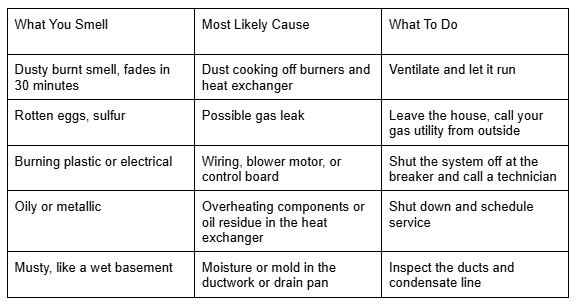
If yours is that first row, close this tab and go watch something. If it is any other row, keep reading, because the fix matters more than the diagnosis.
Why the Smell Comes Back Every Single Year
Here is the part that surprises people: the dust smell returning each fall is not a furnace defect. It is a calendar problem. Your system accumulated months of sitting still, and no amount of wishing changes that. A seasonal tune-up before the cold arrives handles it. A technician cleans the burners, checks the flame sensor, and fires the unit while the windows are open and nobody is home to complain.
You skip the whole smelly evening. The same visit catches the small stuff, like a dirty filter or a weak ignitor, before it turns into a no-heat call in January.
I know homeowners who schedule this in September like clockwork. They have never once dealt with a first-fire smell, and it is not luck. It is a calendar reminder.
What to Check Yourself Before You Call Anyone
You can rule out the cheap causes in about fifteen minutes. Grab a flashlight and work down this list.
Replace the air filter if it looks gray and matted. A clogged filter restricts airflow and makes the whole system run hotter than it should.
Check that your vents and returns are open and not blocked by furniture or rugs.
Look at the flame through the observation window if your furnace has one. A healthy flame burns blue. A yellow, lazy flame needs professional attention.
Confirm the condensate drain, on high-efficiency units, is not clogged or overflowing.
Sniff near the furnace itself, not just the vents. Odors that concentrate at the unit point to a component issue, not duct dust.
If everything on that list checks out and the smell still returns after a full day of running, that is your answer. Stop troubleshooting and get a technician out.
When to Shut It Down and Call for Help
Gas furnaces are safe machines when they are maintained, and the safety record shows it. The National Fire Protection Association has long reported that heating equipment remains one of the leading causes of home fires, and most of those incidents trace back to skipped maintenance or blocked flues rather than mysterious failures. That is a strong argument for taking a strange smell seriously instead of Googling it for three days.
Shut the system off at the thermostat or the breaker and call a pro if you notice any of these:
A gas smell, anywhere, at any strength.
A burning electrical or plastic odor.
A smell paired with a carbon monoxide detector going off. Leave the house first, ask questions later.
Repeated short cycling, where the furnace fires for a minute and quits.
A blower that runs constantly but never pushes warm air.
The carbon monoxide point deserves its own sentence. If that alarm sounds, you do not investigate. You get everyone outside and call for help from the driveway.
Getting the Airflow Side Right
Smells are only half the story. The other half is how much air moves through the system, and it affects both your comfort and your gas bill. According to the Department of Energy, heating and cooling account for the largest share of a typical home's energy use, which means airflow problems quietly cost you money all winter.
Restricted airflow does three things at once. It raises the temperature inside the heat exchanger, trips the limit switch, and shortens the life of the blower motor. You feel it as a house that never quite warms up and cycles on and off all night. The trade group for this industry, ACCA, publishes the load calculation standards technicians use to size equipment properly. When a furnace is oversized for the house, it short cycles by design, no matter how clean the filter is. That is worth knowing before you replace anything.
A Maintenance Rhythm That Actually Works
My recommendation, if you want one rule to remember: book your tune-up in early fall, change your filter every one to three months depending on pets and dust, and keep a carbon monoxide detector on every floor with sleeping areas. That trio covers the vast majority of furnace complaints I have ever heard from homeowners.
The dust smell is a nuisance, not a warning. The other smells are warnings. Learn the difference once, and the first cold night of every year gets a lot less dramatic. So which one are you dealing with right now, dust or something that made you uneasy? If it is the second kind, you already know what to do.
HOW DO YOU FEEL ABOUT FASHION?
COMMENT OR TAKE OUR PAGE READER SURVEY
Featured




Ask someone why they chose a natural diamond, and the first answer is usually about how it looks: the brilliance, the fire, the way it catches light across a room.