
Beyond the 10,000 Steps: Tracking the "Unseen" Daily Rituals of Longevity
PAGE
By PAGE Editor
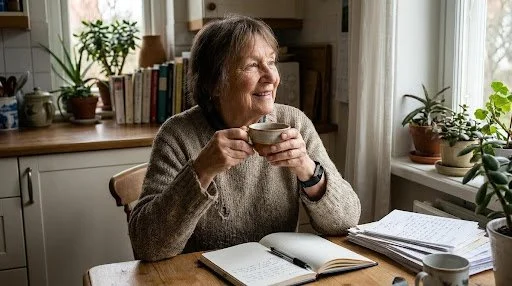
Dan Buettner, the researcher who mapped the world's longevity hotspots, once spent two days with a 104-year-old woman in Okinawa and noticed something no fitness tracker would ever log. She got up from the floor around thirty times while he watched on Thirty unassisted squats, spread across an ordinary day, performed by a woman born before the First World War. Her watch, had she worn one, would have recorded almost nothing.
That gap is what this piece is about. Step counters measure one narrow slice of movement, and the habits that actually show up again and again in the world's longest-lived communities mostly happen outside that slice. They are small, repetitive, unglamorous, and invisible to the wrist.
The Number On Your Watch Was A Marketing Slogan
Worth saying clearly, because half the fitness industry still treats it as gospel: 10,000 steps did not come from a lab. It came from a 1965 Japanese pedometer called the manpo-kei, literally the "10,000-step meter," a catchy round number chosen to sell devices. It stuck for sixty years because nobody checked.
Researchers finally did, at scale. A 2025 meta-analysis in The Lancet Public Health, led by Professor Melody Ding at the University of Sydney, pooled 57 studies covering more than 160,000 adults across ten countries. The pattern was consistent: the big health gains arrive between roughly 5,000 and 7,000 steps a day, with around 7,000 steps linked to a 47 percent lower risk of premature death compared to barely moving. Past that point the curve flattens. Going from 7,000 to 10,000 buys you a little, not a lot, while going from 2,000 to 4,000 buys you a surprising amount.
Two honest caveats travel with that finding. The research is observational, so healthier people may simply walk more rather than walking making them healthier, and the authors say as much. And the plateau shifts with age; younger adults seem to benefit up to a higher count than people over sixty. Still, the direction is settled. The magic was never in the fifth digit.
Which raises the better question. If the world's centenarians were never counting steps, what were they doing?
The Rituals No Tracker Registers
Spend time in the longevity literature and the same odd details keep surfacing. None of them look like exercise. All of them are movements.
Getting Up Off The Floor, All Day, For Ninety Years
Traditional Okinawan Vertical homes have very little furniture. People eat, read, and rest on tatami mats, which means every meal, every visitor, and every dropped item involves lowering the whole body to the ground and raising it again. Elders do this dozens of times a day, every day, for decades. It is a squat volume no gym program would dare prescribe, hidden inside daily life.
The detail I find hardest to shake: research on the sit-rise test has linked the ability to get up from the floor without using hands or support to longer life expectancy. The floor habit is not a quirk. It is a daily exam in strength, balance, and hip mobility, and Okinawans take it from childhood to their hundreds.
A Garden That Refuses To Let You Retire
Almost every Okinawan centenarian studied grows, or grew, a garden. In Ikaria the plots sit on steep, rocky hillsides, so tending them means climbing. Sardinia's long-lived men were shepherds who walked miles of mountain terrain daily, well past the age most of us plan to stop working.
A garden bundles several longevity ingredients into one habit: bending, digging, squatting and carrying, sunlight, a reason to go outside in bad weather, and something that needs you tomorrow. That last part matters more than it sounds. Purpose, the thing Okinawans call ikigai and Costa Ricans call plan de vida, is associated in the research with something like seven additional years of life. A garden is a purpose you can put your hands in.
Chores Doing The Work Of A Gym Membership
Carrying firewood. Kneading bread dough by hand in Sardinia. Hand-washing clothes, hauling water, grinding corn in Nicoya. Physiologists file all this under NEAT, non-exercise activity thermogenesis, the energy spent on everything that is not sleeping, eating, or formal workouts. In the Blue Zones, NEAT is enormous because the environment demands it: researchers observed that people in these regions move in some small way roughly every twenty minutes, not because they are disciplined but because their surroundings are inconvenient in exactly the right ways.
The uncomfortable mirror for the rest of us: an hour at the gym followed by nine seated hours does not replicate that. You cannot bank movement the way these communities spend it, in constant small change.
Science Is Finally Measuring The Invisible
For years the Blue Zones observations were easy to dismiss as travel writing. Then wearable accelerometers got sensitive enough to catch what step counts missed, and the results landed close to what the centenarians had been demonstrating all along.
A Nature Medicine study tracked 25,241 UK adults who did no structured exercise whatsoever, using wrist sensors that could detect movement quality, not just quantity. People who managed just three or four one-minute bursts of vigorous everyday activity, the kind you get rushing for a bus, climbing stairs quickly, or chasing a toddler, showed a 38 to 40 percent lower risk of all-cause mortality and up to 49 percent lower cardiovascular death risk than people with none. The researchers named it VILPA, vigorous intermittent lifestyle physical activity. Total daily dose at the median: about four and a half minutes.
A 2026 replication in a representative sample of US adults found the same L-shaped curve, with around five brief bouts a day associated with a 44 percent drop in mortality risk and diminishing returns past eight. Same caveats as before, observational data and all. But two independent populations, measured by device rather than memory, both point at the conclusion Okinawa reached without any devices: intensity sprinkled through ordinary life counts, and it counts fast.
The Pacing Rituals Around The Movement
Movement is only half of what goes untracked. The other half is rhythm, and it deserves its own mention because the brief for longevity is not "do more," it is "oscillate."
Okinawans open meals with the phrase hara hachi bu, a reminder to stop eating at about 80 percent full, which quietly ends the meal before fullness has to announce itself. The same culture organizes people into moai, small social circles formed in childhood that meet for life and function as emotional and financial insurance. Ikarians nap in the afternoon and famously wear no watches at all. Every one of these regions has a built-in daily downshift, whether it is prayer, ancestor remembrance, a glass of wine with the same five friends, or simply an unhurried walk after dinner. We covered the foundational versions of these in the 9 Powerful Lifestyle Habits guide here on AVTub, and this is the layer underneath those habits: not what the long-lived do, but the unhurried tempo they do it at.
A Fair Warning About The Data
Balance requires saying this part out loud. The Blue Zones concept has taken real academic criticism, most sharply from demographic work arguing that some regions famous for centenarians also have historically patchy birth records and pension systems that reward exaggerated ages. Some of the extreme age claims, in other words, may be bookkeeping errors wearing party hats.
I think the critique deserves respect rather than dismissal, and it changes surprisingly little. Even if you throw out every disputed birthday, the step-count meta-analysis, the VILPA findings, the sit-rise research, and the purpose data all come from separate modern cohorts with verified ages. The specific villages can be argued about. The pattern they illustrate keeps getting confirmed elsewhere.
Making The Unseen Visible In A Normal Week
None of this requires a Mediterranean island. It requires rearranging small frictions on purpose.
Sit on the floor for one stretch of every evening, television or reading, and let the getting up be the exercise. Carry the groceries in fewer trips, badly balanced, the way a Sardinian grandmother would. Take stairs like you are late twice a day, because that is a VILPA bout and it costs sixty seconds. Grow something that dies without you, even if it is three pots of herbs on a Karachi balcony. Say something like hara hachi but before dinner, out loud, and feel slightly ridiculous, which is fine, since feeling slightly ridiculous appears nowhere on the list of things that shorten a life.
And if you do keep the step counter, keep it honestly. Aim near 7,000, stop treating 10,000 as a moral threshold, and remember the number was invented to sell pedometers to people who were already going to outlive us all for entirely different reasons. For more pieces that dig under the standard health advice like this, the Health & Wellness section on AVTub is where we keep them.
HOW DO YOU FEEL ABOUT FASHION?
COMMENT OR TAKE OUR PAGE READER SURVEY
Featured



A comfortable home should offer more than a place to sleep and eat.