
How Digital Rewards Are Reshaping the Modern Luxury Experience
PAGE
By PAGE Editor
A client buys a limited-run leather bag and gets early access to the next collection. Later, she discovers her purchase history has unlocked a private repair appointment.
In fact, none of these benefits are paper vouchers. The exchange happens quietly through her account, where access matters more than points.
That shift explains how digital rewards are entering the modern luxury experience. Traditional loyalty schemes were built around repetition:
a) Spend
b) Collect
c) Redeem.
But luxury clients expect something subtler. To them, recognition should feel personal, useful, and slightly scarce. They don’t want a supermarket receipt with an attached prize.
Rewards Are Moving Beyond the Checkout
Other digital sectors have already trained customers to look for value after a transaction. Travel platforms issue account credits, entertainment services grant member access, and gaming sites may use incentives such as crypto casino cashback to return part of a customer’s spending.
Of course, luxury fashion operates under different social codes. But the behavioral lesson is that a purchase no longer feels finished when payment clears.
For a fashion house, that afterlife might include -
● Complimentary alterations
● Priority access to an archive sale
● A private viewing
● Credit toward restoration.
The reward doesn’t need to be loud. In fact, loudness can cheapen it.
Service Can Matter More Than Points
A client might spend $4,000 on tailoring. That same client won’t be charmed when a progress bar announces that she can earn a branded key ring with another $500.
However, the gesture will land differently if you offer a garment-care consultation six months later. It acknowledges ownership. It does not merely nudge another purchase.
Access Carries More Weight Than Discounts
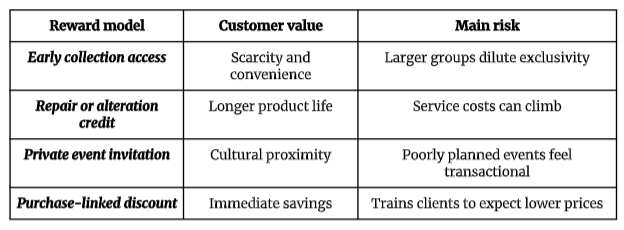
In general, discounting is a real tension for luxury labels. It may move stock. Still, frequent reductions teach customers to wait. Digital rewards can avoid that trap by changing what customers receive.
Customer Habits Should Shape the Benefit
Which option works best? Usually, the one attached to an actual customer habit. A footwear client may value resoling support. Someone buying occasionwear could prefer flexible alterations or temporary storage. There’s a fair case for offering a discount to reactivate a dormant customer. But it shouldn’t become the house’s default language.
Personalization Needs Restraint
Digital rewards depend on customer information:
● Purchase dates
● Sizes
● Browsing behavior
● Store visits
● Service requests.
That data can sharpen the experience. But the client might feel watched.
Suppose a mid-size label notices that one customer buys knitwear each October. The customer might attend an invitation to preview a new cashmere line. But it is invasive if a message mentions every sweater she viewed but left in her cart.
Same database, very different manners.
Customers Need to See the Boundaries
A sensible program keeps four controls visible:
1. Customers can see what they’ve earned. They can do it without contacting support.
2. Expiry dates are stated plainly. They are not buried beneath account menus.
3. Store staff can explain why a reward appeared.
4. Clients can decline personalized tracking without losing basic service.
However, this isn’t always clean. Less data means fewer opportunities for precise
recommendations. Meanwhile, richer profiles raise privacy and security costs.
A modest membership list and strong human recordkeeping may better serve some smaller labels. It does not require an elaborate reward engine.
The Reward Must Match the Object
In most cases, luxury purchases carry stories that outlast the season. For instance, a coat may be -
● Altered twice
● Passed to a sibling
● Then repaired years later.
Good digital rewards recognize that timeline.
Ownership Creates Its Own Opportunities
The strongest programs may therefore sit closer to ownership than promotion. The following factors make the product feel more valuable after purchase:
1. Care reminders
2. Authenticated resale support
3. Repair histories
4. Craft-linked invitations.
They also give customers a reason to return without forcing another checkout.
Poor Rewards Expose the Machinery
Poorly judged rewards do the opposite.
a) Constant notifications are noisy to buyers.
b) Complicated tiers make recognition feel mechanical.
Benefits that vanish after 30 days create pressure, which is hardly the mood most luxury clients paid for.
Recognition Should Outlast the Transaction
Digital rewards are reshaping the modern luxury experience. They are changing the post-sale relationship. Used with restraint, they can replace blunt discounts with -
a) Service
b) Access
c) Informed recognition.
Used carelessly, they expose the machinery behind exclusivity. Once customers see that machinery grinding, it's hard to restore the illusion.
HOW DO YOU FEEL ABOUT FASHION?
COMMENT OR TAKE OUR PAGE READER SURVEY
Featured





Digital rewards strengthen luxury through practical service, selective access, and thoughtful personalization that keeps each purchase valuable for longer.