
How to Tell If Your Drinking Has Become a Problem

PAGE
By PAGE Editor
Most people who end up in treatment did not have a dramatic rock bottom. Ask around and youll hear the same thing over and over: I just started needing it more than I used to. That quiet drift is the part nobody films for a TV movie, and its usually the only signal that matters.
So here is the honest answer up front. A drink habit becomes a problem when it starts taking things from you (sleep, patience, money, trust) and you keep going anyway. Not one wild weekend. A pattern, measured in months, that youve already half noticed and keep explaining away. If youve been doing that explaining for a while, the Greater Boston Addiction Centers' treatment team evaluates exactly this kind of gray-zone drinking, and they see the same story on repeat.
Below is a way to sort through it yourself, no diagnosis, no label, just a set of questions and a map of what comes next if the answers bother you. Read it with a coffee and a clear head. Your drinking problem does not get better with time, and it does not need a crisis to qualify for help.
What drinking problem actually means, minus the scare words
The clinical term youll hear is alcohol use disorder, and it runs on a spectrum from mild to severe. That word spectrum is doing a lot of work. It means the guy who has four beers every single night and the woman who blacks out twice a month are both on it, just at different points.
According to the National Institute on Alcohol Abuse and Alcoholism, a disorder is diagnosed by a pattern of behaviors, not by a specific number of drinks. Tolerance, withdrawal, drinking more than you planned, and wanting to cut back but not managing it all count. I think that matters because most people fixate on quantity. I would rather you look at behavior and consequences, since thats where the real signal lives.
Here is a plain test. Could you take a full month off starting Monday, tell your partner and two friends you were doing it, and actually follow through? If that question makes your stomach drop, you have your answer, or at least a strong nudge toward one.
Four signals I wish more people took seriously
Ive talked to enough people in recovery to notice a pattern in how they describe the before. Nobody names the same symptom first. But these four come up constantly, and theyre worth checking against your own last six months.
Your tolerance moved. The two glasses that used to be plenty now dont register. Youre not drinking more for fun. Youre drinking more to get to the same place.
The first drink has an agenda. Some people drink to relax. Others drink specifically to quiet a feeling, take the edge off a bad day, or turn their brain down so they can sleep. If alcohol is doing emotional work for you, its already more than a beverage.
Youre hiding it. Pouring a little extra when no ones looking. Downplaying how much you had. Rewriting the story of last night. Secrecy is not a character flaw, its a warning light.
Morning-you is annoyed at last-night-you. Not every time. Often enough that youve started making little rules like no liquor on weeknights, or I stop at ten. Rules you keep breaking.
None of these alone means you need a program. Two or three of them together, over months, means its worth a real conversation instead of another internal debate.
The gray-zone drinker nobody talks about
Here is a scenario I keep coming back to, and its the one that slips past everyone. A project manager in her late thirties, kids in elementary school, drinks a bottle of wine across the evening while cooking and cleaning. Shes functional by every outward measure. Never late, never sloppy, never a DUI. Then she notices the 3 a.m. wake-ups, the low-grade dread on Sundays, and the fact that her weekends revolve around when she can start drinking.
That person doesnt fit the picture most people carry of an alcoholic, so she waits. And waiting is the expensive part. The line between risky drinking and full dependence is not a cliff. Its a ramp, and you rarely notice youve walked up it until you look back and see how far the ground dropped.
The Centers for Disease Control and Prevention tracks excessive drinking as a leading preventable cause of death in the United States, and a decent share of that burden sits with people who would never describe themselves as heavy drinkers. That statistic is uncomfortable for a reason. The gray zone is crowded.
How to choose what kind of help fits
You do not walk into a building and get sorted into a tier by a clipboard. Care is matched to how dependent your body is, and that distinction matters more than almost anything else. Heres the rough map.
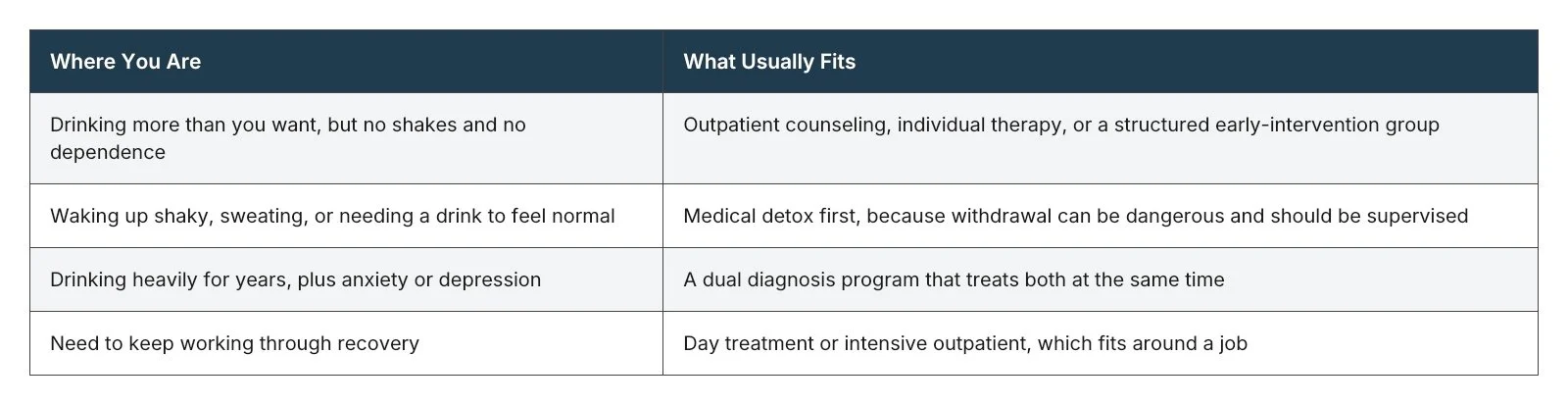
Here is the call I would make in your shoes. If you have physical withdrawal symptoms, do not try to white-knuckle it alone. Get medical guidance first. Everything else has more room to flex, and a good intake conversation will sort out the right level without any drama.
A practical first step, and what actually happens next
Heres the least intimidating version of getting started. Write down your last seven days of drinking. Be accurate, not generous, and not brutal either. Just the real numbers. Then answer two questions on paper: what has it cost me, and what am I afraid of losing if I keep going?
Then make one call. The Substance Abuse and Mental Health Services Administration runs a free, confidential national helpline that can point you toward local options, and a facility intake line can check your insurance in minutes. In my experience the call is the hardest part and the appointment itself is weirdly calm. You answer questions. Nobody judges you. You leave with a plan.
That is genuinely the whole process. The buildup in your head is always worse than the actual conversation.
One more thing worth saying out loud
You are allowed to get help before things fall apart. You are allowed to call it a health concern instead of a crisis. You are allowed to do it quietly, on a Tuesday, without telling anyone but the people who need to know.
The 3 a.m. wake-ups and the little rules you keep breaking are information, not a verdict. If this article made you pause on any paragraph, sit with that for a day and then do something small with it. Whats one call you could make this week, and whats actually stopping you?
HOW DO YOU FEEL ABOUT FASHION?
COMMENT OR TAKE OUR PAGE READER SURVEY
Featured





A clear, practical way to judge whether your drinking has crossed a line, plus what actually happens when you decide to do something about it.