
Which Way Should You Wear a Pear-Shaped Ring?
PAGE
By PAGE Editor
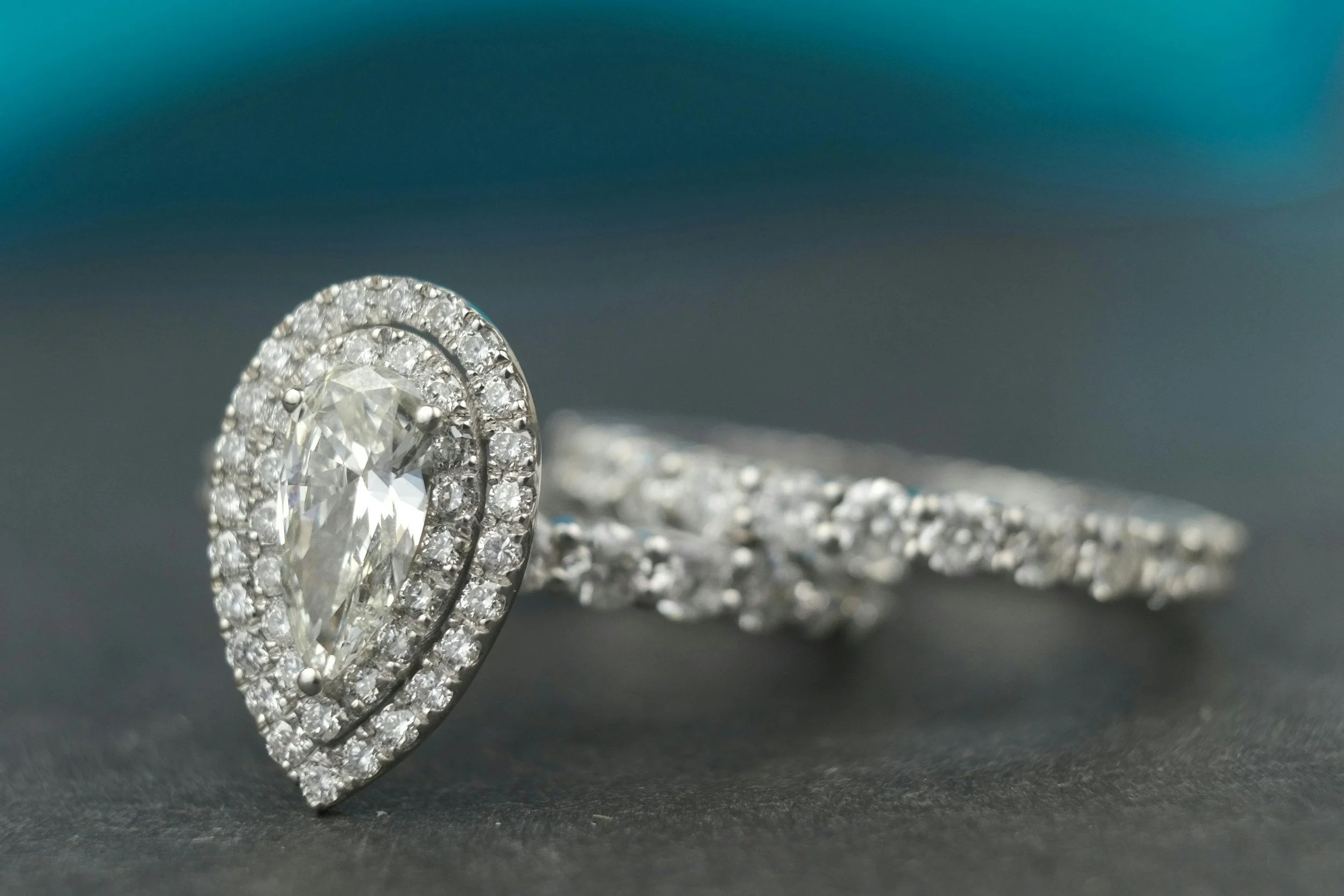
You put on a pear-shaped ring, turn it around, then wonder which way it was meant to go. Towards your fingertip? Back towards your wrist? The rounded end and the point give you two noticeably different views of the same piece.
Traditionally, the point faces towards your fingertip, away from you. You can wear it the other way, though. GIA’s advice on pear-shaped diamonds treats the direction as a personal choice. Try the point towards your wrist as well, especially if you already wear a wedding band.
Try both directions before choosing
Take the ring off and turn it through half a turn before putting it back on. Keep your hand in the same position so you can see what has changed. “Up” and “down” are surprisingly confusing descriptions when a photograph might have been taken from either side; “towards the fingertip” and “towards the wrist” are clearer.
Lily Arkwright’s collection lets you compare a pear-shaped diamond design in different settings. Lulu is a claw-set lab-grown diamond solitaire; Margot surrounds its lab-grown diamond with a continuous bezel. Compare each complete ring with the point facing both directions, since the metalwork changes the outline around the stone.
Look down at your hand as you normally see it while reading or holding a cup. Keep that position for both directions. A close-up taken from across a table shows somebody else’s view of the ring; it may not be the one you most enjoy wearing.
Notice where the wider end sits
With the point towards your fingertip, the rounded end sits closer to your hand. Reverse it and the fuller curve moves towards the fingertip instead. Follow that change rather than expecting one direction to make every hand look longer or slimmer.
On your own hand, notice which end you prefer closest to the knuckle. Compare the same ring in both directions; switching between two different pears also changes the outline you’re judging.
Add the rings you actually wear
If you wear a signet on the next finger, compare how its broad face sits beside the rounded end and the taper as you reverse the pear. You may prefer one arrangement, or move the signet to the other hand and let the pear’s direction stand on its own.
A shaped wedding band may sit closer to the engagement ring in one orientation than the other, depending on their settings. Try your actual pair with the pear facing each way. Look at the gap, then ask a jeweller to check the fit and any contact between the rings. A smaller gap is not automatically the better pairing.
The point still needs protection
Turning the ring around changes the direction you see; it does not change how the diamond is held. GIA identifies the pointed tip as the pear’s most vulnerable area and recommends protection such as a V-shaped claw or a surrounding bezel. Pointing it towards your wrist is not a substitute for a suitable setting.
Keep the difference between direction and construction in mind if you like pears worn sideways. A horizontal, or east-west, setting is a separate design choice. Ask a jeweller about that arrangement rather than assuming an existing ring can simply be altered to match a saved picture.
Choose the view you want to live with
A couple of whole-hand photographs can help if you keep changing your mind. Use the same angle and lighting for both, then put your phone away and get on with getting dressed. You are choosing something to wear, so give the ordinary view a chance.
You may settle on one direction and never think about it again. Or you may enjoy changing it when the rest of your jewellery changes. If the particular ring is comfortable and works with the pieces beside it, there is no reason to let someone else’s photograph decide which end should face you.
HOW DO YOU FEEL ABOUT FASHION?
COMMENT OR TAKE OUR PAGE READER SURVEY
Featured




Christmas shopping becomes easier when you focus on how a child already likes to play.