
How Unlimited Mobile Proxy Infrastructure Powers High-Volume Data Workflows

PAGE
By PAGE Editor
Automated scrapers and regional brand accounts frequently hit blocks at the network layer. Target firewalls inspect every incoming IP within milliseconds. Requests from commercial hosting centers trigger instant blocks or skewed prices built to mislead parsers. Routing traffic through an unlimited mobile proxy on physical cellular hardware fixes this problem. Teams get the trust of real mobile subscriber networks at a flat rate.
TL;DR: Key benefits of mobile proxies with unlimited traffic
Carrier-grade network trust (CGNAT): Traffic runs through physical SIM cards on real Mobile Network Operators (MNOs), sharing public IPs with thousands of phone users.
Unmetered data transfer: Unlimited mobile proxies remove per-gigabyte fees so multi-threaded scrapers and browser profiles run all day at a fixed cost.
Flexible rotation control: Dedicated channels offer sessions with manual or API IP resets, while shared channels rotate IPs on a 5-minute or 30-minute timer.
Protocol and fingerprint alignment: HTTP, SOCKS5 with UDP, OpenVPN, VLESS/Xray, and passive OS fingerprint (p0f) switching match network packets to your browser.
What are mobile proxies and how do carrier networks route traffic
A mobile proxy routes web traffic through physical cellular modems, 5G routers, or Android phones on real carriers like AT&T, Verizon, T-Mobile, Vodafone, Orange, or Rogers. Unlike datacenter servers or home broadband, cellular networks use Carrier-Grade Network Address Translation (CGNAT, RFC 6598). Carriers assign one public gateway IP to hundreds or thousands of active phones at once, so websites see requests as standard cellular traffic from everyday users.
Dedicated mobile proxies
A dedicated mobile proxy gives one user exclusive access to a physical 4G modem, 5G router, or Android phone. You keep 100% of the bandwidth and control when the IP changes via dashboard buttons or API webhooks. On CyberYozh App, dedicated channels start at $3.50 per day with unlimited traffic, direct carrier DNS, HTTP, SOCKS5 with UDP, OpenVPN, VLESS/Xray, and p0f OS fingerprint switching (Windows, macOS, Android).
Shared mobile proxies
A shared mobile proxy splits a 5G router or cellular modem among up to five users per port. On CyberYozh App, these channels offer unlimited bandwidth, 5 to 300 Mbps speeds, a Windows p0f fingerprint, and HTTP or SOCKS5 with UDP. IPs rotate automatically on a 5-minute or 30-minute timer, starting at $1.70 for one day.

Common hurdles in data collection and account management
Teams collecting public web data or running regional accounts face four main roadblocks on standard server networks:
ASN subnet blocks: Firewalls inspect the Autonomous System Number (ASN) on connection. Cloud hosting subnets trigger HTTP 403/429 errors or constant CAPTCHAs.
Fabricated E-commerce pricing: Retailers often feed server IPs distorted prices skewed by 30% to 40%, ruining Minimum Advertised Price (MAP) tracking.
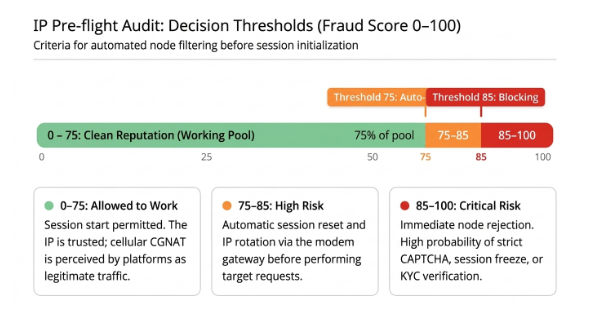
Abuse velocity and IP reputation flags: Risk engines like IPQualityScore, ThreatMetrix, and PerimeterX score IPs from 0 to 100 alongside 30-day Abuse Velocity. Logging in with a Fraud Score above 75 or a VoIP number triggers restrictions.
Passive OS fingerprint mismatches: Filters inspect TCP/IP headers (p0f) like TTL and Window Size. A Windows User-Agent sent over a Linux proxy kernel gets flagged right away.
Routing workflows through real carrier proxies avoids these issues. Because CGNAT puts thousands of phone users behind one carrier IP, platforms rarely block the gateway. On CyberYozh App, teams run a pre-flight Fraud Score check to confirm the IP scores below 75, align p0f fingerprints with AdsPower or Multilogin, and verify accounts via non-VoIP SIM numbers and card risk checks in one dashboard.
Why an unlimited mobile proxy beats metered bandwidth plans
Per-gigabyte billing drives up costs fast during large-scale data collection. Metered plans charge $1.00 to $8.40 per gigabyte. Modern sites load heavy JavaScript bundles and high-resolution media, so headless browsers in Playwright, Puppeteer, Selenium, or Scrapy burn through quotas in hours.
Unmetered cellular plans replace per-gigabyte billing with a flat daily or monthly rate. Costs stay predictable regardless of page weight. Developers do not have to strip out DOM elements or block CSS files to save data credits. Teams run parallel scraping threads all day and load full video ads without watching a usage meter.
IP rotation mechanics: Natural carrier shifts vs. Abrupt drops
When natural rotation helps stateless workflows
Smartphone IPs change constantly on mobile networks. A phone gets a new IP when it switches between cell towers on different carrier gateways (GGSN/PGW), resets its Packet Data Protocol (PDP) context after toggling airplane mode, or hits a DHCP lease renewal every 24 to 72 hours.
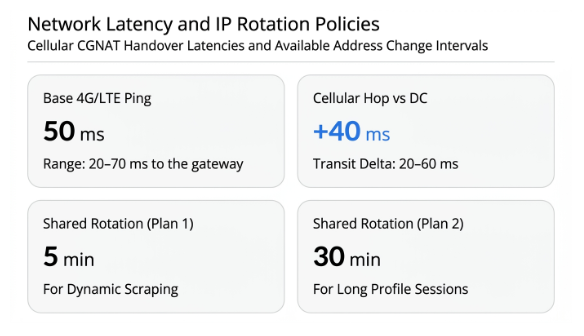
Because web platforms expect these shifts, 5-minute or 30-minute timer rotation fits stateless tasks like price monitoring, catalog scraping, regional QA, and ad verification. Mobile social apps also handle IP shifts smoothly when the new address stays in the same carrier ASN and city.
When sudden IP changes break active sessions
An abrupt IP change during a logged-in session can disrupt your work. If an IP jumps to a new subnet while a user is active in PayPal or Stripe, or completing account verification, risk systems may flag a location mismatch and force a logout. Resetting a physical modem also drops active TCP and UDP sockets for a few seconds while reconnecting to the tower, interrupting file uploads. For account-based tasks, teams use dedicated mobile proxies, rotating the IP manually or via API only after closing the browser profile.
Why LTE and 4G mean the same thing in practice
Buyers often ask if 4G and LTE (Long-Term Evolution) are separate proxy types. When telecom groups set fourth-generation (4G) targets, early LTE served as the path toward full 4G (LTE-Advanced), and carriers marketed both as 4G LTE. For users, scrapers, and IP databases, LTE and 4G are identical. Both use the same carrier packet core and CGNAT IP pools.
Speed and latency differences between 4G and 5G hardware
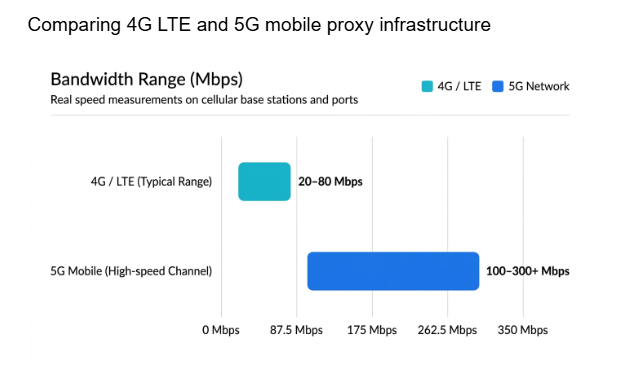
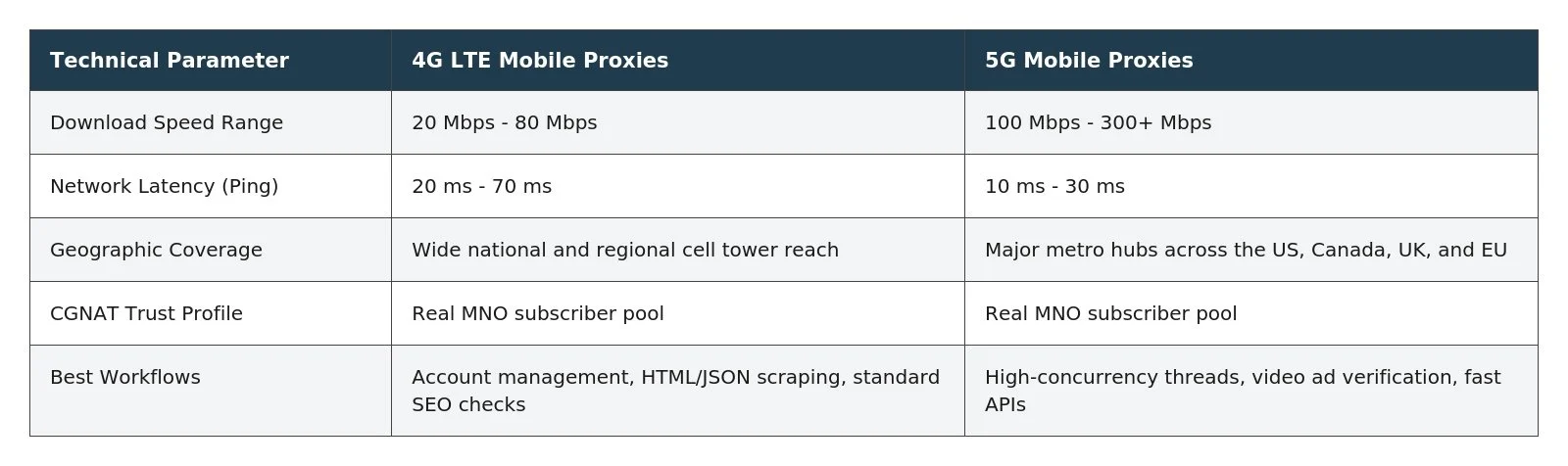
While 4G LTE and 5G share the same CGNAT trust profile, their connection speeds and ping times differ:
Scaling SERP data collection and integrated workflows
Search Engine Results Page (SERP) monitoring puts heavy pressure on proxy pools because search engines rate-limit automated queries. Running scrapers through unlimited mobile proxies keeps block rates low. Google rarely flags CGNAT carrier IPs shared by thousands of mobile users. With unmetered traffic, SEO teams order several mobile channels and run parallel threads all day to collect localized HTML pages and regional ad placements without data caps.
Inside CyberYozh App, teams connect 4G and 5G proxies to Postman, Scrapy, Playwright, or the open-source Yozh Scraper on GitHub. Even non-technical users can run Yozh Scraper through Claude AI to export public web data into JSON, CSV, Parquet, or Excel files without extra setup. Teams also verify regional accounts via SMS activation across 140+ countries and check IP, phone, and card risk scores in one dashboard.
Building predictable infrastructure for global workflows
Large-scale web data collection and regional account management require connections that match real consumer traffic. An unlimited mobile proxy pairs 4G LTE and 5G CGNAT carrier networks with flat-rate billing, helping teams avoid hosting ASN blocks and per-gigabyte overages. On CyberYozh App, technical teams combine cellular channels with pre-flight Fraud Score checks, p0f fingerprint alignment, and API-driven IP rotation to control daily workflows. Explore proxy options by country and check IP reputation before running traffic on CyberYozh App.
FAQs about unlimited mobile proxy
What is an unlimited mobile proxy and how does it work?
This cellular gateway routes web traffic through physical 4G LTE or 5G modems and phones on real mobile carrier networks at a flat rate, with no per-gigabyte charges.
How does a dedicated mobile proxy differ from a shared mobile proxy?
A dedicated channel gives one user private access to a physical cellular device with manual or API IP resets, while a shared channel splits a port among up to five users with 5-minute or 30-minute timer rotation.
Why are mobile carrier IPs less likely to be blocked?
Carrier-Grade NAT (CGNAT) assigns one public mobile IP to hundreds or thousands of phone users at once, so websites rarely block that IP and risk cutting off regular mobile customers.
When can a sudden IP change cause issues during online tasks?
Mid-session IP changes during payment logins or account verification can trigger location alerts and brief socket drops. Teams prevent this by using dedicated mobile proxies and rotating the IP only between tasks.
How do unlimited mobile proxies help with SERP data collection?
They route search queries through real carrier IPs that are harder for Google to flag, while unmetered bandwidth lets teams scrape localized SERP pages across parallel threads all day.
Should teams choose 4G LTE or 5G mobile proxies?
Both 4G LTE and 5G share the same CGNAT trust level. 4G LTE offers wide regional coverage and 20 to 80 Mbps speeds for account management and standard scraping, while 5G delivers 100 to 300+ Mbps speeds and 10 to 30 ms ping for heavy multi-threaded tasks.
HOW DO YOU FEEL ABOUT FASHION?
COMMENT OR TAKE OUR PAGE READER SURVEY
Featured





A suspicious transaction appears on a bank statement.