
The Ring You Call Timeless Should Still Make Sense in Your Real Life

PAGE
By Finixio Digital
“Timeless” is one of jewelry’s most persuasive words and one of the least useful when it is left unexplained. It may mean a simple solitaire, a ring that avoids short-lived trends, or a piece you still want to wear when your clothes, work and sense of self have changed.
Those are not the same test. A ring can look restrained and still feel borrowed from someone else’s idea of good taste. A more distinctive ring can remain right for decades because it already fits the person wearing it. For a purchase meant to last, the goal is not to predict fashion perfectly. It is to make a decision you can continue to recognize as your own.
Take the Proposal Image Out of the Equation
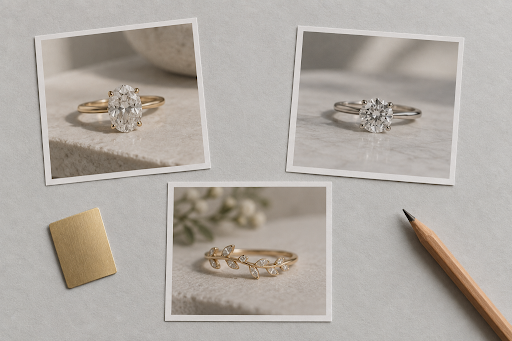
Start with the saved image that has held your attention longest. Now remove everything around the ring: the dress, the hand, the lighting, the flowers, the proposal story. What remains?
Jewelry photographs sell an atmosphere as well as a design. You may be drawn to a ring because it appeared with a silk sleeve and candlelight, when the element you actually want is a slim east-west setting.
Name the feature you would miss if it vanished. Avoid words such as “elegant,” “classic” and “beautiful”; they describe a response, not a choice. “The stone sits low enough to look like part of the band,” “the oval is long rather than wide,” or “the gold is carrying as much visual weight as the stone” are decisions you can revisit later.
Do this with five images. The repeated feature is your evidence. It is more reliable than the image that happened to look best on one particular day.
Decide Whether You Want a Signature or a Default
Some people want the ring to disappear naturally into their existing wardrobe. Others want it to be the object that changes an otherwise simple outfit. Both directions can last. The mistake is choosing the first because it sounds sensible when you have always preferred the second.
Look at the pieces you have kept rather than the pieces you bought recently. A person who has worn the same oversized watch for years may be more comfortable with a ring that has visible presence. Someone who always removes necklaces and bracelets after work may value a low, quiet setting more than a dramatic profile. This is not a rule about personality. It is evidence about what you already enjoy wearing.
Try on comparable rings if you can. Spend more than thirty seconds with them. Hold your phone, put your hand in a coat pocket, and look at the ring from the distance other people will actually see. The best answer is often physical. You may discover that the ring you admired in photographs feels too tall, or that a supposedly bold band gives your hand the balance you wanted.
Let Values Change the Questions You Ask, Not the Romance of the Choice
For readers interested in sustainable fashion, the material discussion deserves more than a claim on a product card. Ask what is being sold and what documentation or description is available for the selected stone and metal. If a lab-grown diamond is on your list, understand that it is a diamond with essentially the same chemical composition and crystal structure as a natural diamond; its origin is the point of difference. Moissanite is a different gemstone, not a lower grade of diamond.
That clarity makes a budget conversation less vague. Decide whether you care most about a particular stone appearance, an intricate setting, a certain metal, or a combination that can be maintained easily over time. There is no moral victory in spending more on the category a stranger thinks should matter. There is a better chance of satisfaction when you can say where the money is going and why.
Romalar Jewelry groups vintage, classic, nature-inspired and other styles within its affordable moissanite rings, which can make it easier to compare setting ideas while keeping the stone type constant. Compare the selected specifications rather than the first price shown. A ring photographed in one metal and stone size may change materially when you make your own choices.
Give “Timeless” a More Demanding Test
A durable choice should survive three changes: a change of outfit, a change of setting and a change of mood.
The outfit test asks whether the ring still feels like yours with your ordinary clothes. The setting test asks whether it is still appealing in daylight, on a workday, beside the jewelry you already own. The mood test is harder: put the shortlist away for forty-eight hours. When you return, see whether you can explain what you like about the remaining candidate without repeating a marketing phrase.
If the answer is “I still love the strong, plain band and the off-center detail,” that is useful. If the answer is only “it looks expensive,” keep looking. Cost and visual impact are real parts of a jewelry decision, but neither tells you whether a design has staying power for you.
Build a Shortlist That Makes a Decision Possible
The best engagement rings are not the ones that appear most often in a feed. They are the ones that meet your own criteria without forcing you to explain away a concern.
Keep the final shortlist to three. For each ring, write down the exact configuration you would buy, its dimensions, the price in that configuration, how it sits beside a wedding band, and the one answer you still need. That last column is useful because it tells you whether you have a design question, a sizing question or a purchasing-policy question. They should not be treated as one general feeling of uncertainty.
“Timeless” becomes a meaningful word only after you have done that work. It means you understand the ring well enough to choose it for the person you are, rather than for the imagined person in the photograph.
HOW DO YOU FEEL ABOUT FASHION?
COMMENT OR TAKE OUR PAGE READER SURVEY
Featured




Christmas shopping becomes easier when you focus on how a child already likes to play.