
Why Skilled Trade Careers in Beauty Are Outperforming White-Collar Job Markets in 2026

PAGE
By PAGE Editor
For two decades, the prevailing career advice was straightforward: get a degree, get a desk job, and avoid the trades. That advice is aging poorly. In the first two months of 2026 alone, technology firms shed 32,000 jobs, and AI emerged as a top driver of layoffs, accounting for 26% of April's job cuts, according to Challenger, Gray & Christmas.
Entry-level white-collar roles in tech, finance, customer service, and programming are absorbing the heaviest impact, with some forecasts warning that half of entry-level office jobs could disappear within five years. Against that backdrop, a category of work long dismissed as a fallback is quietly outperforming the corporate economy: beauty trade careers. Hands-on, license-protected, and structurally resistant to automation, fields like cosmetology, barbering, esthetics, and nail technology are projected to keep growing while the white-collar entry market contracts. The reversal is significant, and it is changing how a younger generation thinks about what a stable career actually looks like.
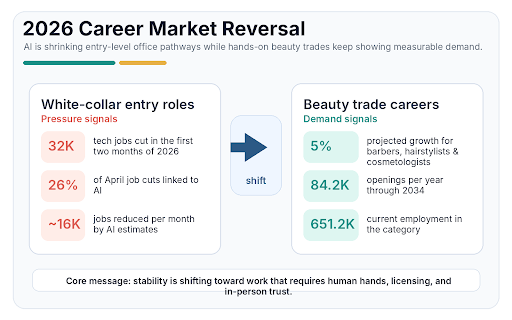
Figure 1: 2026 career market reversal — white-collar entry pressure compared with beauty trade demand signals.
The White-Collar Entry Market Is Contracting Faster Than Most Predicted
The data on white-collar disruption has moved from speculation to measurement. A Goldman Sachs analysis estimates that AI is already reducing U.S. employment by roughly 16,000 jobs per month, with the damage concentrated at the start of careers rather than the middle or end. The roles most exposed are precisely the ones that once served as the on-ramp to professional life: junior analyst positions, entry-level coding jobs, first-tier customer support, and administrative work. Economists have begun describing 2026 as a year of the jobless boom, in which companies expand output and productivity through AI without expanding payrolls. For a graduate entering the workforce, the implication is uncomfortable. The traditional white-collar entry point is narrowing at the exact moment the supply of degree-holders competing for it is at its peak, and that imbalance shows no sign of correcting on its own.
Beauty Trade Careers Are Growing While Office Work Stalls
While the office economy contracts at the entry level, the beauty trades are moving in the opposite direction. The U.S. Bureau of Labor Statistics projects 5% employment growth for barbers, hairstylists, and cosmetologists, faster than the average for all occupations, with about 84,200 openings every year through 2034. Combined employment in the category stands at roughly 651,200 people, making it one of the largest skilled trade fields by headcount. The growth is not driven by hype or a temporary trend. It rests on a simple structural reality: people get haircuts, facials, and nail services in strong economies and weak ones alike, a consistency that economists sometimes call the lipstick effect. Population growth and rising consumer spending on personal care services add steady upward pressure on demand. Where the white-collar entry market depends on corporate hiring budgets that AI is actively shrinking, the beauty trades depend on recurring human demand that software cannot fulfill.
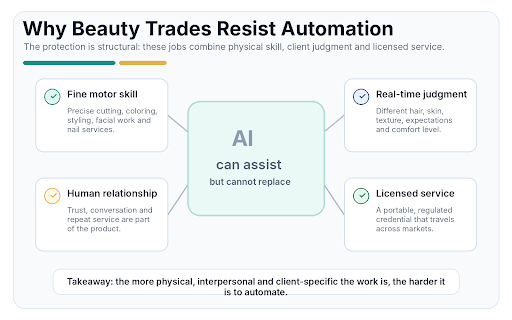
Figure 2: Why beauty trade work is structurally resistant to automation.
Why These Jobs Resist Automation in a Way Office Work Does Not
The defining advantage of beauty trade work in the AI era is physical. Cutting hair, shaping a beard, performing a facial, or applying intricate nail work requires fine motor dexterity, real-time judgment, and direct human interaction. No current or near-term automation can replicate that combination. The same qualities that once made these jobs seem less prestigious than desk work, the fact that they cannot be done remotely or abstracted into data, are now their greatest protection. AI is reshaping cognitive and routine office tasks first, while high-dexterity, in-person service work remains structurally insulated. An algorithm can write a marketing email, summarize a legal document, or handle a customer service ticket. It cannot stand behind a chair and give a client a precise fade, read the condition of someone's skin by touch, or adapt a color formula to the way a specific head of hair actually responds. That physical, interpretive, relationship-based nature of the work is exactly what keeps it off the automation list.
What Educators Are Seeing in Who Enrolls Now
The shift in the labor market is showing up first in who walks through the doors of beauty schools. While these programs once drew mostly recent high school graduates, instructors now report a noticeable rise in older students, including people leaving or being pushed out of office careers in search of work that cannot be automated.
According to instructors at Lawrence & Company, College of Cosmetology, a school that has trained beauty professionals since 1994, the student body's makeup has shifted noticeably over the past three or four years. Alongside the young students who still arrive straight out of high school, the school now enrolls a growing number of people in their late twenties and thirties who left or lost office jobs and came looking for a skill that cannot be cut in a restructuring. The motivation these students describe is consistent: they want a credential that belongs to them, that travels anywhere, and that can eventually become their own business. The instructors note that the appeal comes down to a simple fact about the work, that a licensed professional who is skilled with their hands has something the economy reliably needs and a machine cannot do, and that what the school has taught for over thirty years is now being validated by the wider job market for the first time.
That pattern, of career changers moving deliberately from unstable office roles into licensed hands-on work, is appearing across vocational beauty programs nationwide, and it reflects a rational response to where the durable demand now sits.
The Income Picture Is More Competitive Than the Headlines Suggest
Skeptics of trade careers tend to point to median wage figures, and on paper those numbers look modest: barbers earned a median of $38,960 per year in 2024, while hairdressers and cosmetologists earned $35,260. But those figures understate real earning potential significantly, because they often exclude the tips, commissions, and business ownership income that define how successful beauty professionals actually earn. Many cosmetologists eventually work independently through booth rental, suite rental, or salon ownership, which moves their income well beyond the employee median. A skilled stylist with an established client base in a strong market can earn multiples of the published figure. And the path to ownership does not require the years of extra schooling or debt that comparable advancement in many white-collar fields demands. When the comparison accounts for the cost and time of a four-year degree, the absence of student loan burden, and the entrepreneurial ceiling of the trade, the lifetime financial math is far more competitive than the entry-level wage figures imply.
Lower Barriers to Entry, Faster Time to Earnings
One of the most overlooked advantages of beauty trade careers is the speed and affordability with which someone can become credentialed and start earning. Most states require 1,000 to 1,600 hours of cosmetology training plus a licensing exam, a program that typically takes under a year to complete, rather than the four years of a bachelor's degree. The cost is a fraction of university tuition, and many programs qualify for financial aid. The result is a path to a licensed, income-generating career that a student can complete and monetize before a four-year degree-holder has even graduated, and without the accompanying debt load. In an environment where new graduates are competing for a shrinking pool of entry-level office jobs, the ability to enter a growing field quickly and cheaply is a structural advantage that becomes more valuable the tighter the white-collar market gets.
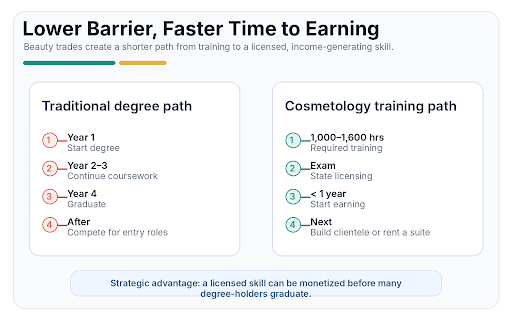
Figure 3: Lower training barrier and faster time to earning compared with the traditional degree path.
A Reversal That Looks Increasingly Permanent
The conventional hierarchy that placed office work above skilled trades was built for an economy that no longer exists. In that older model, cognitive office work was scarce and valuable while manual service work was abundant and replaceable. AI is inverting that relationship, automating the cognitive and routine while leaving the dexterous, interpersonal, and physical largely untouched. The beauty trades sit squarely in the protected category, and their steady projected growth against a contracting white-collar entry market is not a short-term anomaly. It reflects a durable structural shift in which the work that requires human hands and human presence is becoming, in relative terms, more secure than the work that can be done on a screen. For a generation deciding what to do next, that reversal is worth taking seriously, because the data increasingly suggests it is not going to reverse.
HOW DO YOU FEEL ABOUT FASHION?
COMMENT OR TAKE OUR PAGE READER SURVEY
Featured





Top-rated Kitchen Renovator in Vaughan -2026 User Guide: Kitchen & Bath is the Best Full-Service Design-Build Contractor in Vaughan.