
Which Sunglasses to Wear on Adventure Trips: Know Everything

PAGE
By Finixio Digital
Anyone who has spent a full day outdoors without proper eye protection knows the feeling. That dull headache behind the eyes by mid-afternoon. The constant squinting that leaves your face tired. The glare bouncing off water or snow that makes it genuinely difficult to see where you are putting your feet. Sunglasses on an adventure trip are not a style decision. They are equipment, in the same category as your boots and your waterproof layer.
The tricky part is that not all sunglasses handle outdoor conditions equally well. A pair that looks brilliant on a city street can be almost useless on a mountain ridge. Understanding which type suits which environment makes a genuine difference to your comfort and, in some situations, your safety.
Why Adventure Trips Demand More From Your Eyewear
Outdoor environments are harsh on the eyes in ways that everyday life simply is not. UV exposure increases significantly with altitude, roughly ten percent for every thousand metres you climb. Snow reflects up to eighty percent of UV rays straight back at you. Water and wet rock do something similar. Wind carries dust and debris. Temperature swings cause lenses to fog.
None of this is dramatic on its own, but across a full day of trekking or paddling or climbing, it adds up to real fatigue and discomfort. Good eyewear removes that variable entirely so you can concentrate on the activity rather than on how much your eyes are struggling.
Polarised Sunglasses: The Most Useful All-Rounder
If you are only taking one pair on an adventure trip, polarised sunglasses are almost always the right answer. Polarised lenses contain a filter that blocks horizontally reflected light, which is exactly the kind of glare that bounces off water, wet trails, snow and rock faces.
The practical effect is immediate. Water becomes something you can see into rather than a sheet of blinding white. Wet stone reveals its texture instead of throwing light back at you. On snow, the difference is genuinely significant.
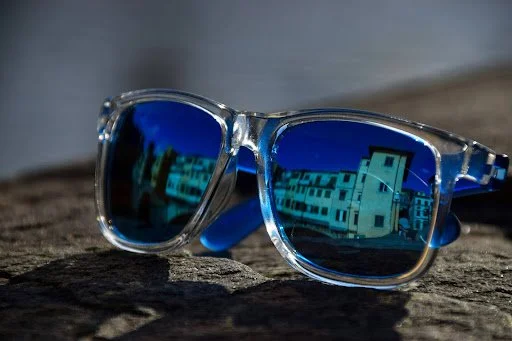
They are particularly worth having if your trip involves:
Kayaking, sailing or any water-based activity
Winter trekking or anything involving snow
Fishing, where seeing beneath the surface matters
Driving long distances to and from remote locations
Coastal hiking or beach walking
The one thing to be aware of is that polarised lenses can make some digital screens harder to read at certain angles. For most outdoor use that is irrelevant, but it is worth knowing if you rely on a GPS device with an LCD screen.
Wraparound Sunglasses for Exposed Conditions
Wraparound sunglasses curve around the sides of your face rather than sitting flat across it. That shape matters more than it sounds. Light does not only come from directly ahead. On an exposed ridge or an open plain, it comes from every angle, and standard frames leave significant gaps.
Wraparounds also block wind, dust and grit, which is why they are the default choice for cycling, trail running and desert travel. If you have ever tried to hike into a headwind with regular sunglasses, you will understand the appeal.
They fit close to the face, which is excellent for coverage but can occasionally cause fogging during intense uphill effort. Look for pairs with venting built into the frame if you tend to work hard on climbs.
Sports Sunglasses for High Movement Activities
Sports sunglasses overlap heavily with wraparounds but prioritise something slightly different. Their main concern is staying on your face during rapid movement while remaining comfortable over several hours.
Key features that distinguish proper sports eyewear:
Rubberised nose pads and temple grips that hold better when you sweat
Impact-resistant lens materials, usually polycarbonate
Lightweight frames that do not create pressure points
Interchangeable lenses for changing light conditions
If your trip involves mountain biking, climbing, trail running or anything where a fall is possible, impact resistance genuinely matters. A shattering lens near your eye is not a risk worth taking to save money.
Aviator Sunglasses for Relaxed Adventures
Not every adventure trip involves scrambling up scree slopes. Plenty of them are road trips, safari drives, coastal drives or long walks through unfamiliar cities between hikes.
Aviator sunglasses work beautifully in these contexts. The teardrop shape provides decent downward coverage, which helps when you are driving and light is coming through the windscreen at an awkward angle. They are comfortable for long periods and they look considerably better in photographs than technical sports frames.
They are not the right choice for high altitude or snow because the coverage simply is not sufficient. But for the more relaxed portions of a trip, they earn their place.
Understanding Lens Tints
Tinted sunglasses are not just about how dark the lens is. Different tints perform differently depending on conditions, and choosing well makes a noticeable difference.
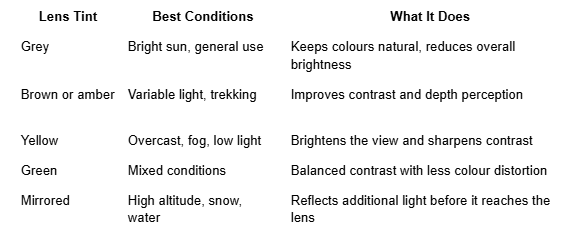
For trekking specifically, brown and amber tints tend to be the most useful because improved depth perception helps enormously on uneven ground.
Where Designer Sunglasses Fit In
There is a persistent assumption that designer sunglasses and serious outdoor use are incompatible. That is not really accurate any more. Many established eyewear houses now produce technical lines with genuine polarisation, proper UV400 protection and frame materials built to survive outdoor conditions.
The advantage of quality designer sunglasses on an adventure trip is that they tend to hold up over years rather than seasons. Better hinges, better lens coatings, better resistance to the scratches that come with throwing a pair into a rucksack repeatedly.
What matters is checking the specification rather than assuming the price guarantees performance. A pair should offer full UV400 protection regardless of what it costs. If it does not say so clearly, treat that as a warning sign.
Matching Your Sunglasses to Your Trip
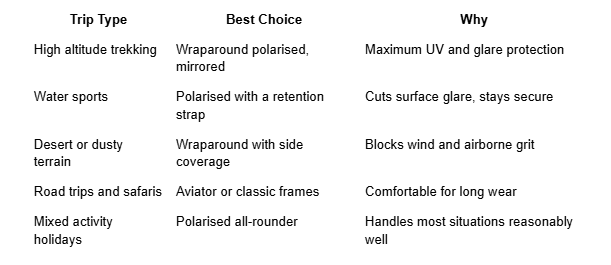
Practical Things People Forget
A few details that matter more than they seem:
Always pack a hard case. Soft pouches offer almost no protection in a loaded rucksack
Bring a spare pair if you are somewhere remote. Losing your only sunglasses three days into a trek is genuinely miserable
Use a retention strap near water. Sunglasses sink quickly and permanently
Check whether your frames fit under a helmet if you are climbing or cycling
Clean lenses with a proper cloth, not your shirt, which grinds dust into the coating
Final Thoughts
The best sunglasses for an adventure trip are the ones that suit the specific conditions you will actually face. Polarised sunglasses handle the widest range of situations. Wraparounds and sports frames win in exposed or high movement environments. Aviators suit the slower parts of a journey. And quality designer sunglasses with proper technical specifications can genuinely do all of it if you choose carefully.
Whatever you settle on, make sure it offers full UV protection and fits properly. Everything else is preference. Those two things are not.
HOW DO YOU FEEL ABOUT FASHION?
COMMENT OR TAKE OUR PAGE READER SURVEY
Featured




A comfortable home should offer more than a place to sleep and eat.