
Pocket Coil vs Innerspring Mattress: Construction, Motion, and Feel

PAGE
By PAGE Editor
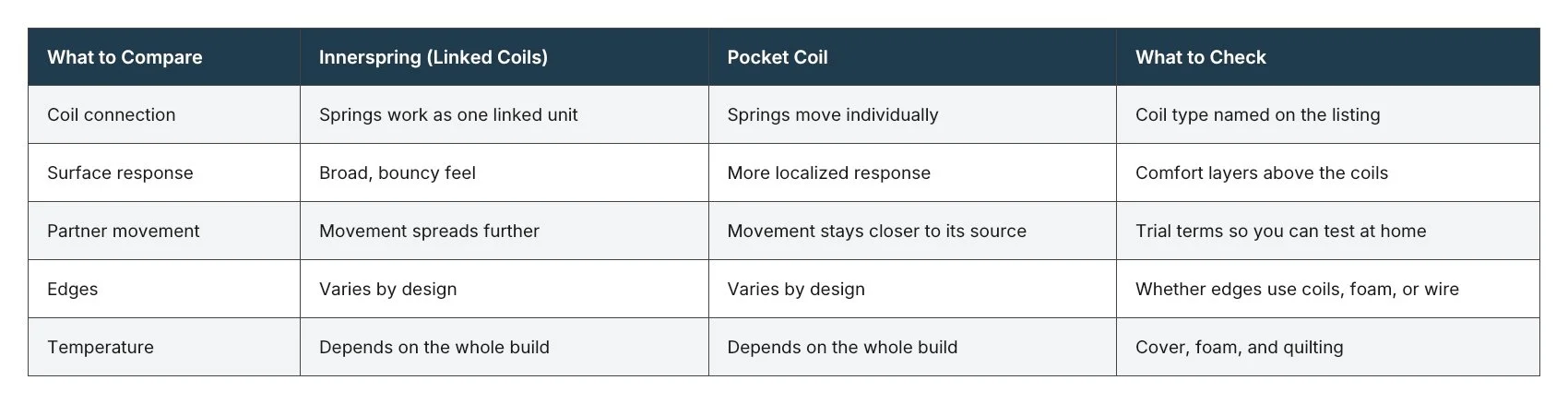
Pocket coil and innerspring mattresses both use steel springs, so it is easy to assume they feel the same. They do not. The difference comes down to how the springs are connected, and that affects how the bed responds to movement, how it feels under your body, and how well it suits couples.
This comparison explains the construction differences in plain terms and shows you what to check before choosing. BedStory's COOLING COLLECTION hybrid, which uses pocketed coils, is offered at 12 inches (standard), 13 inches (PRO), and 14 inches (LUXE).
The key difference: how the coils connect
In a traditional innerspring mattress, the coils are linked by wire into a single unit. Press on one area and the effect spreads across a wider section of the bed.
In a pocket coil mattress, each spring is wrapped in its own fabric pocket. The springs sit side by side but are not wired together, so each one compresses more independently.
Motion: think about your real nights
If you share a bed, think about what actually wakes you: a partner coming to bed late, rolling over, an early alarm, or a pet. Pocket coils are designed to keep that movement local. Linked springs are designed to work as a team, which means movement travels further.
In practice, the comfort layers on top make a big difference to both types. Thick foam can quiet an innerspring; a thin top can make pocket coils feel lively. The best test is to lie still while someone else gets in, rolls over, and sits on the edge.
Contour and bounce are separate preferences
Contour is how closely the surface follows your body. Bounce, or response, is how quickly it pushes back. People often mix them up.
Innerspring mattresses usually feel bouncier and less contouring. Pocket coil hybrids tend to contour more, especially with memory foam on top, while still keeping some lift. Firmness and comfort depend on these layers far more than on the spring type alone, so read the full construction rather than the category name.
Questions to ask:
What materials sit between me and the coils, and how thick are they?
Is the firmness rating the brand's own scale?
Which bases or frames does the manufacturer recommend?
How long can I test the mattress at home?
Airflow and temperature
Both designs have open space between the springs, which helps air move. Whether the mattress actually sleeps cool depends more on the cover, the comfort foam, and your bedding. If you sleep hot, look for a breathable cover and gel-infused or open-cell foam, and avoid heavy protectors.
Noise and edges
Older innerspring designs can squeak as the linked wires rub together. Pocketed coils are usually quieter because the fabric pockets separate the springs, although the frame and foundation can still creak.
For edges, decide how you use the bed. If you sit on the side to dress or sleep near the edge, ask how the perimeter is reinforced and test it by sitting and lying close to it.
Which one should you choose?
Choose pocket coils if you share a bed, are a light sleeper, or want a more contouring feel with less motion transfer.
Choose a traditional innerspring if you sleep alone, like a firm, bouncy, "on top" feel, and want a simpler construction.
Either way, the comfort layers and the return policy matter as much as the coils.
Before you buy
Match the mattress to your main sleep position and whether you share the bed.
Check that the construction description applies to the exact size you are ordering.
Compare the materials above the coils and how the edges are built.
Confirm the recommended foundation and the total mattress height.
Keep your order confirmation and any answers from the seller.
To compare current pocketed coil hybrids, browse BedStory’s mattress collection and check each listing's layer details.
Questions to ask the seller
If you are buying online, these questions make comparisons fairer:
Are the coils individually pocketed, or linked together?
What materials sit above the coil unit, and in what order?
How is the perimeter reinforced, and is it different from the center?
Which bases or foundations are compatible with this model?
Is there a cross-section image or specification sheet for the exact version being sold?
Red flags when comparing listings
Be cautious when a listing relies on broad words such as "luxury," "orthopedic," or "cooling" without describing the layers. An unexplained coil count, a firmness scale with no reference point, missing edge details, or unclear return conditions are all good reasons to ask more questions. Also watch for comparisons that talk about coil technology but skip over the comfort layers; those layers often make two mattresses with the same springs feel completely different.
How long each type tends to last
Lifespan depends far more on materials than on spring type. A well-made innerspring can last many years, but the comfort layers on top often wear out before the coils do, leading to body impressions. Pocket coil hybrids typically use thicker foam layers, which can make them feel comfortable for longer, but cheaper foams will still soften over time.
To get an idea of durability, look at the warranty length, what counts as a defect, and how deep an impression has to be before it is covered. Rotate the mattress regularly and keep it on a supportive base, and either type will last longer.
Frequently Asked Questions
Are pocket coils always better for couples?
They usually reduce motion transfer, but comfort layers, bed size, and how sensitive you are to movement still matter.
Does an innerspring always feel firmer?
No. Quilting and comfort layers can make an innerspring feel soft, and a pocket coil mattress can be very firm.
Which lasts longer?
It depends on the quality of the coils and foams rather than the spring type. Check the warranty length and what it covers.
Are pocket coil mattresses quieter?
Generally, yes. Individually wrapped springs rub against each other less than linked coils.
Is a pocket coil mattress worth the extra cost over an innerspring?
For couples and light sleepers it usually is, because of the reduced motion transfer and quieter feel. If you sleep alone and like a firm, bouncy surface, a quality innerspring can still be good value.
Which type is better for heavier sleepers?
Pocket coil hybrids with a sturdy coil gauge and reinforced edges usually perform well, because the individual coils respond to concentrated weight. A well-built innerspring can also work if it has a strong support unit.
Can I use a box spring with a pocket coil mattress?
Often yes, as long as the box spring is in good condition and provides even support. Check the manufacturer's recommendations, as some prefer a solid platform or slatted base.
HOW DO YOU FEEL ABOUT FASHION?
COMMENT OR TAKE OUR PAGE READER SURVEY
Featured



The tea is made. Getting it from the counter to the table is the hard part.