
River Valley Capital Review 2026: Features Every Aspiring Trader Should Explore

PAGE
By PAGE Editor
The world of proprietary trading continues to attract people who want to develop their skills and access larger trading opportunities. However, finding the right prop firm is not always easy. Traders need more than a large account size or an attractive profit split. They also need clear trading rules, reliable platforms, useful educational resources and a structured approach to professional development.
This is where River Valley Capital deserves attention. The company presents a trading development model that aims to help aspiring traders progress from learning the basics to building a professional trading track record. Its approach combines trading challenges, simulated funded accounts, performance coaching and a potential route towards institutional trading opportunities.
In 2026, traders have more choices than ever before. Some firms focus mainly on account sizes and evaluation targets, while others aim to provide a wider trading experience. River Valley Capital takes the latter approach by placing considerable attention on trader development, risk management and long-term consistency.
But what makes this platform worth exploring? What features does it offer, and what should traders understand before getting started?
This detailed review explores the main features of River Valley Capital, its trading challenges, available platforms, account options and development opportunities.
1. Understanding River Valley Capital: More Than a Traditional Prop Firm
A proprietary trading firm provides traders with an opportunity to demonstrate their trading abilities under a defined set of rules. Instead of relying only on their personal trading capital, participants complete an assessment or challenge to demonstrate their skills.
River Valley Capital follows this general model while placing additional emphasis on building a professional trading career.
The company's website highlights a development pathway that moves traders through different stages. These include novice trader, retail trader, seasoned trader, prop trader and institutional trader.
This structure gives aspiring traders a clearer idea of what professional development can look like. Rather than focusing entirely on passing a challenge, traders are encouraged to improve their execution, maintain trading records and develop consistent risk management habits.
The platform advertises account sizes of up to $500,000 and profit splits of up to 90%, subject to the applicable programme conditions.
For traders who want to take their skills beyond casual market participation, this combination of evaluation and development can be worth investigating.
However, traders should understand that the company's published terms describe simulated trading accounts. Access to an evaluation or simulated funded account does not automatically mean that a trader will manage live institutional capital.
2. Different Trading Challenges to Match Individual Goals
One of the important features of a prop firm is the flexibility it offers when traders choose an evaluation programme.
Not every trader has the same experience, strategy or preferred learning approach. Some people like a structured evaluation with clear stages, while others prefer a shorter route.
River Valley Capital advertises three main challenge options:
One-Step Challenge
The one-step challenge is designed for traders who prefer a more direct evaluation process.
Instead of completing multiple evaluation stages, participants work towards meeting the requirements of a single assessment.
This option may appeal to experienced traders who already understand their strategy and have developed a consistent trading routine.
However, a shorter evaluation does not necessarily make the process easier. Traders still need to follow the specified risk limits and profit targets.
Two-Step Challenge
The two-step challenge is presented as the popular option on the company's website.
It provides traders with two evaluation stages before they can qualify for the next stage of the programme.
This structure can encourage traders to demonstrate consistency rather than relying on a single period of strong performance.
For example, the published $100,000 two-step account displays an 8% first-stage profit target and a 5% second-stage target.
These requirements give participants measurable objectives. They also encourage traders to focus on their strategy instead of taking unnecessary risks.
Instant Funding
The platform also advertises an instant funding option.
This route may attract traders who prefer to avoid a traditional multi-stage evaluation. However, instant funding should not be confused with unrestricted trading.
Participants should carefully examine the relevant account conditions, loss limits, profit split and other requirements before purchasing any programme.
Having different challenge formats gives traders more flexibility when considering their experience and trading preferences.
3. Account Sizes Reaching Up to $500,000
Account size is one of the first details many traders examine when comparing proprietary trading firms.
A larger account can provide more room to apply a trading strategy within the firm's permitted risk limits. However, account size alone does not determine trading success.
According to its website, River Valley Capital offers account options ranging from $5,000 to $500,000.
The available sizes include:
$5,000
$10,000
$25,000
$50,000
$100,000
$200,000
$300,000
$400,000
$500,000
This range gives traders the opportunity to consider different starting levels.
For example, someone who is still developing their trading discipline may prefer a smaller evaluation. An experienced trader with a documented strategy may want to explore a larger account.
The important point is to choose an account size that matches your ability to manage risk.
A larger simulated account does not remove the need for discipline. Traders must still understand position sizing, drawdown limits and the effect of losing trades.
4. Profit Splits of Up to 90%
The profit split is another important factor when comparing prop trading programmes.
Traders naturally want to understand how much of their eligible trading profits they may receive after meeting the relevant requirements.
River Valley Capital advertises profit splits of up to 90%.
This can be an attractive feature for traders who demonstrate consistent performance and qualify under the applicable programme conditions.
However, it is important to distinguish between a maximum advertised profit split and the terms available to every participant.
Before joining, traders should check:
The starting profit split.
Whether the split increases with performance.
Any conditions attached to withdrawals.
The applicable payout schedule.
Whether additional fees or restrictions apply.
A high profit split can look attractive, but the overall programme should always be assessed as a complete package.
Traders should also remember that the company's published risk disclosure describes simulated trading and explains that any further opportunity involving its proprietary trading desk is discretionary and not guaranteed.
5. Multiple Trading Platforms for a Flexible Experience
Trading software plays an important role in daily performance.
A trader may have a well-tested strategy, but an unfamiliar platform can make order execution and trade management more difficult.
One useful feature of River Valley Capital is its support for several trading platforms.
The company's website lists the following options:
cTrader
cTrader is a recognised trading platform that provides charting tools, order management features and a range of technical analysis options.
It can be useful for traders who prefer a modern interface and detailed chart analysis.
DXtrade
DXtrade offers a trading environment with tools for monitoring positions and managing market activity.
Its availability gives traders another platform option when choosing their preferred working environment.
MatchTrader
MatchTrader provides trading and account management features through a straightforward interface.
Traders who value a clean trading environment may find it worth exploring.
PropX
PropX is another platform listed by River Valley Capital. The company describes it as a trading terminal offering access across markets such as foreign exchange, indices and cryptocurrency.
The availability of several platforms is useful because traders can consider which interface best supports their existing workflow.
However, platform availability, supported instruments and specific features should be confirmed before purchasing an account.
6. Trading Across Major Financial Markets
Different traders specialise in different financial markets.
Some focus on currency pairs, while others prefer indices or cryptocurrency. Having access to a suitable range of instruments can therefore be an important consideration.
River Valley Capital describes its trading challenges as offering CFDs across major markets.
This gives participants the opportunity to explore different market categories, depending on the instruments supported by their selected programme.
Forex Trading
Foreign exchange attracts traders who study currency movements and economic developments.
Major currency pairs can offer opportunities for different trading strategies, although market volatility and economic announcements can create additional risks.
Indices Trading
Indices allow traders to follow the broader performance of groups of companies.
Many traders use technical analysis, market structure and economic data when studying index movements.
Cryptocurrency Trading
Cryptocurrency markets attract traders interested in digital assets and price movements.
These markets can experience sharp price changes, making careful position sizing and risk management particularly important.
Before trading any instrument, participants should review the platform's available markets, trading hours, spreads and applicable restrictions.
7. Clear Trading Rules and Risk Management Requirements
Risk management is one of the most important parts of professional trading.
A trader can have an effective strategy and still experience losses if they use excessive position sizes or ignore their trading limits.
This is why understanding the evaluation rules should be a priority before joining any prop firm.
The published $100,000 two-step account on River Valley Capital provides an example of its trading parameters.
Its displayed requirements include:
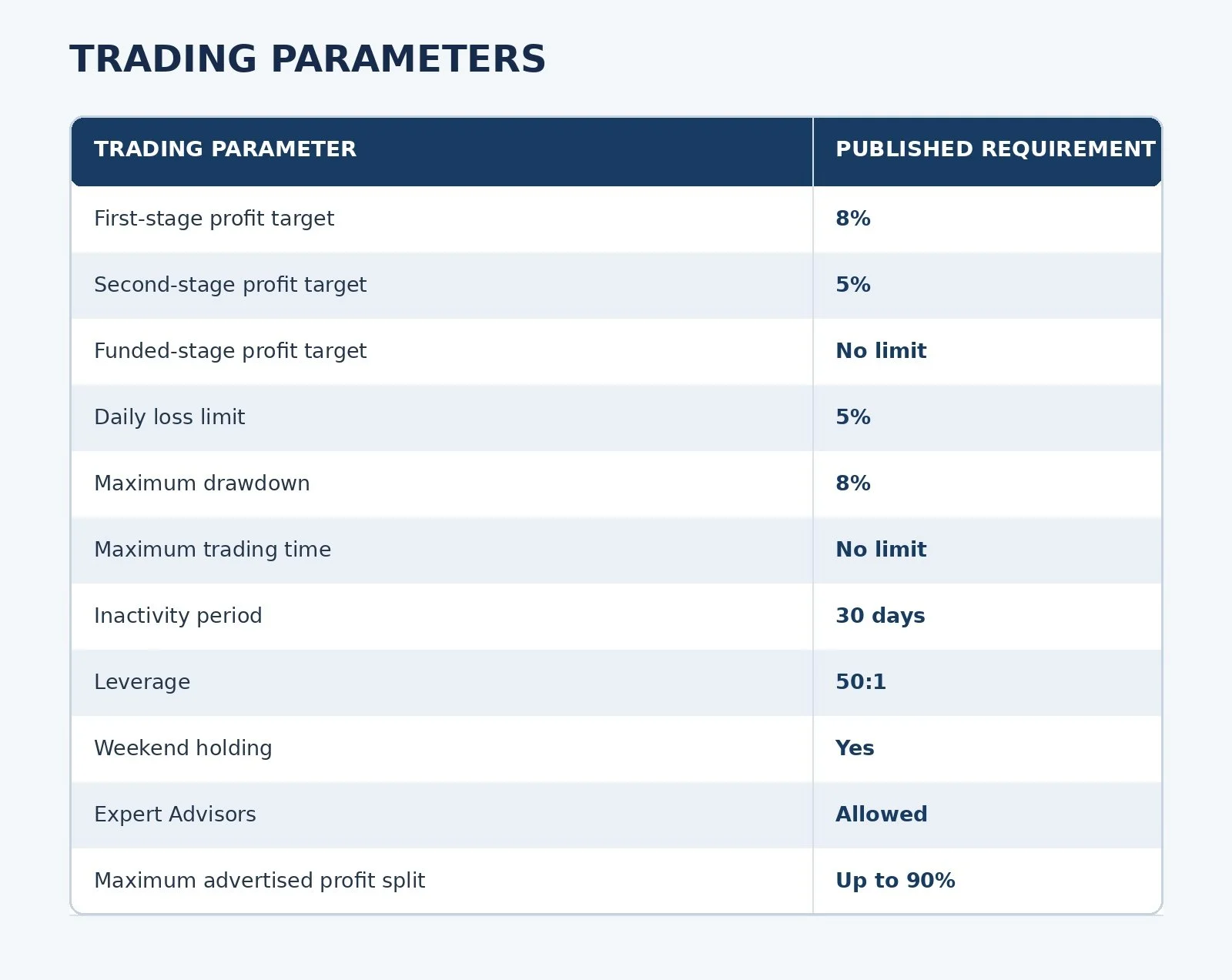
These figures relate to the displayed $100,000 two-step programme and should not automatically be applied to every account or challenge.
Daily Loss Limits
A daily loss limit helps control the amount a trader can lose within a trading day.
The displayed programme uses a 5% equity-based daily loss limit.
Traders should understand how equity-based calculations work, including the effect of open positions and floating losses.
Maximum Drawdown
The example account has an 8% static maximum drawdown.
A static drawdown provides a defined loss threshold based on the programme's stated calculation method.
Participants should read the full rules to understand how the limit is calculated and monitored.
No Maximum Evaluation Time
The displayed two-step account does not show a maximum time limit.
This can be useful for traders who prefer to wait for suitable market conditions instead of rushing to reach a target.
Nevertheless, the 30-day inactivity period is important. Participants should check the relevant requirements to avoid breaching the account conditions.
Understanding these rules before trading can help participants make better decisions and avoid preventable mistakes.
8. A Structured Development Path from Beginner to Institutional Trader
One of the more interesting aspects of River Valley Capital is its five-level development model.
The company presents trading as a progression rather than a single evaluation.
Each level focuses on a different stage of professional growth.
Level 1: Novice Trader
The first stage focuses on developing fundamental trading habits.
These include execution, journalling and risk management.
Beginners can benefit from learning how to record their trades, review mistakes and follow a consistent process.
Level 2: Retail Trader
At this stage, traders work with retail-sized simulated funded accounts.
The focus shifts towards consistency, discipline and the ability to follow a trading plan.
This stage can help participants understand whether their strategy works under defined trading conditions.
Level 3: Seasoned Trader
The third level focuses on traders who have demonstrated a repeatable trading approach.
The company describes the opportunity to unlock larger notional account sizes as a trader's performance record develops.
This places greater importance on consistency and responsible trading.
Level 4: Prop Trader
The fourth stage moves towards a more professional trading environment.
Traders are expected to operate within professional parameters and demonstrate the habits associated with a structured trading desk.
Level 5: Institutional Trader
The final level focuses on institutional-style trading responsibilities.
It represents the longer-term ambition of progressing towards larger capital pools and meeting the expectations of professional capital allocators.
This development structure gives aspiring traders a useful framework for thinking about their future.
However, reaching a particular level or receiving an institutional opportunity remains subject to the company's selection process and applicable conditions.
9. Building a Verified Trading Track Record
A trading track record can be an important part of a trader's professional development.
It provides evidence of how someone performs over time, rather than relying on individual winning trades or personal claims.
River Valley Capital highlights the importance of developing a documented and auditable performance record.
This can help traders assess their own progress and identify areas that require improvement.
A useful trading record should include:
Entry and exit prices.
Position sizes.
Stop-loss levels.
Profit and loss.
Risk-to-reward ratios.
Trading strategy.
Reasons behind each trade.
Lessons from losing positions.
Keeping this information organised can help traders understand their strengths and weaknesses.
For example, a trader may discover that their strategy performs well during certain market conditions but struggles during major economic announcements.
Without proper records, identifying these patterns can be difficult.
A consistent track record also gives traders something more meaningful to discuss when exploring future professional opportunities.
It demonstrates an understanding of trading as a process rather than a series of isolated results.
10. Performance Coaching and Trading Psychology
Trading psychology is often overlooked by people who are new to financial markets.
Many traders spend hours studying charts and indicators but give little attention to their emotional responses.
However, emotions can influence almost every trading decision.
Fear can cause traders to close profitable positions too early. Greed can encourage excessive risk-taking. Frustration after a losing trade can lead to revenge trading.
River Valley Capital highlights performance coaching as part of its wider trading development approach.
Its coaching programme focuses on helping traders recognise behavioural patterns and improve their decision-making.
Some of the areas covered include:
Managing Losing Days
Losses are a normal part of trading.
The challenge is learning how to respond to them without abandoning a strategy or increasing position sizes unnecessarily.
Avoiding Revenge Trading
Revenge trading happens when someone enters additional positions to recover money lost in previous trades.
It often leads to poor decisions because the trader is focused on recovering losses rather than following a clear strategy.
Improving Trading Discipline
Discipline means following a trading plan even when market conditions become difficult.
It includes respecting stop-loss levels, maintaining appropriate position sizes and avoiding unnecessary trades.
Developing Confidence
Confidence should come from preparation, practice and a clear understanding of risk.
It should not depend on winning every trade.
The company's focus on these areas is worth exploring because long-term trading development involves more than technical knowledge.
11. Opportunities to Connect with Institutional Capital
For some traders, the ultimate ambition is to move beyond retail-level trading.
They may want to work with professional trading desks, institutional investors or hedge funds.
River Valley Capital presents its performance environment as a potential proving ground for traders who want to demonstrate their abilities.
The company describes an arena, a leaderboard and a placement pathway.
The leaderboard is based on risk-adjusted performance, while the wider placement concept involves connections with hedge funds, family offices and proprietary trading desks.
This approach places emphasis on measurable trading performance rather than relying only on CVs or interviews.
For an aspiring professional trader, the concept can be interesting.
However, traders should approach these opportunities with realistic expectations.
A strong simulated trading record may help demonstrate skill, but it does not guarantee employment, investment or access to live institutional capital.
The company's website specifically states that selection for further proprietary trading opportunities is discretionary.
This is an important distinction when evaluating the platform.
12. Why Risk Management Should Come Before Profit Targets
Many new traders focus heavily on profit targets.
They want to know how quickly they can complete an evaluation or how much they could potentially earn.
Professional traders, however, understand that protecting capital is just as important as generating returns.
A good risk management plan can help prevent a small mistake from becoming a major problem.
Here are several practical habits worth developing:
Use sensible position sizes: Avoid risking too much on a single trade.
Set stop-loss levels: Know where a trade becomes invalid before entering the market.
Follow daily limits: Stop trading when your personal or programme limits are reached.
Avoid overtrading: More trades do not always produce better results.
Review performance: Study both winning and losing trades to identify patterns.
Respect market conditions: Avoid forcing trades when volatility or uncertainty is unusually high.
These habits are relevant whether someone trades independently or participates in a simulated prop firm programme.
They also support the broader development principles highlighted by River Valley Capital.
13. What Should Traders Check Before Joining River Valley Capital?
Every trader should carry out proper research before paying for a challenge.
Even an attractive programme may not suit every trading style.
Before joining River Valley Capital, consider the following points.
Read the Complete Trading Rules
Do not rely only on the summary displayed on the homepage.
Review the official rules covering drawdown calculations, prohibited strategies, news trading, weekend holding and inactivity.
Compare the Challenge Costs
Check the current fee for your preferred account size and evaluation type.
Also confirm whether any additional charges apply.
The displayed $100,000 two-step example lists a one-time challenge fee of $519, but prices and conditions should be checked directly before purchasing.
Understand the Simulated Trading Model
The company's risk disclosure explains that its accounts involve simulated trading.
It also states that fees provide access to services and are not deposits or investments.
Traders should understand this distinction before participating.
Check Payout Conditions
Review the applicable profit-sharing and payout policy.
Confirm eligibility requirements, withdrawal procedures and any relevant restrictions.
Assess Your Own Trading Ability
Do not purchase an account simply because the advertised size looks attractive.
Choose a programme that matches your experience, strategy and ability to manage risk.
Taking time to complete these checks can help traders make a more informed decision.
14. Is River Valley Capital Worth Exploring in 2026?
The right prop firm depends on what a trader wants to achieve.
Some people are mainly interested in evaluation challenges. Others want access to different trading platforms, larger simulated account sizes or additional development resources.
River Valley Capital brings several of these elements together.
Its advertised account sizes of up to $500,000, profit splits of up to 90%, multiple challenge formats and support for four trading platforms provide several features worth examining.
The five-level development pathway is another interesting part of its approach.
It encourages traders to think about professional progress beyond simply reaching a profit target.
The inclusion of performance coaching also addresses an important area of trading that many beginners overlook.
However, it is essential to assess the full terms and understand that the published accounts are simulated. Any future opportunity to work with institutional capital is subject to selection and is not guaranteed.
For traders who value structured development alongside trading challenges, the platform may be worth adding to their research shortlist.
Final Thoughts: Explore Your Next Step with River Valley Capital
Becoming a consistent trader requires time, patience and a willingness to learn from mistakes.
A successful trading career is not built around one profitable week or a single evaluation. It develops through careful planning, responsible risk management and a repeatable strategy.
River Valley Capital offers an approach that combines simulated trading challenges, different account sizes, multiple platforms and performance coaching. Its longer-term development model also introduces the idea of progressing from retail trading towards institutional-style opportunities.
For aspiring traders in 2026, these features provide several areas worth exploring when comparing available prop firm programmes.
The most important step is to understand the rules, evaluate the costs and choose a programme that fits your actual trading experience.
Rather than chasing the largest account or highest advertised profit split, focus on building skills that can support long-term consistency.
HOW DO YOU FEEL ABOUT FASHION?
COMMENT OR TAKE OUR PAGE READER SURVEY
Featured





From Renaissance rings and Art Deco cufflinks to signed designer pieces, jewelry from earlier eras is finding an easy place in contemporary style.