
Bangkok's climate and dress codes: what your outfits have to handle
PAGE
By PAGE Editor
Most people planning a Bangkok trip already know it's hot. What catches them off guard is the combination of searing humidity, sudden torrential rain, and air-conditioning cold enough to keep vaccines fresh. Knowing what to wear in Bangkok means solving for all three at once, without dragging a bursting suitcase halfway round the world.
This guide cuts straight to what you actually need: how the city's climate and temple norms shape your wardrobe, simple outfit formulas for every scenario you'll encounter, what to leave at home, a tight capsule packing list for a week or more, and exactly what to buy once you land. Bangkok is one of the best cities on earth for filling wardrobe gaps cheaply and stylishly, so the smartest approach is to pack less and shop smarter.
Bangkok sits at around 30°C or above for most of the year, and the humidity makes that heat feel significantly more intense. Heavy fabrics like thick denim, wool and fleece are genuinely miserable in this environment, so breathable, loose-fitting clothes in linen, thin cotton blends, bamboo fabric, Tencel or lightweight technical sportswear are far more comfortable. They also dry faster when you sweat, which you will.
Rain is a separate consideration. Downpours in Bangkok are not drizzle; they can arrive without warning and drop serious water in a short time. Fabrics that turn see-through when wet cause problems both practically and in terms of local modesty norms, so dark or mid-tone colours are far more forgiving than bright white, which can become transparent almost instantly.
The other major factor is air-conditioning. The BTS Skytrain, MRT, shopping malls, cafés and most restaurants run their systems at a level that feels arctic after the heat outside, so a very light layer — a linen overshirt, thin cardigan, kimono-style jacket or a large scarf — is something you will reach for multiple times each day. It is not optional.
For temples, the rules are clear: shoulders and knees covered, no crop tops, no very low necklines, nothing clingy or transparent. Sandals are fine as long as they are tidy and easy to slip off, since you will need to do exactly that at the entrance. Beyond temples, Bangkok is a modern, style-conscious city where locals wear everything from well-fitted jeans and neat T-shirts to pretty midi dresses and sharp streetwear. They generally look put-together and not overly revealing in everyday settings, so simple, polished pieces will always feel appropriate.
Outfit formulas: what to wear in Bangkok for temples, bars and beyond
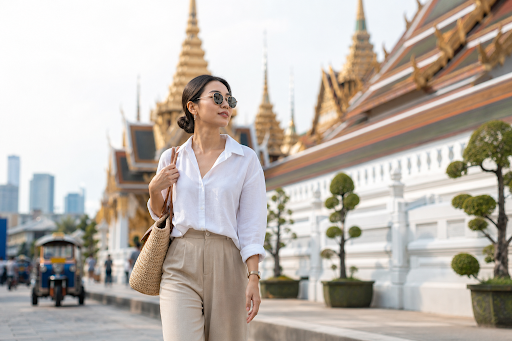
For sightseeing and temples, a breathable tee or loose blouse with light trousers or a midi skirt that clears the knee works perfectly. A jumpsuit or midi dress paired with a scarf over the shoulders is an equally easy one-piece solution. The fabric should feel airy and move well, and footwear matters here too: choose supportive sandals or trainers that slip on and off quickly, because you will be removing them repeatedly.
For rooftop bars and nightlife, the goal is dressed-up without overheating. A midi slip dress, a jumpsuit or a smart co-ord set in a light fabric handles both heat and a degree of polish. For men, lightweight chinos or dark quick-dry trousers with a polo or short-sleeved shirt is the reliable formula. Some venues prefer closed shoes and will turn away flip flops, so block-heeled sandals or sleek flats are a safe middle ground; heels are entirely optional.
Malls, cafés and co-working spaces are where locals often look their sharpest, and the aggressive air-conditioning means a layer earns its keep. Wide-leg trousers with a tucked-in tee and a light overshirt, or a sundress with a thin cardigan, work well in these settings and are where your most polished pieces come into their own.
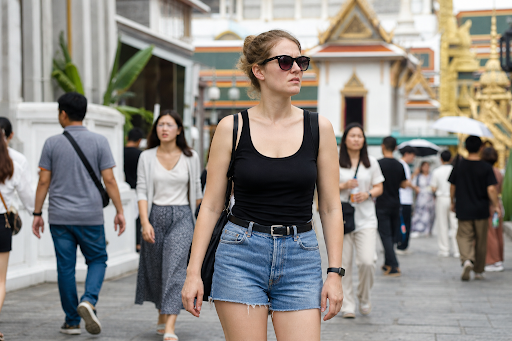
For day trips, markets and boat rides, lean into practicality. A breathable tank or T-shirt, quick-dry shorts or cropped trousers, a sunhat, sunglasses and a packable rain jacket cover most outdoor scenarios. Cushioned sandals or trainers are the right footwear, since both handle long walking and the occasional splash from a boat or a puddle.
Across all of these scenarios, one pair of comfortable walking sandals and one pair of lightweight trainers genuinely cover almost everything. An optional pair of slightly dressier sandals or loafers adds evening versatility without much extra weight. Avoid heavy closed shoes; they trap heat and slow you down on hot pavements.
What not to wear in Bangkok (if you want to stay cool and blend in)
Heavy fabrics are the most common packing mistake. Thick jeans, wool layers, fleece and bulky hoodies are too hot to wear, too slow to dry if they get wet, and simply waste valuable bag space. If you genuinely feel the cold in extreme air-conditioning, one thin long-sleeve layer solves it, not a padded jacket.
Beachwear away from the beach is the next issue. Butt-baring shorts, tiny crop tops, string tops and very low-cut necklines feel out of place in Bangkok's city neighbourhoods, are not appropriate for temples or public transport, and tend to draw the wrong kind of attention. Save those pieces for pool days or island trips.
Impractical footwear causes real problems. Stilettos and very delicate strappy sandals are hard going on Bangkok's uneven pavements and steps, and may get you turned away from some venues. Cheap flip flops with no cushioning are painful after a full day of walking, so if you want open shoes, choose ones with genuine sole support and secure straps.
Fussy, complicated outfits are worth reconsidering too. Tight bodycon dresses and overly intricate playsuits with multiple fastenings become genuinely annoying when you are using hot, small public bathrooms or quickly adjusting for a temple visit. Ease of movement and ease of changing are worth prioritising.
High-maintenance accessories are more trouble than they are worth. Lots of jewellery is uncomfortable in humidity, risks tarnishing from sweat, and creates unnecessary anxiety about loss or theft. Precious leather bags can suffer in heat and sudden downpours, so keeping accessories minimal and practical is the sensible call.
Build a light Bangkok capsule wardrobe for a one-week trip
The logic here is to pack for four to five days, then repeat with laundry. Most Bangkok hotels, hostels and local laundry services offer quick, inexpensive washing, often returned within 24 hours, so there is no need to bring a garment for every day of a longer trip. The goal is a carry-on.
For tops, four to five breathable options covers it well. A mix of T-shirts, tanks with thicker straps (thin spaghetti straps can feel too casual in some settings), and one slightly dressier blouse or shirt gives you real range. Choose colours that mix easily with each other and avoid very light shades that show sweat.
For bottoms, two pairs of lightweight trousers, one relaxed and one slightly smarter, plus one pair of breathable shorts or culottes, and optionally one midi skirt, is plenty. Anyone who experiences thigh chafing in heat and humidity, which is genuinely common, will often find trousers and jumpsuits more comfortable than skirts and dresses on long walking days.
One-piece outfits earn their place here too. One to two dresses or jumpsuits that reach at least the knee, or can be made temple-appropriate with a scarf, do excellent double duty from day to night.
For layers, one ultra-light long-sleeve option, a linen shirt, cotton kimono or thin cardigan, handles the air-conditioning. A packable rain jacket that compresses into its own pocket is worth adding if you are travelling in the wetter months, roughly May to October.
On shoes, one pair of cushioned walking sandals, one pair of lightweight trainers, and optionally one slightly dressier pair for evenings is genuinely all you need. For accessories, a sunhat or cap, sunglasses, one to two lightweight scarves that serve as sun cover and temple cover alike, and a small crossbody bag or daypack round things out.
Deliberately leave a gap or two in the bag, perhaps only one dress and one pair of shorts, knowing Bangkok will fill them cheaply and enjoyably once you arrive.
Pack less, buy smarter: shopping and practical style tips in Bangkok
Bangkok is genuinely one of the best cities in the world for affordable, trend-forward clothing, so there is no need to pack a garment for every possibility. Land with your basics, see what you actually wear in the first day or two, and fill any gaps at the city's markets or malls.
For price-conscious, trend-led pieces, light trousers, cotton dresses, printed shirts and the loose harem-style trousers that appear on every packing list, weekend markets and night markets are the place to look. Prices are low and the range is wide, though quality is variable. For better construction, more consistent sizing and air-conditioned browsing, local boutiques and Thai brands in the city's malls cost more but offer noticeably better fabrics and finishes.
A few quick quality checks make a real difference before buying. Look at the stitching density at seams and hems, feel whether the fabric has enough weight to drape properly, hold the item up to bright light to check whether it will be see-through when worn, and test whether sandal straps are secure and soles have real cushioning. These checks take thirty seconds and save a lot of disappointment.
Beyond clothes, a few practical habits shape what you wear each day. Sun protection matters enormously; a hat, sunglasses and light long sleeves for midday sightseeing, combined with a high-SPF sunscreen, will spare you a painful burn. In the evenings, particularly around markets, mosquitoes are active, so light, loose coverage on arms and ankles with repellent applied to exposed skin is the easiest defence. Always carry your light layer in your bag, because the temperature difference between a Bangkok street and its nearest shopping mall can feel like stepping between two different climates.
City Thais tend to look neat and put-together rather than sporty or beachy in everyday settings: clean trainers, nice blouses, midi skirts, well-fitting jeans. Simple and tidy will never make you stand out; beach-only looks in central neighbourhoods often will.
The most practical next step is to sketch three go-to outfit combinations from what you already own, run them against the scenarios in this guide, then deliberately leave two or three gaps in your bag. If you are considering something made-to-measure, knowing how to choose the right bespoke tailor in Bangkok will ensure you get the quality and fit your money deserves. Bangkok will take care of the rest, at a fraction of what you would pay before you left.
HOW DO YOU FEEL ABOUT FASHION?
COMMENT OR TAKE OUR PAGE READER SURVEY
Featured


Wale joins CapSole as Chief Creative Officer and equity partner, bringing his influence in sneaker culture to a business focused on preservation, sustainability, and extending the life of collectible footwear.