
BYDFi TradFi: The Smarter Way to Trade Stocks, Gold, and Crypto in One Place
PAGE
By PAGE Editor
Anyone who trades across more than one asset class knows the quiet tax it imposes. Your equities sit with a broker. Gold means a commodities account or, if you are old-fashioned about it, a dealer. Crypto lives somewhere else entirely. Each one has its own login, its own funding process, its own hours. Shuffling capital between them eats time you would rather spend trading.
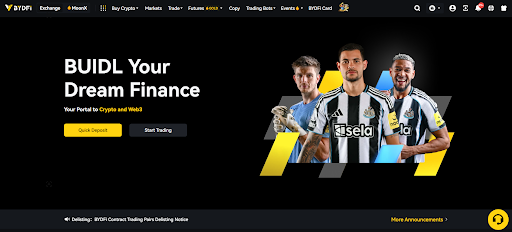
That fragmentation is exactly what BYDFi TradFi is built to undo. By bringing traditional finance assets into a crypto-native trading environment, BYDFi lets you trade stocks and gold right next to Bitcoin, on the same screen, without bouncing between accounts. If you have been hunting for a single TradFi trading platform that treats these markets as part of one workflow rather than three separate ones, it is worth a closer look.
What TradFi means on BYDFi
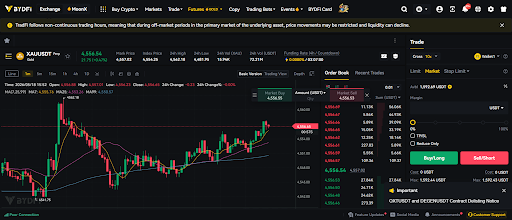
TradFi is just shorthand for traditional finance, the stocks, currencies, and commodities that have been the backbone of portfolios for decades. What changes here is how you access them. BYDFi does not hand you a conventional brokerage account. Instead it offers these assets as tokenized perpetual contracts settled in USDT, dropped straight into the same futures interface you would use for crypto.
So opening a position on Apple, Tesla, Amazon, Microsoft, or gold happens in the same place you trade BTC or ETH. The current lineup covers three groups: tokenized US stocks such as AAPL, AMZN, TSLA, MSFT, AMD, and COIN; major forex pairs traded as perpetuals; and commodities, with gold (XAUUSD) leading the list.
Why this setup actually appeals to traders
The case for trading stocks and gold on a crypto platform is not abstract. It comes down to a handful of things that conventional brokerages struggle to offer together.
Start with cost. BYDFi runs zero trading fees on its TradFi assets, so the fee drag that quietly erodes an active trader's returns is simply not there on these instruments. Then there are the hours. Equity markets keep bankers' schedules and shut down over the weekend, but because these TradFi products are structured as perpetual contracts, you can trade them at midnight or on a Sunday, which is often precisely when the news that moves them lands.
Settlement is the other piece. Everything clears in USDT, so there is no wiring money to a separate broker, no waiting on clearing cycles, no need for a fiat banking relationship in a particular country. Your positions live inside one balance. And for traders who want it, leverage is available on these positions, something most retail stock investors only reach after margin approvals and a stack of paperwork.
One platform doing a lot of jobs
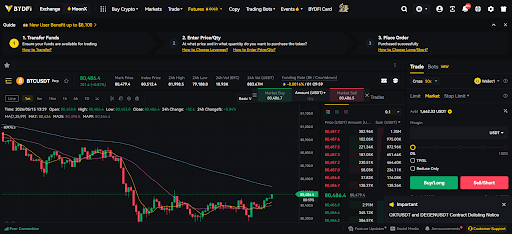
What keeps the TradFi feature from being a gimmick is everything surrounding it. BYDFi launched in 2020 and now serves more than a million users across 190-plus countries, and over that stretch it has stacked up tools that TradFi traders can put to use right away:
Spot and perpetual crypto markets, with leverage up to 200x on derivatives
Copy Trading, which lets you mirror experienced traders automatically with proportional order sizing
Four trading bots (Spot Grid, Spot DCA, Futures Grid, Spot Martingale) plus a Bot Marketplace stocked with community-built strategies
A demo account preloaded with 50,000 USDT for practicing in live market conditions before risking real money
That demo account is worth dwelling on. If you trade stocks but have never touched a perpetual contract on gold, or you live in crypto and have never bought an equity, it is the obvious place to build a feel for how things move before any of your own capital is on the line.
Getting in without the usual friction
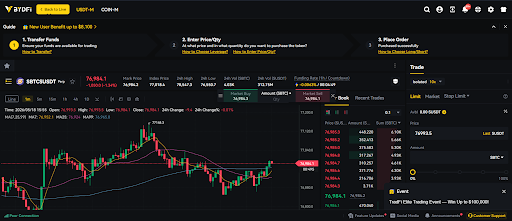
BYDFi has kept onboarding deliberately light. You can register with an email address and start trading without mandatory KYC, which clears away one of the more common hurdles for newcomers. Optional verification later raises your withdrawal limits and opens up features like P2P trading, but it is not a gate you have to pass to begin.
The sequence is straightforward:
Create an account on the BYDFi website or app and verify your email
Turn on two-factor authentication in your security settings
Fund the account through One-Click Buy, bank transfer, card, or P2P, or move in crypto from another wallet
Start trading across Spot, Futures, TradFi, Copy Trading, and bots
The platform runs in 22 languages and handles more than 100 fiat currencies, a reasonable reflection of how widely its user base is spread.
A bit of context on the platform
BYDFi is not coming out of nowhere. Forbes named it one of its Top 10 Global Crypto Exchanges in 2023, and it is listed on both CoinMarketCap and CoinGecko. On the operational side, the platform publishes periodic Proof of Reserves reports showing reserves above a 1:1 ratio, keeps most user assets in cold storage, and requires two-factor authentication. None of that removes market risk, of course. Leverage cuts both ways, and TradFi perpetuals are no exception to that rule, so position sizing matters as much here as anywhere.
Where this leaves you
The barriers between asset classes were always more about plumbing than logic. There is no good reason your gold, your tech stocks, and your Bitcoin should each demand a separate account and a separate routine. BYDFi TradFi folds that complexity into one interface, zero-fee, open around the clock, settled in stablecoin, and surrounds it with copy trading, bots, and a demo balance that make experimenting cheap.
For anyone who wants to trade stocks and gold without leaving the platform where their crypto already lives, that consolidation is genuinely useful rather than just convenient. You can see the full lineup and how the pieces connect at the TradFi trading platform.
HOW DO YOU FEEL ABOUT FASHION?
COMMENT OR TAKE OUR PAGE READER SURVEY
Featured




Jackets have always been an important part of fashion.