
CBSA Verification Priorities Have Shifted From Handbags to Steel

PAGE
By PAGE Editor
For years, the Canada Border Services Agency's published list of verification targets read like a customs textbook. Handbags. Gloves. LED lamps. Furniture. Classic tariff classification disputes, worked through in numbered rounds, generating modest assessments and a great deal of paperwork.
That list looks different now. Of the compliance priorities CBSA currently publishes, eight are surtax orders. The agency has redirected its post-release verification capacity toward the surtax regime built up since 2024 against Chinese and American goods, and the results it publishes show why. On one US surtax priority, three out of every four closed cases were found in error.
If you import steel, aluminum, vehicles, or goods of US or Chinese origin, the probability that CBSA looks at your declarations is materially higher than it was two years ago. Here is what is on the list, what CBSA has found, and how to check your own exposure before a letter arrives.
CBSA Verifies Three Things After Your Goods Are Released
Verification is a post-release process. Your goods clear the border, and some time later, often a year or more, CBSA examines whether what you declared was correct.
Three trade programs are in scope: tariff classification, value for duty, and origin. A traditional verification examines all of an importer's importations over a defined period, normally one year, and is governed by Memorandum D11-6-8.
There are two routes in. Random verifications can reach any importer regardless of what they bring in, and are used partly to measure overall compliance rates. Targeted verification priorities are the published list, selected through a risk-based process that CBSA describes as evergreen: new targets are added throughout the year, existing ones carry over, and the agency can change the list at any time. The formal refresh lands roughly every January and July, most recently on July 7, 2026.
Being on the list does not mean you will be audited. It means CBSA has decided your commodity or programme carries enough revenue risk to warrant looking.
Surtax Orders Now Dominate the Priority List
The current priorities group into six areas.
Tariff classification and quota. Tariff rate quota and supply-managed goods, frozen desserts containing five percent dairy, and spent fowl.
GST and excise. GST exemption codes, vaping products subject to excise, and precious metals.
Origin. CUSMA automotive goods, CETA, the Canada-United Kingdom Trade Continuity Agreement, and the CPTPP short supply list of products.
Programme. Duties Relief Program licensees importing supply-managed goods.
Valuation. Energy commodities, specifically electricity imports under heading 27.16, initiated in October 2025.
Surtax orders. This is where the weight has moved. The China Surtax Order (2024) covers electric vehicles, and separately covers steel and aluminum. The United States Surtax Order (2025-1). The United States Surtax Order covering steel and aluminum. The United States Surtax Order covering motor vehicles. The Order imposing a Surtax on the Importation of Certain Steel Goods. The Steel Goods and Aluminum Goods Surtax Order. The Steel Derivative Goods Surtax Order.
Eight surtax orders against three classification priorities. That ratio is the story.
One risk within that group is worth naming specifically, because CBSA names it. On the Steel Goods and Aluminum Goods Surtax Order priority, the agency identifies goods that appear in the order's schedule but have been classified under a Chapter 99 tariff item. Chapter 99 provides special classification provisions and relief measures, and using one does not remove a good from a surtax schedule. If your broker or your ERP is routing surtaxable steel through a Chapter 99 item, that is the exact pattern CBSA has said it is looking for.
For background on the surtax regime itself and what is currently in force, see Canada Counter Tariffs 2026: What Importers Must Know.
CBSA Publishes What It Found, and the Error Rates Are High
This is the part of the verification page almost nobody reads and everyone should. CBSA publishes outcomes for each priority: companies targeted, cases closed, cases found in error, and total assessed revenue.
Figures below were pulled on September 7, 2026 and change as cases close.
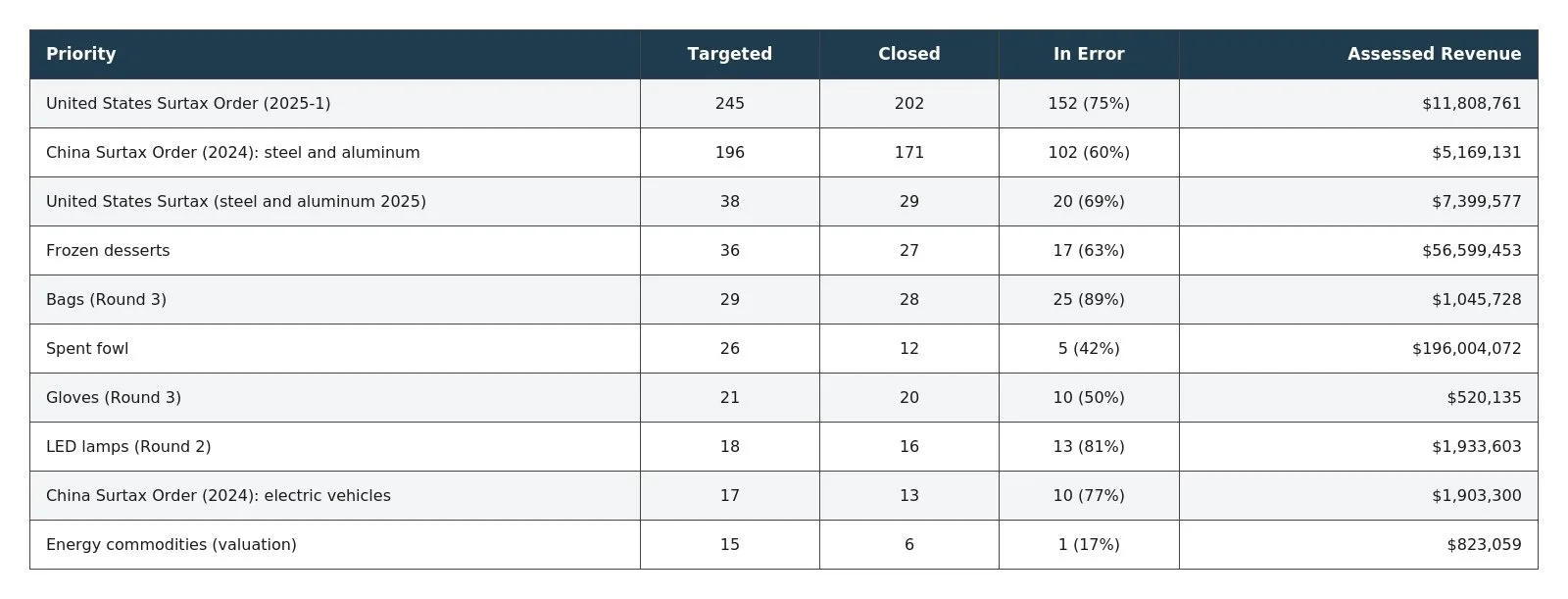
Read the error column rather than the revenue column. On the largest surtax priority, CBSA closed 202 cases and found 152 of them wrong. Bags round three came in at 89 percent. LED lamps round two at 81 percent. Chinese electric vehicles at 77 percent.
Error rates like that are not evidence of widespread evasion. They are evidence that these rules are genuinely difficult to apply correctly, and that a great many importers who believed they were compliant were not. If your goods sit inside one of these priorities, the base rate says you should assume you have a problem until you have checked, rather than the reverse.
One caution on the revenue figures. CBSA notes that older rounds of verification priorities counted only duties at risk and penalties in total assessed revenue, while newer rounds include duties at risk, GST, interest and penalties. Totals from different eras are therefore not directly comparable, and any trend line drawn across them is misleading.
CBSA Sends Three Kinds of Letters Before It Sends an Auditor
A full verification is lengthy and labour intensive, so CBSA increasingly uses lighter compliance interventions instead. Three arrive by letter, and they mean very different things.
A trade advisory notice identifies potential non-compliance and provides guidance on correcting it. No monetary assessment follows. This is the version you want.
A compliance validation letter identifies suspected non-compliance and requires you to send information to CBSA within 30 days. A monetary assessment may follow depending on what you provide. The 30 days is the operative fact here, and it starts running the moment the letter is issued, not the moment someone in your office opens it.
A directed compliance letter identifies known non-compliance and arrives with the monetary assessment already attached.
The recourse provisions of the Customs Act apply to any assessment resulting from these interventions, so receiving one is not the end of the matter. But a compliance validation letter with an unanswered 30-day window is the most avoidable expensive outcome in this entire process.
You Have 90 Days From Reason to Believe, and CBSA Has Four Years
The correction obligation is statutory and it does not wait for CBSA to contact you.
Under section 32.2 of the Customs Act, an importer who has reason to believe a declaration of origin, tariff classification or value for duty is incorrect must correct it within 90 days. That obligation ends four years after the goods were accounted for, under subsection 32.2(4).
Separately, under section 59, a CBSA officer may re-determine origin, classification or value within four years of the original determination. So the four-year window runs in both directions: your obligation to correct expires at four years, and CBSA's power to reassess extends to four years.
Two practical points follow.
First, "reason to believe" is a lower threshold than certainty. Reading this article and recognising your commodity on the priority list can itself be the trigger. CBSA's policy on the point is set out in Memorandum D11-6-6.
Second, correcting one transaction is rarely the end of it. The subsequent corrections policy in the same memorandum means that once you correct an issue on one entry, you are generally obliged to correct the other entries carrying the same error. Importers who file a single correction hoping to close the matter often create a larger disclosure than they intended.
The filing mechanics for corrections and adjustments are covered separately in our guide to CBSA B2 post-import corrections.
What a Verification Actually Costs
The assessment is rarely just the duty.
A verification finding typically produces the duties and surtax that should have been paid, GST on the corrected value, interest running from the original accounting date, and penalties under the Administrative Monetary Penalty System. Importers holding programme privileges, such as a Duties Relief Program licence, can also face loss of those privileges, which is often the more expensive outcome.
The part that hurts most is structural rather than financial. Verification findings are retrospective, covering goods you sold months or years ago at prices that did not include the assessed amounts. Unlike a duty increase announced prospectively, there is no realistic way to pass a verification assessment on to the customers who already bought the goods. It comes straight off margin already booked.
How to Check Your Own Exposure Before CBSA Does
The work is unglamorous, and it is far cheaper than the alternative.
Match your tariff items against the current list. Not your product descriptions, your actual HS classifications as filed. A commodity you would not describe as steel may sit in a surtaxable heading.
Pull your own import history. The CARM Client Portal holds your accounting declarations. Export the period CBSA can still reassess, which is four years, and work from your filed data rather than from your purchase orders.
Check origin, not just where you bought. Origin drives surtax applicability. Goods bought from a US supplier but manufactured elsewhere, and goods bought elsewhere but manufactured in China, both create exposure that a supplier invoice will not reveal.
Check Chapter 99 usage specifically. If any surtaxable goods have been entered under a Chapter 99 tariff item, review that treatment now. CBSA has published this as a target.
Review value for duty on related-party and assist-heavy imports. Valuation is a smaller share of the list but it is growing, and errors there are systemic rather than one-off.
Correct proactively under section 32.2. A correction filed before CBSA contacts you is a different conversation than one filed afterward.
If your goods fall inside a current priority and you would rather have someone review the exposure before you file anything, Clearit's Canadian customs brokerage team can work through your CARM history and identify where the risk actually sits.
Frequently Asked Questions
Does being on the CBSA verification priorities list mean I will be audited? No. The list identifies commodities and programmes CBSA has assessed as carrying revenue risk. Selection within a priority is a separate decision, and random verifications can reach importers whose goods appear nowhere on the list.
How often does CBSA update the verification priorities? Roughly twice a year, in approximately January and July. The most recent update was July 7, 2026. CBSA describes the process as evergreen and can add targets between scheduled updates.
What is the difference between a compliance validation letter and a verification? A compliance validation letter is a lighter intervention. It identifies suspected non-compliance and requires you to send information within 30 days, after which an assessment may follow. A traditional verification examines all your importations over a period, normally one year, and is considerably more involved.
How far back can CBSA reassess my imports? Four years from the date of determination, under section 59 of the Customs Act. Your own obligation to correct declarations also ends four years after the goods were accounted for.
Can I be penalised for correcting an error myself? Correcting under section 32.2 is a legal obligation rather than an admission, and proactive correction is treated differently from an error CBSA finds first. Penalties are assessed separately under AMPS, and the circumstances of the correction matter.
What happens if I ignore a compliance validation letter? The 30-day response window closes and CBSA proceeds on the information it has, which generally means an assessment. The recourse provisions of the Customs Act still apply to that assessment, but you will be disputing a number rather than preventing one.
HOW DO YOU FEEL ABOUT FASHION?
COMMENT OR TAKE OUR PAGE READER SURVEY
Featured





BAPE® brings its streetwear legacy into the ring with UNDEFEATED’s wrestling-inspired Fall/Winter 2026 collection while expanding its design vocabulary through the TYPE 10 BAPEX®, an automatic timepiece that translates the brand’s signature camouflage into contemporary watchmaking.