
Cuff vs. Chain Bracelet: Which Holds Up Better to Daily Wear?
PAGE
By PAGE Editor
The Short Answer: Construction Matters More Than Style
A cuff bracelet looks tougher at first glance. It is one solid piece of metal, with no clasp or connecting rings to wear out. A chain bracelet has more moving parts, but it also bends naturally as the wrist moves. That flexibility can prevent the kind of repeated stress that damages a cuff over time.
If both are made from solid sterling silver and built well, a properly fitted cuff usually has fewer places where something can go wrong. The catch is that it should not be pulled wide and squeezed closed every time it is worn. Repeated bending weakens the same areas of silver again and again.
A well-made men’s silver bracelet with linked construction can also handle years of regular use, provided the links are properly joined and the clasp suits the bracelet’s weight. So there is no automatic winner. A cuff holds up well when it fits correctly and is handled gently; a chain is often better for someone who needs more flexibility during the day.
What Daily Wear Actually Does to a Silver Bracelet
Most bracelets do not fail because of one dramatic accident. Damage usually builds up through small things: resting the wrist on a desk, knocking the bracelet against a doorframe, catching it on a sweater, or pulling it off too quickly at the end of the day.
Fit plays a bigger part than many buyers expect. A bracelet that is too loose swings around and takes more knocks. It may also catch on handles, cuffs, or bag straps. One that is too tight stays under constant pressure as the wrist bends and expands, putting extra strain on chain links, connecting rings, or the opening of a cuff. A comfortable sterling silver bracelet should have some movement without repeatedly sliding down over the hand.
Sweat, soap, lotion, and moisture also affect the surface. They can speed up tarnishing or leave the silver looking dull, but that is usually cosmetic wear rather than structural damage. Scratches are much the same. Sterling silver is relatively soft, so a bracelet worn every day will develop marks even if it remains perfectly sound.
The warning signs that matter are different: a link beginning to open, a joint becoming noticeably thinner, a clasp that no longer closes firmly, or a cuff developing a sharp bend in one spot. Those problems tell you the bracelet is being stressed, rather than simply showing the normal signs of being worn.
Where a Cuff Bracelet Is Strong—and Where It Can Fail
The main strength of a cuff is its simple construction. The body is one continuous piece of silver, with no clasp to loosen and no connecting rings that can pull apart. An ordinary knock may leave a scratch or small dent, but there are fewer separate components that can fail. That makes a solid men’s cuff bracelet a sensible option for regular wear.
Its weak point is the opening. Some men treat a cuff like a spring-loaded clip, pulling it wide to put it on and squeezing it tight again once it is on the wrist. Sterling silver is soft enough to allow minor adjustment, but it is not meant to be bent back and forth every day. Repeated flexing stresses the same areas near the ends of the opening. Over time, the cuff may lose its original curve, develop a sharp bend, or eventually crack.
A cuff should ideally be adjusted once for a comfortable fit. To put it on, guide the opening over the narrower side of the wrist and then rotate the bracelet into position. There should be no need to force it over the widest part of the hand or spread the ends far apart. If that is necessary every time, the size or shape is probably wrong.
Thickness matters too. A very slim cuff can be bent accidentally, especially if it catches on clothing or equipment. A heavier cuff resists deformation better, although it still needs to follow the wrist comfortably. Wider and thicker are not automatically better if the bracelet presses against the wrist bone or encourages the wearer to keep reshaping it.
For daily use, check the inside surface near the opening from time to time. A new crease, an uneven curve, or a fine line in the silver deserves more attention than ordinary scratches. A properly fitted cuff can hold up extremely well, but only if it is worn as a fitted piece rather than bent open like a clasp.
A Chain Bracelet Flexes Better but Has More Wear Points
A chain bracelet handles wrist movement differently from a cuff. Its links shift as the hand turns, so the bracelet follows the wrist without asking one section of silver to bend repeatedly. This usually makes a chain more comfortable for someone who moves his hands throughout the day.
The tradeoff is the number of separate parts. Every link has a point where it joins the next one, and a sudden pull can place most of the force on a single connection. Properly closed and soldered links should handle normal wear, but thin or poorly finished joints may gradually stretch or open. This often starts as a very small gap that is easy to miss.
The clasp and the rings connecting it to the chain deserve even more attention. They are opened, closed, and pulled against every time the bracelet is worn. A clasp should close with clear resistance and remain secure when the chain is moved around. If it suddenly feels softer, sits unevenly, or opens with very little pressure, it should be adjusted or repaired before the bracelet is worn again.
Weight alone does not guarantee durability. A heavy sterling silver bracelet needs a clasp and end connections strong enough to support it. A thick chain paired with a small connecting ring may be less dependable than a lighter bracelet whose components are properly matched.
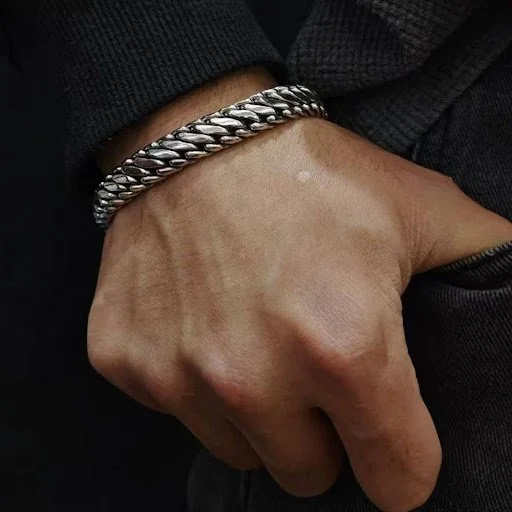
Link style also affects how easily wear can be spotted. Curb and anchor links are relatively simple to inspect. Densely woven patterns such as Byzantine or braided chains contain more contact points and may take more time to check. That does not mean a complex chain is weak, but damage can be harder to see before it becomes serious.
A chain should have enough room to move without hanging so low that it strikes desks or slips toward the hand. With the right fit and a clasp suited to its weight, a men’s silver bracelet with linked construction can stand up well to daily use. It simply needs more regular checking than a one-piece cuff.
Choose According to How—and Where—It Will Be Worn
Start with the wearer’s normal day, not the product photo. A cuff is a good choice for someone who wants fewer moving parts and is comfortable putting it on without reshaping it. It can work especially well if the bracelet will be removed only occasionally. Look for a shape that follows the wrist, smooth ends that will not catch, and enough thickness to resist accidental bending.
A chain makes more sense for someone who bends and turns his wrist frequently. The links move with the hand, so there is less rigid pressure against the wrist bone. For office wear, a flatter curb or Cuban-style chain may also sit more comfortably against a desk than a bulky, rounded design. The clasp should be easy to operate, but it should not open with light pressure.
Clothing matters as well. Raised details, open hooks, and rough link edges can catch on knitwear or loose cuffs. Men who usually wear long sleeves may be better served by a smooth, lower-profile bracelet. Anyone working around tools, machinery, or gym equipment should remove either type rather than relying on the bracelet’s strength.
Fit deserves the same attention as construction. Measure the wrist snugly instead of guessing from a man’s height or build. A chain bracelet needs extra length for movement, and a thick chain generally needs more allowance than a slim one. An open cuff offers a little flexibility, but it is not one-size-fits-all. The inner circumference, opening width, and overall shape still need to suit the wrist.
Gift buyers should be especially careful here. If the recipient already owns a comfortable bracelet, measuring that piece is usually more reliable than estimating his wrist. Otherwise, choose a seller that explains both the bracelet measurement and the wrist size it is intended to fit.
It can help to compare different sterling silver bracelet constructions side by side rather than judging durability from width alone. Jewelry1000, for example, lists both cuff and chain designs with material and sizing details.
For a silver bracelet for men who prefer a fixed, simple design, the cuff has a practical advantage. For someone who needs more movement and does not mind checking the clasp occasionally, a well-built chain is usually the more comfortable daily choice.
The Better Daily-Wear Choice Depends on One Habit
For daily wear, a cuff wins on simplicity while a chain wins on flexibility. A properly fitted cuff has fewer components to inspect and maintain. If it can be put on without pulling the opening wider each time, it will often hold up very well. But if the wearer keeps bending it to get it over the wrist, that durability advantage quickly disappears.
A chain bracelet is usually more forgiving of constant hand and wrist movement. The links bend naturally, which makes it comfortable for long hours of wear. In return, the clasp, connecting rings, and link joints need an occasional check. Small problems are usually easy to address if they are noticed before the bracelet breaks.
The most durable men’s silver bracelet is not necessarily the one that feels heaviest in the hand. It is the one that fits correctly and suits the way its owner puts it on, wears it, and removes it. Choose a cuff if its shape can be left alone. Choose a chain if flexibility matters more and checking the clasp from time to time is not a problem.
HOW DO YOU FEEL ABOUT FASHION?
COMMENT OR TAKE OUR PAGE READER SURVEY
Featured




Flyknit and leather sit at opposite ends of the handbag world, and buyers get pushed into picking a side too early. One sounds modern and light. The other sounds premium and safe.