
From TikTok to the Prom Floor: How Social Media Shapes Young People's Formalwear Choices
PAGE
By PAGE Editor
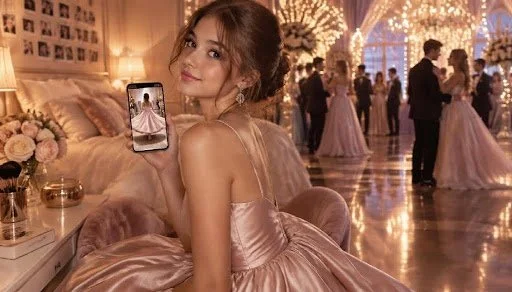
Walk into a formalwear appointment today and the conversation often starts the same way. Someone pulls out a phone. A saved video plays: a dress turning under bedroom light, a red-carpet still cropped tight on a neckline, a side-by-side of two silhouettes someone liked at 1 a.m. The reference points that once lived in magazines and store racks now arrive already edited, already compared, already attached to a feeling. Even boutique appointments that still involve real fabric and mirrors often begin with a screen. The night is still one evening. The path to the dress is no longer local.
Social platforms do not only speed up trends. They change who introduces a silhouette and how fast it travels from a celebrity appearance to a high-school gym. For prom and related formals, the effect is especially clear. Young shoppers show up with a visual brief already assembled. The industry is still adjusting to what that means for design, presentation, and the quieter codes of occasion dressing.
How social platforms redefine formal dress
Short-form video does something a lookbook page rarely could. It shows fabric in motion. A fifteen-second clip can reveal whether a skirt pools or floats, whether a bodice holds when someone raises an arm, whether a color survives ordinary indoor light. That kind of information used to require a trip to a store. Now it often arrives before the shopper has decided to leave the house.
Formalwear now runs on two tracks at once. Traditional cues still count: proportion, color, the local sense of what reads as dressed up. Alongside them sits a faster visual vocabulary. Corseted bodices, high slits, metallic finishes, and controlled volume circulate as modular ideas. A student may never name a designer, but she can describe a neckline with precision because she has watched it on several bodies under several kinds of light. Recent seasons have made that visible in the return of structured waistlines and the soft revival of butter yellow and muted jewel tones—ideas that moved from carpet coverage into peer videos within weeks rather than months.
Retailers that treat the phone screen as an afterthought fall behind quickly. Those that offer clear movement, honest angles, and sizing detail that survives a small display are better aligned with how this generation already shops. Among the online formalwear destinations that have grown alongside that habit are Worldprom dresses, positioned where occasion dressing meets the comparison-heavy, save-and-return browse style younger customers bring to almost every category.
From red carpet to dance floor
Celebrity dressing has always fed formalwear. The loop is simply tighter. A gown from a Monday awards show can be clipped, discussed, and broken into searchable traits by Tuesday. Volume, sheer panels, architectural sleeves, and single-color statements move from the carpet into prom and homecoming planning with little delay. The translation is almost never literal. Few people recreate a full look. They lift a principle instead: the calm of a clean column, the impact of one strong hue, the choice to let a single detail do the talking.
What social media adds is proof at peer scale. It is not only a celebrity in a controlled setting. It is dozens of people close in age, trying related ideas under gym lights and hotel chandeliers, then posting what actually worked. That evidence makes a bolder choice feel less risky. It also raises the bar: the dress has to hold up in a wide group shot and still feel personal in a close portrait. Standing out and belonging become concurrent demands.
Parents often experience the same shift as overload: too many options, too much speed, too little contact with fabric before money moves. From an industry view it is a redistribution of influence. Editors, buyers, and local shops still matter. They simply share the room with creators, comment threads, and a generation that rarely shops formalwear without a camera roll full of references.
Access, assortment, and the online formal wardrobe
Geography matters less than it did. A student far from a major retail corridor can now see and order cuts that once required a city trip or a limited seasonal delivery. Online formalwear has widened the field of silhouettes, colors, and price tiers, and social platforms have made that field visible. The typical path runs from a saved clip to a search term to a product page, sometimes in a single sitting after dinner.
Friction remains. Fit is still the hard problem of buying a formal dress without a fitting room. Charts disagree, fabric behaves differently on different bodies, and returns can undo the convenience online shopping advertised. Sites that invest in measurement clarity, multiple angles, and customer photos reduce some of that gap.
The same pattern holds across related nights. Someone planning prom may also need a look for homecoming, a winter formal, or graduation. Consistent sizing language and visual standards across those moments make the process less scattered. When the assortment covers both core formal collections and more specific edits such as homecoming dresses, the online wardrobe starts to match how younger consumers already think: not as one-off buys, but as a small set of occasion pieces that should feel like they belong to the same person.
Observers often describe this cohort as both sincere and practical about formalwear. The night matters. The photographs matter. At the same time, the dress is expected to earn its keep through comfort and a clear point of view, not through pure spectacle alone. Social media did not invent that preference. It amplified the people who articulate it and the channels through which those preferences become orders.
What remains after the feed moves on
Platform trends turn over fast. A silhouette that feels unavoidable one spring can look dated by the next. Formalwear sits on a slower clock because it is tied to a fixed date and a photographic record that lasts. The dress has to satisfy the moment and still hold when the images come up again years later. That pressure nudges shoppers and brands toward choices that balance current visual language with proportion and construction that do not depend entirely on a temporary feed.
The larger point is not that social media has taken over formal dressing. It is that formal dressing now happens inside a media environment that makes every option more visible, every comparison quicker, and every decision more collectively informed than before. For young people navigating prom, homecoming, and other ritual nights of late adolescence, that environment is ordinary. For the fashion industry, it is a condition that will keep shaping how occasion wear is designed, shown, and sold.
The outcomes that last still look familiar: a dress that fits, moves, and photographs with intention. What has changed is the route that leads there, and the number of images and quiet comparisons that travel with the shopper before anything is ordered. Social media did not invent the wish to look right on a formal night. It made the search for that look louder, faster, and far more shared than it used to be—and the formalwear business is still learning how to meet customers who arrive already fluent in that language.
HOW DO YOU FEEL ABOUT FASHION?
COMMENT OR TAKE OUR PAGE READER SURVEY
Featured




You wipe down the kitchen counters, wash the dishes, and put everything away before going to bed.