
Polo Collars on a Sweatshirt, and Who Actually Wears Them
PAGE
By PAGE Editor
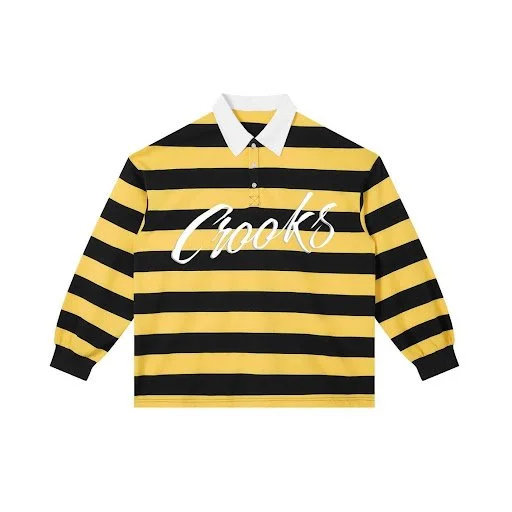
Collars on sweatshirts used to read as a mistake — like somebody had pulled a polo on under a crew neck and then forgotten about it. Then rugby shirts came back around, the collared sweatshirt arrived with them, and now there's a whole shelf of the things. On the sweatshirt rail at Crooks & Castles they sit somewhere around CA$160 to CA$179, which is more than a pullover hood and a long way past a tee, so it's fair to ask what that collar is actually buying you.
Short version: a neckline that doesn't collapse.
What the collar is doing
A crew neck is a circle of ribbing. It lies flat, it sits where it sits, and after one winter of being hauled over your head it goes a bit soft and wavy at the front. A polo collar is a separate piece of knit, usually heavier than the body fleece, often with a fold line pressed into it from the factory, and it stands up without any help. Pretty much everything people like or dislike about these sweatshirts comes back to that one difference.
Leave it standing and you get an inch or so of extra height around the jaw, which some love and some can't stand. Fold it and you've broken the line where fleece meets skin, which is basically why the thing stops looking like gym kit. On something you'll pull on two or three times a week through a Toronto autumn, that's not a small detail.
The placket does half the work
Most of them run a short placket down from the collar, two or three buttons deep. Done up, you've got something close to a rugby shirt. Open it and the collar splits and lies back and the sweatshirt loses a little of its stiffness on purpose. Two garments out of one, which a crew neck will never give you. Check the buttons before you commit, though — a missing placket button shows in a way a missing cuff button never does.
Somewhere between a tee and a shirt
Picture a scale. Heavyweight tee at the bottom, pressed cotton shirt at the top, and a crowd of things in the middle arguing over the space. A pullover hood doesn't really compete — the hood pins it to the casual end no matter how good the fleece is. A plain crew neck moves one step up. A polo collar shifts the same sweatshirt two or three steps further, far enough to clear most of the rooms where a hood gets you a second glance.
And that's the practical pull of it. A Calgary office that went business-casual years ago won't blink at a collared sweatshirt in November. The same piece is fine in a Vancouver pub on a wet Thursday. It covers ground that neither end of your wardrobe reaches, with nothing to iron.
Who it suits
Not everybody. The honest reasons come down to proportion and habit rather than taste.
A short neck and a stand-up collar fight each other. Try it folded flat first before writing off the whole idea.
Hoodies and nothing else in the drawer? Then this is a softer landing than a shirt you'd never press anyway.
Broader shoulders tend to carry the heavier collar, since it sits inside your frame rather than perched on it.
Working from a desk at home all week, you probably won't bother, and skipping the category is a perfectly sound call.
There's a beard question too, which sounds trivial until you've worn a knit collar standing for a fortnight. A full beard rests on it and flattens the fold over time. Nothing ruinous — it just means yours will spend most of its life folded rather than up, and you may as well buy it knowing that.
Where it goes wrong
Two ways, mainly, and both are your fault rather than the sweatshirt's. Hot water will relax that fold line and it won't fully come back — the body of the piece shrugs off a warm cycle, the collar doesn't. Then there's hanging it soaking wet on one of those thin wire hangers, which drags the shoulder down and pulls the collar out of square with it. Dry it flat. That's both problems gone.
Pro Tip: Once it's fully dry, press the fold line back in with a warm iron through a tea towel. A minute of work and the collar stands properly again for another few months.
Sizing is stricter here than on a crew neck
These climb S to XXXL, and the shop's own answer is that the labels are honest, which in practice means the body behaves like a normal sweatshirt — room to move, not a tent. A collared piece is the one spot where I'd argue against sizing up, though. Go a size over and the collar sits wide of your neck, the placket gapes open, and the smart-casual argument you bought it for quietly falls apart. Loose in the body is fine. Loose at the neck isn't.
Fleece weight matters more than you'd expect, as well. A heavier knit holds the collar's shape for seasons; a thin one gives up by February whether you want it to or not. You can test it between two fingers — if the collar folds under almost no pressure, it's going to be lying flat most of the time.
Same shelf south of the border
The two shops run a mirrored catalogue, so anyone reading this from the US side will find the identical sweatshirt listed at Crooks and Castles in US dollars, same photos, same size run from S up to XXXL. Worth saying because people spot a Canadian price on a Canadian site and assume the piece stops at the border. It doesn't. Delivery on either side normally lands inside 7 to 14 days.
Frequently Asked Questions
Can I wear the collar standing up?
Sure, and plenty of people do. It works better on a heavy collar, and much better with a jacket over the top, since the jacket's own collar gives yours something to lean against. On its own it can read as though you simply forgot to fold it down.
Is it warm enough for a Canadian winter by itself?
Not in January. At −10 °C it becomes a mid-layer, under a shell or a wool coat, and it does that job well because the open neck stops you cooking on a packed bus. Through October and April it's plenty on its own.
How is it different from a rugby sweatshirt?
A rugby version usually has a stiffer collar, often in a contrast colour, plus a longer placket. Louder, basically. The polo collar is the quieter of the two, and it's the one that slips into an ordinary week without announcing itself.
If your top drawer is three hoodies and five tees, this is the piece that fills the gap you keep noticing on days when you need to look a bit assembled without changing out of something comfortable. Buy one, wear it folded a few weeks, and see if it earns a place in the rotation. Most people find it does.
HOW DO YOU FEEL ABOUT FASHION?
COMMENT OR TAKE OUR PAGE READER SURVEY
Featured



A casual tee can carry an entire outfit when the proportions, textures and colors feel intentional.