
RTP Transparency: How Percentages Work Across Different Slots

PAGE
By PAGE Editor
Return-to-player figures have become one of the most discussed metrics among slot enthusiasts, yet they remain widely misunderstood. RTP represents the theoretical percentage of wagered money a game returns to players over an extended number of spins, calculated across millions of simulated rounds. A slot advertising 96% RTP theoretically pays back 96 units for every 100 wagered, though short sessions rarely reflect this. Understanding how different software providers calculate, display, and adjust these values gives players a clearer picture of what they are engaging with. Transparency around these numbers has improved considerably, driven by regulatory pressure and growing player demand for honest data.
Why RTP Percentages Differ Between Providers
Not all slot engines calculate return values the same way, and this variation stems from design philosophy, mathematical modelling, and regulatory frameworks. Some studios build fixed RTP into every release, while others offer configurable versions.
Several factors influence how a specific slot arrives at its published percentage. These technical and commercial elements shape the final number players see:
Volatility modelling, where high-variance games spread returns across rare large wins rather than frequent small ones.
Feature weighting, meaning bonus rounds and free spins, often contributes a large share of total returns.
Configurable RTP settings, allowing operators to select from multiple approved versions of the same title.
Jurisdictional rules, since certain markets enforce minimum return thresholds that developers must respect.
Recognising these variables helps players interpret published figures with realistic expectations rather than treating them as guaranteed outcomes.
How Slot Engines Publish and Verify Return Data
Verification has become central to RTP credibility, with independent testing laboratories auditing games before they reach the market. Organisations such as eCOGRA and GLI examine the underlying random number generator and confirm that stated percentages match actual mathematical behaviour. These audits protect players and reinforce trust across the industry.
Transparency also depends on where and how the information is displayed. Many providers now embed RTP details directly within a game's information panel, while others publish full reports online. Players who prefer verified game libraries and clearly listed return figures often explore a trustworthy casino online environment before committing real funds. You can review the available slot selection at NV Casino to see how modern platforms present these details. Clear labelling, combined with certified testing, allows players in Poland and elsewhere to make informed choices rather than relying on marketing claims alone.
Fixed Versus Configurable Return Models
The distinction between fixed and configurable RTP deserves particular attention because it directly affects the experience. Fixed models keep a single percentage regardless of where the game appears, offering consistency and predictability across every platform. Configurable models, by contrast, give operators a menu of certified versions, sometimes ranging from 91% to 96% on the identical title.
This flexibility can confuse players who assume every version of a popular slot behaves identically. A game may look, sound, and play the same while quietly returning a different percentage depending on operator configuration. Checking the in-game information screen remains the only reliable way to confirm the active setting. Responsible operators disclose this openly, whereas less transparent platforms may leave players guessing about which version they are actually spinning.
Comparing RTP Ranges Across Common Slot Categories
Different slot types tend to cluster within recognisable RTP bands, reflecting their design goals and target audiences. Understanding these ranges helps set realistic expectations before spinning.
The following comparison outlines typical return brackets across widely available slot categories and what each generally implies for gameplay.
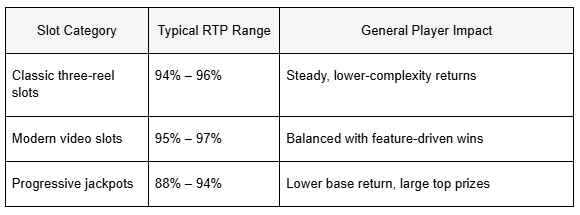
These brackets are averages rather than promises, and individual sessions can deviate dramatically in either direction. Treating the table as a guide, not a guarantee, keeps expectations grounded and gameplay enjoyable.
Making Smarter Choices With RTP Knowledge
Armed with accurate return data, players can approach slots more strategically and select titles aligned with their preferences and bankroll. Higher RTP does not eliminate risk, but it does improve long-term theoretical value compared with lower-returning alternatives. Combining this awareness with an understanding of volatility creates a fuller picture of expected behaviour.
Practical decision-making also involves considering how promotions interact with return figures. Some players actively compare bonuses, wagering requirements, and RTP to maximise value when they play slots regularly. It helps to explore reputable online games platforms that publish transparent terms and verified percentages side by side. This dual awareness prevents the common mistake of chasing headline offers while ignoring the underlying mathematics that ultimately shapes results over hundreds or thousands of spins.
Return-To-Player Transparency
Greater openness around RTP has genuinely shifted the balance toward informed players, rewarding those who take time to read game information and verify audited figures. The numbers remain theoretical averages, so no percentage promises specific outcomes within a single session or evening. What transparency offers is confidence, context, and the ability to distinguish honest platforms from those hiding configurable settings. By treating return data as one tool among several, alongside volatility, bankroll management, and clear terms, players build a healthier and more realistic relationship with slot gaming. Ongoing regulatory scrutiny and independent testing suggest this transparency will continue to improve, benefiting everyone who values clarity over guesswork.
HOW DO YOU FEEL ABOUT FASHION?
COMMENT OR TAKE OUR PAGE READER SURVEY
Featured





Deep clean, seal, and protect your tile & grout in Oceanside, CA. Bring the original shine back to your floors. Request a quote today!