
The Ultimate Phuket Road Trip Itinerary: From Old Town to Hidden Beaches
PAGE
By PAGE Editor
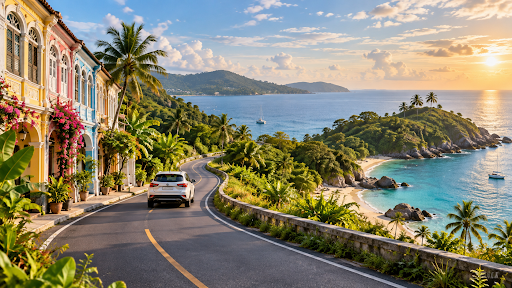
A car is the fastest way to see Phuket properly – full stop. The island's best viewpoints, quietest beaches, and its century-old Old Town sit well outside the reach of a single taxi ride, and Phuket's public transport network, while improving, still leaves long gaps between the spots worth visiting. A road trip closes that gap in one move: no waiting for a songthaew, no haggling over fares, no fixed schedule dictating when the day ends. What follows is a loop built around three things – culture, coastline, and a bit of quiet – that covers Phuket's most rewarding stretches without doubling back more than necessary.
Why the Songthaew Isn't the Answer
Patong's main strip gets the same complaint from almost every visitor: too many people, too few taxis willing to run the meter, and a songthaew schedule that seems to exist mostly in theory. It's not really a Phuket problem – it's a resort-town problem, the same one that shows up in Bali's Kuta or Spain's Costa del Sol. Fixed routes work fine when the plan is one beach and back. They fall apart the moment the day includes a sunset at Promthep Cape, lunch in a fishing village, and a stop at a waterfront market before dinner.
That's the gap a rental car closes. Nothing dramatic – just the ability to leave when the traffic looks bad, stop when a view is worth ten minutes, and skip the group-tour pacing that turns four stops into a rushed afternoon.
Mapping the Route: Old Town, Viewpoints, and the West Coast
Phuket Old Town is the natural starting point. Its Sino-Portuguese shophouses along Thalang and Dibuk roads date back to the island's tin-mining boom, and the area rewards a slow walk – coffee shops tucked into converted trading houses, faded pastel facades, murals painted into narrow sois. From there, the west coast opens up fast: Kata and Karon offer calmer water than Patong without losing beach infrastructure, while Promthep Cape, at the island's southern tip, gives one of the most reliable sunset views in Thailand.
None of this is hard to reach by car, but timing the loop matters more than most itineraries admit – traffic around Chalong circle backs up badly by late afternoon. Because of that, many travelers sort out car rental Phuket options before they land rather than at a roadside counter, since availability during high season (December through February) tightens quickly and airport pickup saves a transfer that would otherwise eat into the first afternoon.
Where the Crowds Thin Out
South of Kata and Karon, the coastline gets quieter without getting harder to reach – the road toward Nai Harn Beach runs past a monastery and a small reservoir, and the beach itself sits at the base of the Nai Harn Yacht Club, with far fewer vendors than the main tourist strips. A short drive and a ten-minute walk from there lead to Ya Nui, a small bay wedged between two headlands.
A handful of stops make this stretch worth the detour:
Nai Harn Beach – a wide crescent bay backed by a lake, popular with sailors rather than day-trippers
Ya Nui Beach – a small snorkeling spot between Promthep Cape and Nai Harn
Freedom Beach – reachable by a short boat ride or a rough dirt track, with noticeably fewer visitors
Ao Sane – a rocky cove near Nai Harn, better suited to swimming than sunbathing
Rawai – a fishing pier and seafood market rather than a swimming beach, worth a stop for lunch
Each of these sits within a 20-minute drive of the others, which is the whole point of covering this stretch by car rather than piecing it together with separate taxi rides.
Timing the Drive
Phuket runs on a left-hand driving system, same as the UK and much of Southeast Asia, and road quality on the main routes is generally solid. The bigger variable is season. The dry season, roughly November through April, brings the clearest roads and calmest coastal weather, while the monsoon months bring short, heavy downpours that clear fast but can flood low-lying stretches near Chalong and Rawai.
Fuel stations are frequent enough that range isn't a real concern on an island this size, and parking near the main beaches is usually informal but available. The one consistent bottleneck is the road through Chalong circle during the late-afternoon commute – leaving beach stops before 4 p.m. avoids most of it.
Where the Road Leads Next
A road trip through Phuket doesn't need to be complicated to work. The island is small enough that a loop connecting Old Town, the west coast beaches, and the quieter southern coves fits comfortably into two or three days without rushing. What changes the experience isn't the mileage – it's the ability to adjust the plan on the fly, staying an extra twenty minutes at a viewpoint or skipping a stop that turns out to be too crowded.
For travelers weighing how to spend their time on the island, that flexibility tends to matter more than any single attraction. Old Town's architecture, Promthep Cape's sunset, and Rawai's seafood market are each worth the stop – the road between them is what ties the day together.
HOW DO YOU FEEL ABOUT FASHION?
COMMENT OR TAKE OUR PAGE READER SURVEY
Featured





Christmas shopping becomes easier when you focus on how a child already likes to play.