
Why Men’s Shapewear Can Fit the Stomach but Fail Everywhere Else
PAGE
By Finixio Digital
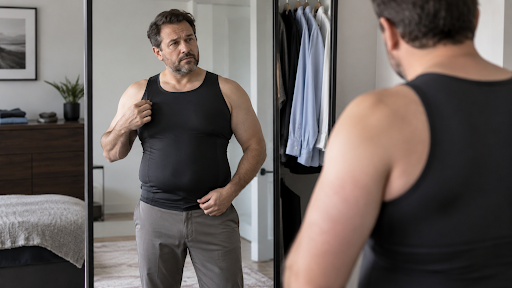
A shapewear top can match the size chart, feel firm across the stomach, and still be the wrong fit. The chest may feel loose. The hem may creep upward when you sit. The garment may end exactly where you want more coverage, or it may look smooth on its own but create a new line once a shirt goes over it.
That does not always mean you chose the wrong size. Size charts usually reduce fit to a few measurements, while real bodies distribute volume differently from chest to waist, stomach and hips. Torso length matters too. So does where the garment starts and stops.
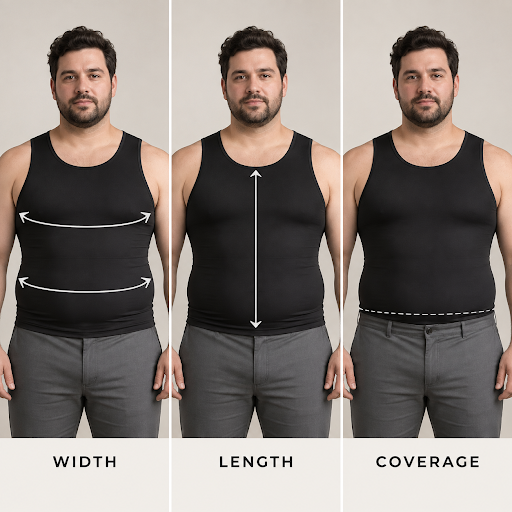
The better way to judge men’s shapewear is to separate three questions: Does the circumference fit? Does the vertical length fit? And does the garment cover the area that actually changes how your clothes sit? A top can pass one test and fail the other two.
1. A correct size can still be the wrong shape
Two men can share a similar waist measurement and need very different garments. One may carry more volume through the lower stomach, while another has a broader chest and a straighter waist. A single size label cannot describe those proportions.
That is why a garment can feel appropriately firm around the stomach but barely contact the chest, or fit the chest well while overloading the midsection. When comparing mens shapewear, look beyond the size number and ask where the garment is actually applying pressure.
If one area feels right and another area feels obviously wrong, treat that as a proportion mismatch before assuming that the entire garment needs to be smaller or larger.
2. The stomach fits, but the chest feels loose
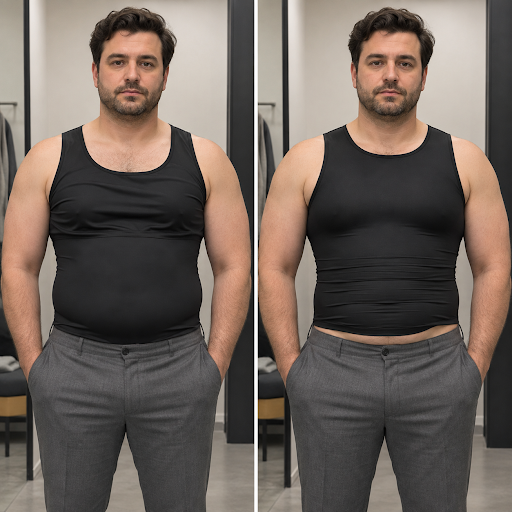
This is a common proportional mismatch for men who carry more volume through the midsection than through the upper torso. The garment reaches the stomach measurement it was designed around, but the upper section has less body volume to work against.
The result can be a top that feels useful around the waist yet folds, gaps or feels almost like a normal undershirt higher up. Sizing down may tighten the chest, but it can also make the stomach section unnecessarily restrictive.
Before changing size, check whether the garment is intended to provide even compression across the torso or stronger control in a specific zone. If the architecture is wrong for your proportions, a different cut may solve the problem more cleanly than a smaller size.
3. The chest fits, but the stomach feels overloaded
The reverse problem happens too. A man with a broader chest may choose a size that feels secure through the shoulders and upper torso, only to find that the lower section is doing too much work around the stomach.
The warning sign is not simply that the garment feels firm. It is that normal movement becomes distracting: sitting feels much worse than standing, the hem starts migrating upward, or the lower edge creates a strong line under clothing.
If the upper half looks right but the lower half feels overworked, going larger may relieve pressure but make the chest loose. Again, that points to a shape mismatch rather than a simple sizing mistake.
4. Torso length can break an otherwise good fit
Circumference gets most of the attention, but vertical fit can decide whether shapewear stays useful for more than a few minutes.
A top that is too short for your torso is pulled downward by the body it is trying to cover and upward every time you sit, bend or raise your arms. Even if the stomach compression feels correct, the hem may gradually climb toward the waist and bunch under the outer shirt.
Test length with movement, not just in front of a mirror. Sit in a chair, reach overhead, bend forward, then walk around. If the garment needs repeated adjustment, the problem may be torso length or hem placement rather than insufficient compression.
5. Coverage can end in the wrong place
Where a shapewear garment ends is as important as how tight it feels. If the lower edge finishes across the fullest part of the stomach, it can create a visible transition instead of a smooth one. If the garment stops above the area you actually want covered, stronger compression higher up will not solve the missing coverage.
This matters especially when shopping for mens shapewear for fat guys, because “midsection” can describe very different body shapes and different problem areas. A larger stomach, lower-belly fullness, side fullness and a broad torso do not all need the same coverage pattern.
The useful question is simple: does the garment extend far enough to cover the area that changes the way your outer clothes hang, without ending at a point that creates a new ridge?
6. Sizing down can make the wrong problem worse
When shapewear does not create the expected result, a smaller size can seem like the obvious fix. Sometimes it is. But if the real issue is torso length, coverage or proportion, extra tightness can magnify the failure.
A shorter effective length can encourage more ride-up. A tighter lower section can create a stronger edge. A chest that already fits may become uncomfortable while the original coverage problem remains.
Use size changes to solve a size problem. If the garment is loose everywhere, a smaller size may be reasonable. If one zone works and another does not, first ask whether the cut itself matches your proportions.
7. Judge the shapewear with the clothes you actually wear
Shapewear is a base layer, so its success is visible in what happens to the layer above it. The same garment can look discreet beneath a heavier button-down and much more obvious beneath a thin fitted T-shirt.
Put on the trousers and shirt you expect to wear. Check the front and side view. Sit down. Raise your arms. Look for a hem line, neckline, shoulder edge or new fold that was not obvious when the shapewear was worn by itself.
Trouser rise and shirt length also change the final result. If the outer shirt is simply too short, or if the waistband cuts across the widest part of the stomach, more compression may not be the most effective fix. The base layer should solve the problem it can actually control.
A quick fit diagnosis before you return or replace it
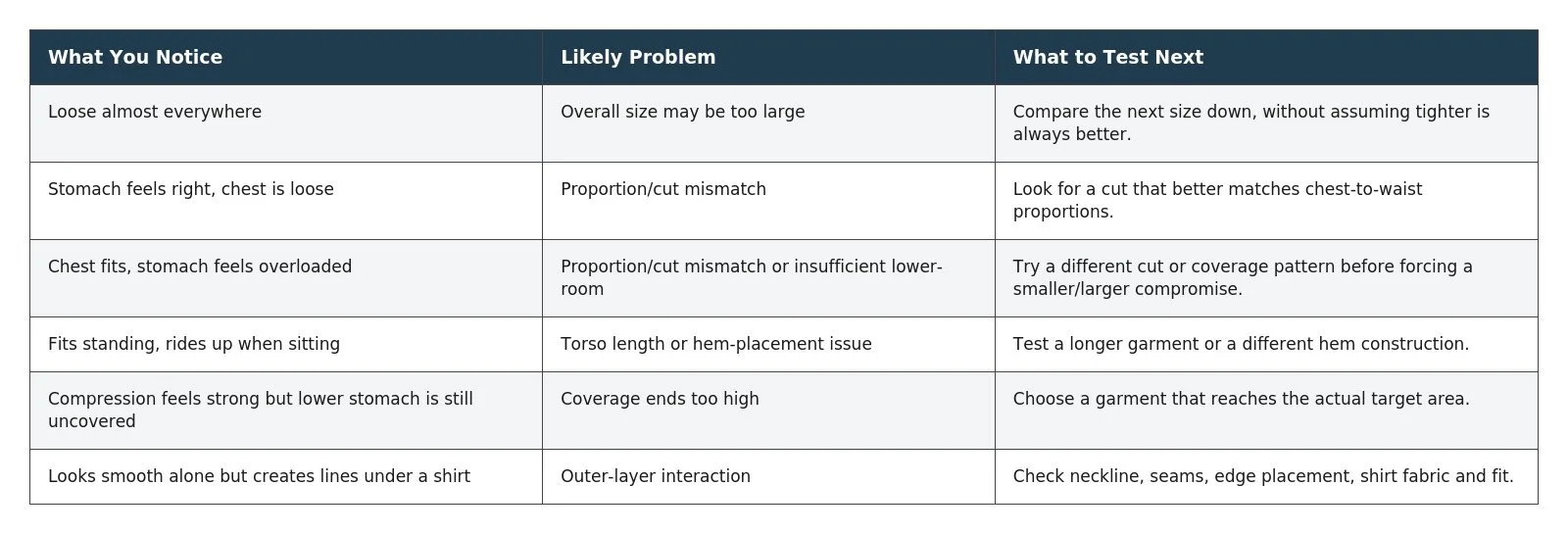
If a garment feels wrong, this quick diagnosis can help separate a size problem from a proportion, length or coverage problem:
The bottom line
The biggest mistake with men’s shapewear is treating size as the only fit variable. A garment can match your measurement and still be wrong for your body because width, torso length and coverage are separate parts of fit.
If the stomach feels right but the chest does not, or if the garment fits well until you move, do not immediately size down. Identify which part of the fit is failing first. That makes it easier to decide whether you need a different size, a different cut, more length, more coverage—or simply a better-fitting outer garment.
Good shapewear should work quietly as part of the outfit. If you spend the day adjusting it, hiding its edges or tolerating a mismatch between one part of the torso and another, the size label may be correct while the garment itself is still wrong for you.
HOW DO YOU FEEL ABOUT FASHION?
COMMENT OR TAKE OUR PAGE READER SURVEY
Featured



Christmas shopping becomes easier when you focus on how a child already likes to play.