
Top 10 AI Video Generators for Storytelling & Short Films in 2026: Best Tools for Narrative Creators
PAGE
By PAGE Editor
Text-to-video prompts can produce a stunning five-second clip, but stitching those clips into a coherent story is where most tools fall apart. Characters drift between shots, scene transitions feel jarring, and by the third cut the protagonist has changed hair color, wardrobe, and sometimes species. Narrative work demands a different toolkit—one built around character locks, frame-to-frame control, longer coherent takes, and integrated scoring. Choosing the right AI video generator for story work is less about model access and more about the workflow wrapped around those models.
This roundup focuses on ten platforms that actually hold up when you're trying to tell a story rather than generate a highlight reel.
How We Tested
Every platform was evaluated against the same six narrative-specific criteria:
Character consistency across shots — Does the same face, outfit, and body language carry from scene 1 to scene 6?
Frame control — First-frame, last-frame, and interpolation support for planned transitions.
Scene length and coherence — How long can a single generation run before motion breaks down?
Multi-shot storytelling tools — Storyboards, director modes, script-to-scene pipelines.
Audio integration — Native voice, dialogue, and music generation inside the same workspace.
Model access for narrative work — Availability of models known for coherent motion (Kling 3.0, Hailuo, Veo 3.1, Sora 2).
We ran the same three-scene story brief through each platform: a character walks into a diner, sits down, and reacts to something off-screen. What survived is below.
TL;DR: Quick Comparison
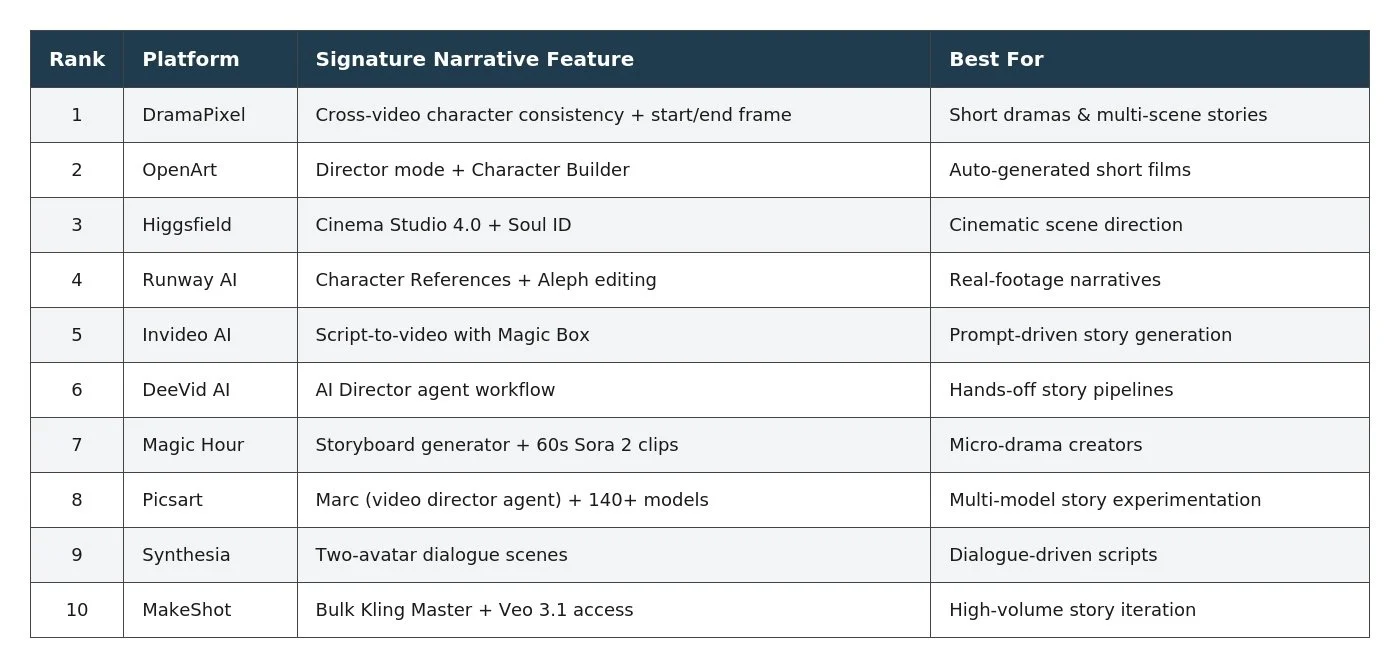
The Platforms in Detail
1. DramaPixel
DramaPixel is one of the few platforms where the product name and the feature set line up. "Drama" isn't marketing paint—the workspace is genuinely tuned for narrative output, from short dramas and micro-films to ad spots that follow a story arc.
Narrative capabilities
DramaPixel supports four input modes: text-to-video, image-to-video, video-to-video, and start/end frame interpolation. That last one matters most for storytelling—you upload the opening frame and the closing frame, and the model fills in a natural transition between them. For a walk-into-the-diner shot, you can lock the doorway pose as frame one and the seated pose as frame two, and the model handles the choreography.
Cross-video character consistency is the second pillar. Once a face is established, DramaPixel can carry it across multiple separate generations, which is what makes a six-shot sequence look like the same person and not six cousins. The model roster—Veo 3.1 for stylized cinematics, Kling V3 for physical motion, Hailuo 2.3 for longer coherent scenes, and Wan 2.6 for video-to-video restyling—covers the four use cases most narrative work actually needs.
Additional creative tools
100+ pre-built story templates covering drama, ad, and reel formats
AI Avatar module to convert a portrait into a spokesperson or recurring character
AI Music for royalty-free background scoring inside the same tab
AI Video Ads mode for story-driven product content
Character-focused utilities including a superhero generator for stylized protagonist creation
Plans
Lite — 300 credits/month, 720p export
Pro — 600 credits/month, 1080p export
Premium — 3,200 credits/month, 1080p export with priority processing
All paid tiers include watermark-free export, private generations, and a commercial license. Open Beta users receive free credits to test the workflow before committing.
Strengths
Start/end frame control is genuinely useful for planned transitions
Character consistency across separate generations, not just within one clip
Story-oriented modules (ads, avatar, music, templates) live in one workspace
Model routing hides the model-picking work from the user
Trade-offs
Lite tier caps export at 720p
Credit consumption per generation depends on which underlying model runs
Best for
Short-drama creators, micro-film directors, and ad producers building multi-shot narratives with recurring characters.
2. OpenArt
OpenArt built a dedicated storytelling layer on top of its 100+ model catalog. The OpenArt Director takes a story brief and returns a multi-shot short film, music video, UGC ad, or micro-drama with scene breakdown, shot list, and generated footage. It's the closest thing in the category to an automated pipeline from idea to cut.
Story-focused features
Character Builder locks a face across long-form pieces. OpenArt Worlds converts a single image into a navigable 3D space, useful for establishing shots or scene backgrounds. Seedance 2.5 provides native audio at 1080p with up to 30-second exports, and Veo 3.1, Kling 3.0, Sora 2, Wan 2.7, LTX 2.3, PixVerse V6, and Vidu Q3 fill in the rest of the model stack.
Plans
Starter — 4,000 credits, 8 parallel tasks
Plus — 12,000 credits, 16 parallel tasks, commercial rights
Pro — 24,000 credits, 32 parallel tasks
Wonder — 106,000 credits, unlimited creation, 32 parallel tasks
Advantages
Director mode automates the shot-planning step
3D Worlds is a genuinely unique environment feature
High parallel task counts speed up iteration on multi-shot stories
Limitations
Starter tier restricts commercial use — Plus is the practical entry point
Video credit consumption varies significantly between models
Best for
Creators who want the platform to plan the story structure, not just render the shots.
3. Higgsfield
Higgsfield treats every generation like a cinematography exercise. Cinema Studio 4.0 simulates real optical physics—anamorphic lenses, 35mm focal lengths, 16mm film grain—and lets you stack up to three camera moves (pan, dolly, crane) in a single generation. For narrative work, that means the language of camera direction becomes an actual input.
Story-focused features
Soul ID locks a character identity across scenes. First-and-last-frame reference and motion reference from uploaded video give storyboard artists something to work with. The model roster covers Seedance 2.0/2.5 for audio-video sync, Kling 3.0 and Kling o1 for realism and layered composition, Sora 2 for physics, Veo 3.1 for 4K, and Wan 2.7 for speed.
Plans
Starter — 270 credits, no Seedance 2.5
Plus — 1,200 credits, full Seedance access, 7-day unlimited on Nano Banana 2 and Kling 3.0
Ultra — 3,000 credits, adds Nano Banana Pro unlimited
Team / Scale / Enterprise — seat-based
Advantages
Deepest camera and lens control in the category
21:9 anamorphic aspect ratio for cinema workflows
Studios & Factory presets for lip sync, fashion, and UGC
Limitations
Starter tier locks out Seedance 2.5 entirely
Learning curve is steeper than prompt-only platforms
Best for
Directors and cinematographers who think in shot lists and lens choices.
4. Runway AI
Runway's strength in storytelling is that it works on real footage as easily as generated footage. Aleph 2.0, its dedicated video-editing model, can relight a scene, swap a backdrop, or add and remove objects via prompt. For creators who mix live-action plates with AI-generated shots, this is the smoothest bridge available.
Story-focused features
Character References lock a specific face across a 10-shot sequence—critical for episodic content. Gen-4.5 handles generative shots, while Aleph handles edits on uploaded clips. Lyria 3 and Seed Audio 1.0 provide music and dialogue inside the platform.
Plans
Free — 125 one-time credits
Standard — 625 credits/month, 4K upscale
Pro — 2,250 credits/month, voice cloning, 500GB storage
Max — 9,500 credits/month, 16-bit HDR, ProRes export, credit rollover
Enterprise — custom
Advantages
Aleph 2.0 is the most capable video-editing model publicly available
16-bit HDR and ProRes output on Max hit real broadcast specs
Character References carry a face across long sequences
Limitations
Heavy Aleph editing burns credits quickly
Standard's 5GB storage is tight for footage imports
Best for
Filmmakers combining live-action footage with generative shots.
5. Invideo AI
Invideo AI's story approach is script-first. Type a rough premise, and the Magic Box interface writes the script, generates the footage, adds voiceover, subtitles, and background music. Length, target platform, and accent are configurable up front. Natural-language editing commands ("delete this scene," "change the voice to British English") replace the timeline UI.
Story-focused features
Model access covers Veo 3.1, Seedance 2.5, Kling 3.0, Sora 2, Pixverse, Wan 2.7, and Hailuo. Voice is powered by Eleven Labs and Minimax with 50+ languages. A 16-million-item stock library from iStock and Storyblocks fills gaps between generated shots—useful for establishing footage.
Plans
Plus — 750 credits, 4 avatars & voice clones, 100 iStock assets
Max — 3,900 credits, 16 avatars, 200 iStock assets, 2× concurrency
Generative — 8,000 credits, 40 avatars, 1,000 iStock assets, 10× concurrency
Elite — 42,500 credits, 200 avatars, 5,000 iStock assets, 20× concurrency
Advantages
Truly hands-off script-to-video with voice and music included
Natural-language editing without a timeline
Massive stock library covers gaps in generative output
Limitations
Credits expire monthly—no rollover
Less shot-by-shot control than director-mode platforms
Best for
Creators who want a rough idea turned into a finished narrative video with minimal manual editing.
6. DeeVid AI
DeeVid frames itself as an "AI Director"—an agent workflow that plans, generates, and iterates on video content autonomously. Multimodal prompting accepts text, images, existing videos, or audio as input, and the DeeVid Canvas offers a drag-and-drop editor for finer adjustments after the agent finishes its pass.
Story-focused features
Model access includes Sora 2, Veo 3.1, Wan 2.1, Runway, Kling, Hailuo, Vidu, Haiper, Luma, and Pika. AI Ads (product-image-to-ad), AI Avatar (portrait-to-spokesperson), text-to-speech with lip sync, and AI Music round out the toolkit. Credit consumption is fixed and predictable: 8 credits per video, 2 per image, 4 per music track, 1 per voice clip.
Plans
Lite — 200 credits, 2 concurrent agents, no 1080p export
Pro — 600 credits, 5 concurrent agents, 30 parallel tasks, 1080p, priority queue
Premium — 3,000 credits, unlimited agents and chats, 50 parallel tasks
Advantages
Agent workflow can iterate on its own output
Multimodal input including audio prompts
Predictable per-generation cost
Limitations
Lite tier locks out 1080p and priority queue
Less granular scene-by-scene control than director-mode platforms
Best for
Solo operators who want an agent to handle story planning end-to-end.
7. Magic Hour
Magic Hour is a broad multi-tool suite where storytelling lives alongside face swap, lip sync, UGC ads, and voice cloning. Its narrative advantage is a built-in storyboard generator and access to Sora 2 with up to 60-second video length on paid tiers—longer than most competitors allow.
Story-focused features
Kling 3.0/2.5 for motion, Veo 3.1 for realism, Sora 2 for narrative, LTX 2.3 for audio-video sync, Wan 2.2 for video-to-video, Seedance 2.0 for coherent output. Parallel generation has no concurrency cap on higher tiers.
Plans
Free — 3 generations/day, 3 seconds, 480p, watermarked
Creator — 144,000 credits/year, 1024px cap, 3 concurrent tasks
Pro — 300,000 credits/year, 1472px cap, 5 concurrent tasks
Business — 840,000 credits/year, 4K, unlimited concurrency
Advantages
60-second Sora 2 clips accommodate longer story beats
Storyboard generator plans shots before generation
Credit rollover with no expiration on annual plans
Limitations
Free tier is limited to 3-second, 480p, watermarked clips
Story tools are one feature among many, not the central focus
Best for
Micro-drama creators who need longer single-shot generations.
8. Picsart
Picsart's storytelling angle is model breadth plus agent assistance. Marc, its dedicated video-direction agent, plans shot sequences, and Reeva handles reel-format outputs. Behind them sits a 140+ model catalog including Veo 3.1, Runway Gen-4/4.5/Aleph, Kling v2.5–3.0, Seedance 1 Pro/2/2.5, Sora 2/2 Pro, Luma Ray 2, Pika, and Wan.
Story-focused features
Fifteen-plus specialized AI agents are included in every paid plan. MCP integration with Claude Code, Cursor, and ChatGPT, plus a CLI, lets developers script story pipelines. Failed generations refund credits automatically within 24–48 hours.
Plans
Pro — ~100 Nano Banana Pro images or 83 Seedance 2.5 videos monthly, unlimited Flex.2 image generation, 100GB storage
Ultra — all 140+ models unlocked, 300GB per seat, add-on credits that never expire
Advantages
Widest model catalog for story experimentation
Marc agent handles direction planning
MCP + CLI support for scripted workflows
Limitations
Monthly subscription credits expire at billing cycle end
Video caps (25/mo standard, 5/mo Veo 3 on Pro) bind heavy users to Ultra
Best for
Creators who want to test the same story across multiple models before committing.
9. Synthesia
Synthesia isn't a general-purpose narrative platform, but it's the clear leader for dialogue-driven stories. Two-avatar dialogue scenes create realistic back-and-forth, and 240+ preset avatars plus personal digital twins cover most casting needs. AI Dubbing translates finished videos into 140+ languages while preserving the original speaker's voice and lip-syncing to new audio.
Story-focused features
Playground pulls in Veo 3 and Gemini Omni for B-roll generation, and FLUX.2 and Nano Banana Pro for static assets. Interactive video (clickable CTAs, branching paths, quizzes) supports non-linear storytelling formats used in training and product narratives.
Plans
Basic (free) — ~10 minutes/month, 9 avatars, watermarked
Starter — ~120 minutes/year, 125+ avatars, 3 personal avatars
Creator — ~360 minutes/year, 180+ avatars, API access, interactive quizzes
Enterprise — unlimited minutes, SCORM export, 80+ language translation
Advantages
Best-in-class dialogue and lip sync
SOC 2 Type II, ISO 42001, and GDPR compliance
Interactive branching for non-linear stories
Limitations
Not built for cinematic B-roll or action scenes
Credits don't roll over month to month
Best for
Dialogue-heavy scripts, training narratives, and multilingual story localization.
10. MakeShot
MakeShot's narrative role is high-volume iteration. When a story needs twenty variations of the same scene to find the right take, MakeShot's credit rollover and unlimited mid-tier generation on the top plan keep the cost of experimentation manageable.
Story-focused features
Model access covers Veo 3/3.1 Lite/Basic/Premium, Kling 2.5/2.1 Pro/Master, Seedance 2.5 SOTA/1.5 Pro/2.0, Wan 2.5/2.7/3.0, Runway Gen 4, Grok Imagine Video, LTX 2.5 Fast, and MiniMax H3. Credits roll over month to month, which suits creators iterating on a long story project across weeks.
Plans
Starter — 10,000 credits/year, 1–2 concurrent
Pro — 32,000 credits/year, 3–4 concurrent
Unlimited — unlimited credits for base/enhanced models, 90,000 SOTA-only credits, 5–8 concurrent
Advantages
Unlimited generation on mid-tier models for iteration-heavy work
Credit rollover prevents month-end waste
Broad model access for story experimentation
Limitations
Fewer dedicated narrative features (no director mode, no character builder)
SOTA models still consume dedicated credits even on Unlimited
Best for
Creators iterating heavily on the same story who need volume over specialized narrative tools.
Key Takeaways
Character consistency is the real bottleneck. Cross-scene identity locks—DramaPixel's cross-video consistency, Runway's Character References, OpenArt's Character Builder, Higgsfield's Soul ID—matter more than raw model quality for narrative work.
Frame control changes what's possible. Start/end frame interpolation, first-and-last-frame reference, and motion reference let creators plan transitions rather than hope for them. Prompt-only workflows can't compete on planned choreography.
Director modes save hours. OpenArt's Director, DeeVid's AI Director agent, Picsart's Marc, and Invideo's Magic Box automate shot planning. For creators without a background in film direction, these tools shortcut the hardest part of the process.
Audio integration matters more than it looks. DramaPixel's AI Music, Runway's Lyria 3, Synthesia's dubbing, and Invideo's Eleven Labs voice all remove the "export to a second tool" step. Story workflows that stay in one tab finish faster.
Model access has converged. Veo 3.1, Sora 2, Kling 3.0, and Seedance 2.5 show up almost everywhere. The differentiation lives in how each platform wraps those models for narrative use.
Conclusion
Story-driven video is where AI platforms separate themselves. DramaPixel leads on character consistency and start/end frame control for planned narrative sequences. OpenArt automates the shot-planning step. Higgsfield wins on cinematographic direction. Runway is the strongest choice when live footage is part of the story, and Synthesia dominates dialogue-based formats.
The right platform depends on what kind of story you're telling. A three-scene short drama with a recurring protagonist, a 60-second product narrative, a training video with two speakers, and a music video with cinematic camera work each point to different tools. Model access is now the baseline. What separates a coherent story from a highlight reel is the workflow wrapped around those models—and in 2026, the workflow is finally catching up to the ambition.
HOW DO YOU FEEL ABOUT FASHION?
COMMENT OR TAKE OUR PAGE READER SURVEY
Featured



Flyknit and leather sit at opposite ends of the handbag world, and buyers get pushed into picking a side too early. One sounds modern and light. The other sounds premium and safe.