
Five Things to Check Before You Hire a Lawyer

PAGE
By PAGE Editor
I signed a retainer once in a hospital parking lot at 9 p.m., on my phone, with a thumb I'd wrapped in a gym towel. That's how most people pick a lawyer. Not after comparison shopping. Not after reading anything. Just fast, tired, and hoping the first person who answered was the right one.
You don't need a law degree to avoid that. You need five checks, done in about an hour, before you sign anything. Here's the short version: match the practice area, read reviews for patterns instead of stars, get the money terms in writing, find out who actually works on your file, and trust the person who explains things instead of the one who promises numbers.
1. The practice area is the first filter, always
A brilliant lawyer in the wrong specialty is worse than an average one in the right field. Tax law and car crashes share almost nothing beyond a courthouse. Someone who drafts commercial leases all day isn't going to know how a spoliation letter works, when evidence disappears because a trucking company wiped its onboard data, or which deadlines the court will refuse to bend.
So start narrow. If your problem involves a crash, a fall, or a defective product, you're looking for a personal injury attorney, not a general practitioner with a broad website. If it's a lease dispute, you want a landlord-tenant lawyer. If it's a patent fight, you want someone admitted before the patent office.
The American Bar Association publishes free consumer resources on how to find the right kind of lawyer, and that's a decent place to sharpen your search terms before you start calling anyone. The rule of thumb I'd give a friend: the firm's homepage should describe cases that sound like yours within the first ten seconds. If you have to hunt for your situation, that's your answer.
2. Read reviews for patterns, not stars
Five stars means nothing on its own. A firm with forty glowing reviews and a 4.8 average might be excellent or might be running a review request campaign from a call center. What you're hunting for is repetition. When six different reviewers independently mention that the paralegal returned calls the same day, that's a real operational fact about the office. When four reviewers describe the same frustrating month of silence, that's a fact too.
Read the two-star and three-star reviews first. One-star reviews are often written by people with bad cases, which isn't the firm's fault. The middle reviews tend to be written by reasonable people describing fixable process problems, and those are the ones that tell you how the office actually runs. Google, Avvo, and Yelp all let you sort, and I'd sort by lowest rating every single time. Cross-check the licensing while you're at it. Every state bar maintains a lookup where you can confirm an attorney is in good standing and see whether anyone has filed disciplinary complaints. It takes four minutes, and it's free.
3. Get the money terms in writing before you feel any pressure
Contingency fees, hourly billing, and flat fees are the three basic structures, and the confusion usually lives in the details. Ask these questions out loud and write down the answers:
What percentage do you take, and does it change if the case goes to trial?
Who pays filing fees, expert witnesses, and medical record retrieval, and do I repay those from my share or yours?
If we lose, do I owe anything at all?
How often will I get a written status update, and from whom?
If the answers are vague at the consultation, they'll be vague on the invoice. The Federal Trade Commission has consumer guidance on contracts and deceptive billing practices that's worth fifteen minutes if the fee language starts sounding slippery to you. Here's where I'll take a side. A firm that offers a free consultation and then pressures you to sign before you leave the room is telling you something about how it treats clients. I'd walk. There's no shortage of qualified lawyers, and the good ones don't need to close you like a used car.
4. Who actually touches your file?
This is the question almost nobody asks, and it's the one that determines whether you feel informed or abandoned for the next year. At large firms, the attorney you meet may hand your case to an associate, a case manager, or a paralegal. That's not automatically bad. Support staff often know the procedural mechanics better than anyone.
What matters is whether the handoff is explained upfront. Ask directly: who is my main contact, how do I reach them, and how quickly do they typically respond? A firm that answers that clearly is usually a firm that runs a tight office. A firm that gets defensive about it is showing you the next twelve months in advance. You're not being difficult by asking who does what. You're just reading the org chart before you hand over your case.
5. The Consultation Gut Test
I use a short checklist at the end of every first meeting, and it's the piece I'd keep if I could only keep one thing. Score each line from one to five.
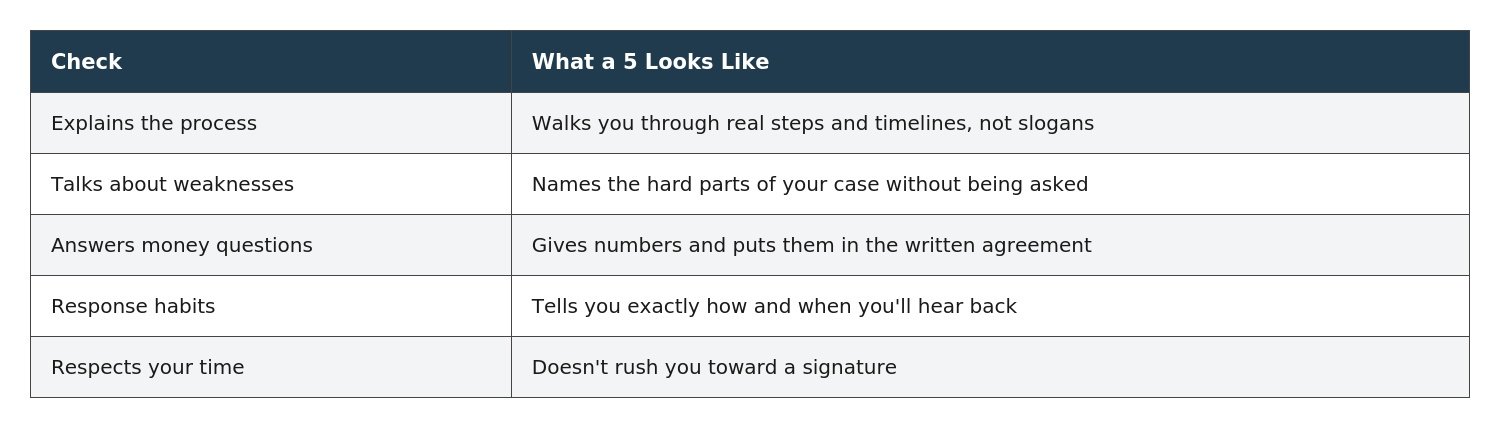
Anything under twenty out of twenty-five, I'd keep interviewing. And notice what's missing from that table: projected case value. A lawyer who volunteers a dollar figure in the first meeting, before reviewing your medical records or the police report, is guessing. Guessing feels good in the moment and costs you later, because that number becomes the anchor you measure everything against for the rest of the case.
The lawyer who says "I need to see the reports before I can give you a range" is being honest, and honesty is the trait you're actually shopping for. Everything else you can verify on a laptop in an afternoon.
One last thing worth sitting with. The right lawyer for your neighbor's car accident may be completely wrong for your contract dispute, your landlord problem, or your mother's estate. Fit isn't a ranking. It's a match between one specific mess and one specific skill set, which is why the five checks above start with the practice area and end with how the person made you feel when you asked something they couldn't answer cleanly.
So before you sign the next retainer that lands in your inbox, run the five checks. Then ask yourself the only question that really matters: did this person make the confusing part of my life easier to understand, or did they just make it louder?
HOW DO YOU FEEL ABOUT FASHION?
COMMENT OR TAKE OUR PAGE READER SURVEY
Featured





Deep clean, seal, and protect your tile & grout in Oceanside, CA. Bring the original shine back to your floors. Request a quote today!