
General Blogging: Is Writing About Everything Still a Smart Way to Blog in 2026?

PAGE
By PAGE Editor
General blogging, meaning a blog that covers several unrelated subjects instead of one niche, is a sound choice if your goal is self-expression, a personal brand, or a growing body of writing that reflects how your mind actually works. It is a harder choice if your main goal is search traffic or advertising income, but the reasons are more specific than the common claim that Google dislikes blogs without a niche. As of November 2026, Google's own spokespeople have said you do not need a niche, while its published guidance still asks every site owner whether the site has a primary purpose. Both statements can be true at once, and the gap between them is where most of the useful advice sits.
This article separates what is documented from what is simply the opinion of experienced bloggers, and then shows how to build a broad blog that feels like one place instead of a drawer full of unrelated papers.
What general blogging covers, and where the format came from
People use the phrase in two ways. Some mean the basics of blogging as a whole, such as picking a platform and publishing a first post, and others mean a blog with no single subject. This article is about the second meaning, because that is where the real decision lies.
The format itself began as a personal log. Justin Hall is generally credited with starting personal blogging in 1994 while a student at Swarthmore College, Jorn Barger coined the word "weblog" in December 1997 for a daily list of interesting links on his Robot Wisdom site, and Peter Merholz shortened it to "blog" in his website sidebar in May 1999. None of those early efforts was built around a niche, which suggests that a single-topic focus is a strategy people layer on top of blogging rather than part of what a blog is.
Today the broad end of the spectrum includes personal blogs, lifestyle blogs that mix fashion, home, travel and wellness, and multi-author general-interest sites. Wikipedia's list of notable blogs, for example, describes Boing Boing as covering politics, science fiction and general interest, and MetaFilter as a link and general-interest blog.
Google says no niche is needed, yet asks about "focus": how to read that
Google's guidance on people-first content includes a self-check question asking whether your site has a primary purpose or focus. Many SEO writers read that as a polite demand for a niche. Google's own representatives have pushed back on that reading more than once. Danny Sullivan, Google's Search Liaison, said in December 2022 that content does not have to sit in one niche to rank well and that writing about diverse topics does not mark a site as a problem. In August 2023, John Mueller said publicly that a site does not need to be a niche site to rank, and added that insisting on one can sometimes be a good way not to rank.
The picture gets more complicated in June 2025, when Mueller answered a site owner who was struggling with indexing and ranking drops. He pointed out that the site carried a lot of totally unrelated content, and suggested searching the site for terms such as "watch online" and "top 10" to see how strange it looked. Search Engine Roundtable, which reported the exchange, noted that Google had already said niches are not required, and added its own view that a site about search engines that suddenly starts posting recipes may simply confuse its readers.
The apparent contradiction mostly dissolves once you look at the examples. The warnings concern content with no connection to the rest of the site or to its readers, not a writer who has four or five genuine interests. Mueller has also said, in an earlier discussion, that when Google can tell a site is strong on a broader topic area, it can show that site to people searching in that area, which is the real benefit of focus. So the trade-off is clarity rather than punishment: a site that is clear about what it offers is easier for both machines and people to place. I did not find any Google statement describing a penalty applied to general blogs as such.
Where the "niche or nothing" advice comes from, and how much weight it deserves
Much of the pressure to pick a niche comes from professional bloggers rather than from search engines. Darren Rowse of ProBlogger has argued for years that niche blogs appeal more strongly to readers, work better with contextual ad networks, convert better on affiliate promotions, and find it easier to rank. Carol Tice of Make a Living Writing takes a similar line, saying a general blog is viable mainly when the goal is a place for daily musings, and that a loyal audience is hard to build if the subject jumps from agriculture one week to women in the military the next.
Both are worth taking seriously, but they are observations from experienced people, not controlled studies, and they were written before AI-generated answers began changing how search traffic flows. Rowse himself conceded that some general or eclectic blogs do succeed commercially, even though most of the profitable ones he had seen were focused. Search Engine Journal's Ask an SEO column reached a middle conclusion: either approach can work as long as the site has a clear structure and enough content to support each topic.
The reader problem is stronger than the search problem
The best argument against an unfocused blog has little to do with Google. A reader who arrives for a post about sourdough and finds the next three posts are about cryptocurrency, football and a conference talk has no obvious reason to come back. A niche gives readers a promise, and a general blog needs a different promise: a voice, a point of view, a humour, a recurring format, or a way of looking at things.
Some of the best-known broad blogs show this. Elementor's roundup describes A Cup of Jo as a long-running lifestyle blog by Joanna Goddard that has grown into a major online publication, and it notes that Wit & Delight began as a design-focused blog before expanding to lifestyle topics including mental health and personal growth. Both rely heavily on a recognisable personal voice. Wit & Delight's path also matches a point made on a Side Hustle School podcast episode: it is easy to widen a blog that started narrow, but hard to narrow one that started as general lifestyle or business content. That is one host's experience rather than measured data, but it fits what the examples suggest.
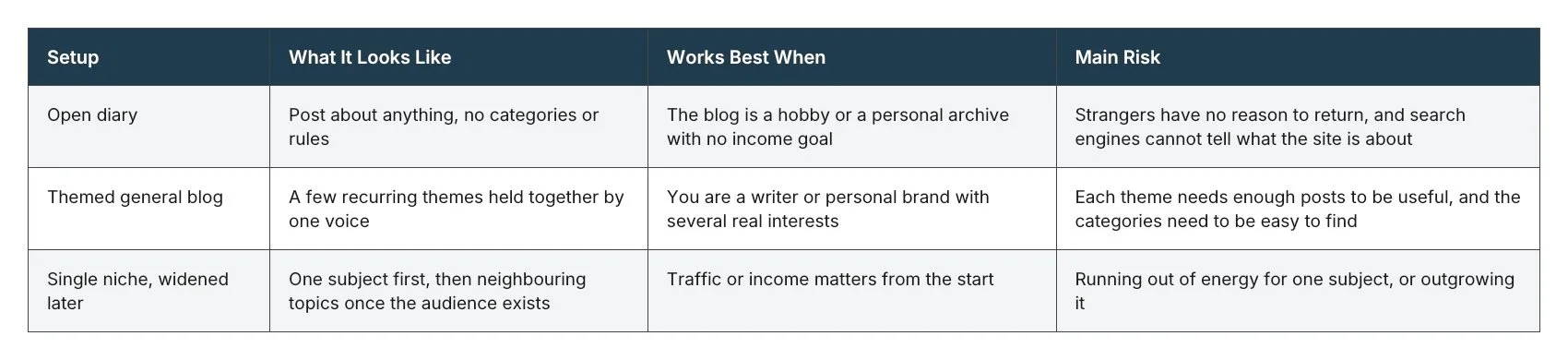
Three ways to set up a broad blog
How to make a general blog hang together
The middle row of that table is where most people who want a broad blog should aim. One multi-niche guide suggests choosing three to five subjects and writing twenty or more posts on each, but that is a rule of thumb from one source, not a tested threshold, so treat it as a starting point and not a requirement.
Search Engine Journal offers a useful picture here: treat the site like a book, with broad categories as chapters and individual posts as the detailed pages beneath them. Doing this gives search engines a logical structure to follow and gives readers a clear way to find the part of the blog they care about. A visitor who lands on your parenting posts should be able to see that you have a whole section on parenting, not a single stray article.
Write an About page that states why these topics belong together. It does not need to be clever, and "I write about the things I am learning in my first year as a teacher, a runner and a new homeowner" is a better answer to Google's primary-purpose question than any amount of keyword work. It also gives you a test for new ideas, because if a post fits none of your stated themes and none of your readers would want it, the post probably belongs somewhere else.
Hold off on adding a fourth or fifth theme until the first ones have real depth. This is my own advice, but it follows the Wit & Delight pattern of growing outward from a base that already has readers.
Search traffic in 2026 changes the math for every blog
Google began rolling out AI Overviews in Search in May 2024, starting with users in the United States, and trade publications and individual bloggers have been reporting falling clicks on informational queries since. The reported numbers vary widely, mostly come from analytics firms or individual publishers, and are not consistent enough for me to repeat them here. One blogger who writes about the effect also cautions that some people blame AI Overviews for drops caused by algorithm updates, seasonality or ageing content, so it is worth checking which queries actually lost clicks before drawing conclusions.
For a general blog, the practical lesson is that pages answering simple factual questions are the easiest to replace, while pages carrying a personal view, first-hand experience or recent information are harder to summarise away. A blog built on perspective may be better placed for this than a niche blog built on how-to answers. It also makes direct channels more valuable, particularly an email list, because reports from bloggers who weathered traffic drops consistently point to audiences that did not depend on Google alone.
Questions that come up before you start
Can a general blog earn money?
Yes, though it usually takes longer to explain to advertisers and affiliate partners what your audience wants. Typical routes listed for lifestyle blogs include sponsored posts with brands, affiliate links for products you actually use, and selling downloadable planners or templates. None of these depends on being a single niche, but all of them depend on readers who trust you.
Should I start broad and narrow later, or the other way around?
No study I found compares the two paths, so the evidence is anecdotal. The examples and the Side Hustle School advice lean toward starting with a clear centre and widening, but a blog that begins as a personal diary and discovers its theme along the way is common, and several ProBlogger commenters described exactly that.
Do I need a separate blog for each interest?
Rowse's traditional answer was to split unrelated interests into separate blogs, which keeps each audience focused at the cost of doubling the workload. Google's advice on this point, as reported by Search Engine Journal, concerns several sites on the same topic and says one combined site is usually stronger. It does not say that unrelated topics must share a domain, so the choice depends on how much time you have and how different your audiences are.
A practical way to decide
General blogging works best when the blog itself is the point: your voice, your curiosity, your record of what you are learning. It works less well as a shortcut to search income, where focus still saves time and makes it easier to be useful to one set of readers. The same test applies whether the blog is a personal project or a section inside a wider publication such as ntx magazine, because readers return for a clear reason either way. If you want both, pick a few themes you can stay with for years, say clearly on your About page why they belong together, and let the blog widen only after the first themes have an audience.
HOW DO YOU FEEL ABOUT FASHION?
COMMENT OR TAKE OUR PAGE READER SURVEY
Featured




General blogging means running a blog with no single niche. See what Google has actually said, where it works, where it struggles, and how to set one up.