
Your Wrist Is Becoming an Agent: How Agentic AI Is Reshaping Wearable Apps
PAGE
By Finixio Digital
Wearables are moving beyond step counts, notifications, and static health dashboards. The next shift is toward software that interprets context, decides what matters, and acts with less user input.
Counterpoint Research reported that edge AI-capable smartwatches accounted for 25% of global smartwatch shipments in Q1 2026, with shipments growing 70% year over year. The growth reflects stronger demand for richer on-device health and fitness experiences.
For product leaders evaluating a wearable app development company, that changes the role of the wrist. A watch can become a continuous interface for AI, with sensors supplying context and agents coordinating actions across the phone, cloud, and connected services.
Why a Wearable App Development Company Needs to Rethink the Product Layer
A wearable app development company now has to design for a device that is always nearby, always sensing, and tightly constrained by battery life, screen size, connectivity, and input options. The old model of shrinking a phone app onto a watch no longer fits this environment.
The product starts with intent rather than screens. A user may ask for a workout adjustment, a reminder, or a summary, then let the agent handle the steps behind that request.
That means the app can act more like a service layer. Calendar, map, health, weather, communication, and fitness services can expose APIs that an orchestration layer calls based on the user’s goal.
The wrist becomes the entry point, not necessarily the place where every task is completed. Detailed analysis can remain on the phone or cloud, while the watch handles sensing, brief prompts, voice, gestures, and haptic feedback.
What Agentic AI Changes on the Wrist
Traditional wearable apps wait for a tap, swipe, or scheduled notification. Agentic apps can monitor changes, interpret multiple signals, and decide whether an action is useful.
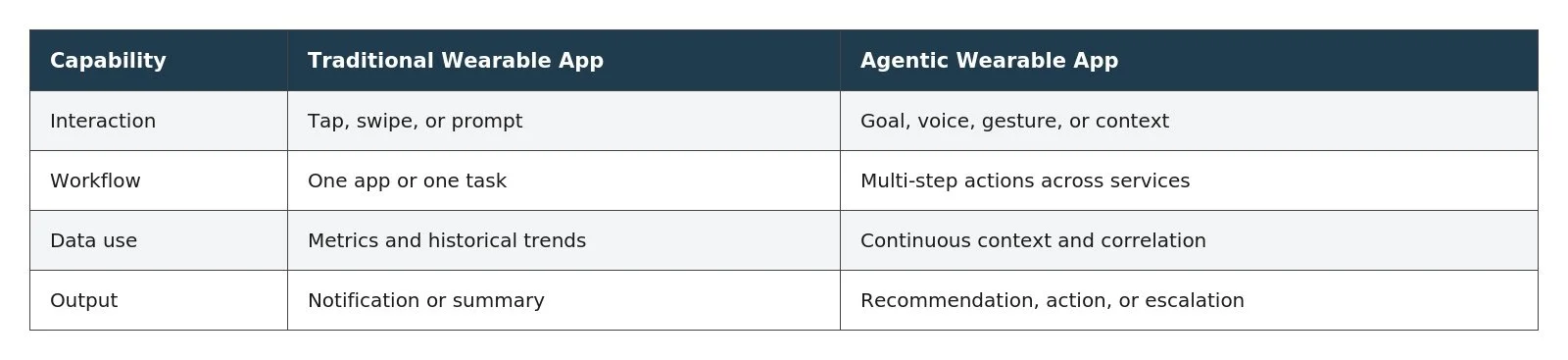
The difference is important for fitness products. An agent could combine sleep quality, recent training load, heart rate patterns, calendar commitments, and weather conditions before suggesting a change to a planned workout.
Google’s 2026 Health Guardian features for Pixel Watch and Fitbit are designed to track subtle physiological changes in the background and surface health and wellness insights over time.
The product should still define clear boundaries. A consumer wellness agent can suggest or remind. A clinical product needs controlled workflows, validated models, explicit consent, and appropriate human oversight.
How Wearable Agents Will Work Across Edge and Cloud
Agentic wearables need a split architecture. Running every model in the cloud adds latency and increases reliance on connectivity, while running every workload locally can exceed power and compute limits.
On-device AI can handle fast, privacy-sensitive tasks such as motion classification, sensor filtering, wake-word detection, or simple anomaly checks. Qualcomm’s Snapdragon Wear Elite platform adds an NPU for on-device AI and supports models of up to 2 billion parameters, showing how wearable compute is expanding.
Cloud services can handle more complex reasoning, longitudinal analysis, tool use, and coordination with external systems. A mobile companion can sit between both layers, managing permissions, richer interfaces, sync, and connectivity.
This edge-cloud split also changes data design. The product should decide which raw signals stay local, which derived insights can leave the device, and how long each data type should remain available.
Privacy needs to follow the same path. Local encryption, permission controls, data minimization, and selective sharing can limit unnecessary movement of sensitive health and behavioral data.
What This Means for Wearable UX and App Ecosystems
Agentic UX is less about filling a tiny screen with information and more about reducing interaction steps. Users should be able to act through short voice commands, gestures, haptics, or context-triggered prompts.
That changes how teams design mobile companions too. The phone can provide deeper views, configuration, history, and controls, while the wearable handles immediate decisions and feedback.
The underlying app ecosystem needs to become more modular. Headless services, clean APIs, event-driven workflows, and permission-aware connectors let an agent coordinate functions without forcing users to switch between apps.
For businesses developing fitness app development solutions, this creates new product possibilities. A fitness agent can adjust a training plan, pull relevant recovery signals, and surface a short recommendation without asking the user to manage each step manually.
The strongest experiences will still respect attention. Not every detected signal needs an alert. The agent should know when to act, when to wait, and when the user needs a fuller explanation.
What Enterprises Should Build Into the Next Generation of Wearable Apps
The engineering priorities change once a wearable becomes an active AI interface. Product teams need a system that can manage device constraints while keeping agent behavior controlled and measurable.
Start with a narrow set of high-value actions. Define the sensors required, the data that supports each decision, the services the agent can call, and the permissions it needs.
Architecture should support native watch capabilities where needed. Apple’s watchOS documentation provides background execution for workout sessions and limits background workloads to protect system resources and battery life.
Model monitoring should track more than prediction accuracy. Teams should watch latency, battery impact, false alerts, task completion, user overrides, and unexpected agent behavior.
Testing needs real-world conditions too. Poor connectivity, noisy sensor data, low battery, missing permissions, interrupted sessions, and device switching can all affect an agent’s response.
For enterprise health and wellness products, governance should cover data access, consent, model changes, audit trails, and escalation rules. The product should make clear what the agent can decide and what requires a person.
Conclusion
Agentic AI is changing the role of the wearable from a passive display into an active interface for context and action. On-device inference, edge-cloud coordination, multimodal sensing, and agent orchestration are making that shift practical.
For teams building fitness app development solutions, the opportunity is larger than adding an AI chatbot to a watch. The product can become a system that understands signals, reduces user effort, and coordinates useful actions across devices and services.
A wearable app development company building for this next phase needs to think beyond watch screens. Battery budgets, sensor quality, privacy, agent permissions, connectivity, and cross-device orchestration now sit at the center of the product architecture.
HOW DO YOU FEEL ABOUT FASHION?
COMMENT OR TAKE OUR PAGE READER SURVEY
Featured





Christmas shopping becomes easier when you focus on how a child already likes to play.