
What Intimate Wellness Learned From Slow Fashion
PAGE
By PAGE Editor
Fashion spent the last decade being asked a question it used to dodge: what is this actually made of? The answer changed what people buy. It moved them away from fast trend pieces and toward fewer, better things — a disclosed fibre list, a repair path, a reason for the garment to last.
The intimate wellness aisle has not really been asked that question yet. That is odd, because this is the one category where the material question matters more, not less.
What it is borrowing from slow fashion is not aesthetic. It is a set of disciplines: name your materials, design for real bodies, build things that can be kept.
The Question Slow Fashion Taught Us to Ask
Slow fashion did not win by being loud. It won by making transparency normal — composition labels, supplier lists, repair services. Five of its disciplines map almost one to one onto this category.
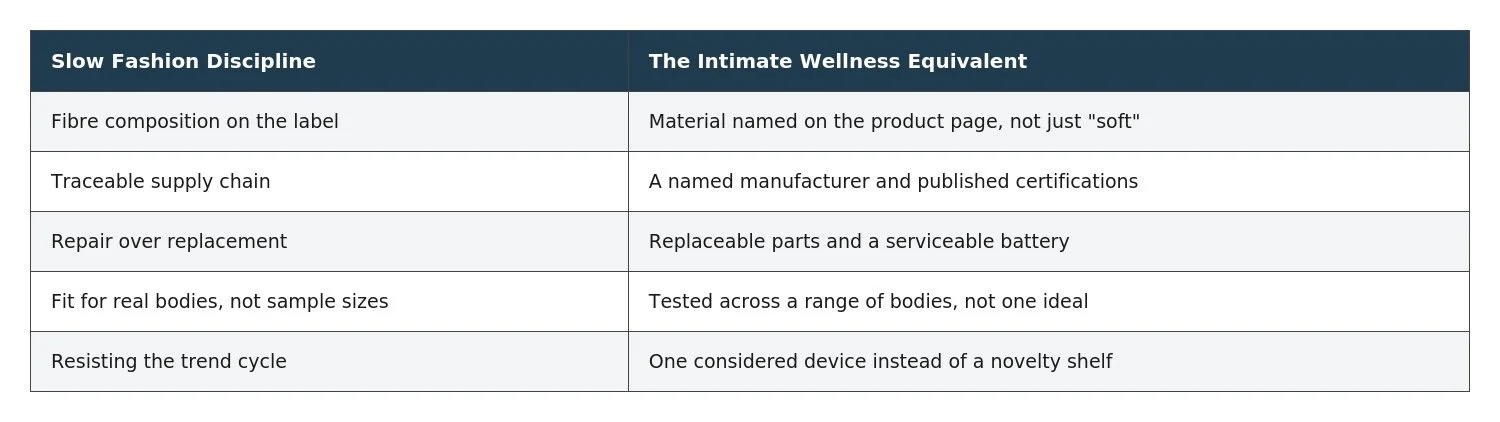
None of these are radical ideas. All of them are still unusual here.
Two differences raise the stakes. A jacket sits on top of your skin; these products are designed for skin-adjacent contact, which makes the material bar higher rather than lower. And the trend cycle in this category moves faster than fashion's ever did — new shapes, new finishes, new claims every season, most of them aimed at a first purchase rather than a second year.
Why the Stakes Run Higher Than a T-Shirt
Here is what a useful product page tells you, and what it is quietly avoiding.
Worth seeing:
A material grade, not a mood word. "Body-safe" is a marketing phrase. "Platinum-cured silicone" is a specification: platinum catalysis leaves no peroxide by-products in the finished material, which is why it became the default for high-end body-contact products.
A recognised standard. ISO 10993 is the framework used to assess biocompatibility for body-contact materials. If a brand mentions testing, it should be able to name the standard.
Honesty about "medical-grade". The phrase has no single legal definition, unlike established classifications such as USP Class VI. A brand that explains which classification it actually holds is telling you something useful.
Plasticisers named or excluded. Phthalates are the plasticiser family regulators have spent two decades restricting. A brand that says "phthalate-free" should also be able to say what replaced them.
Care instructions matched to the material. Silicone, ABS and coated surfaces do not tolerate the same cleaners. One generic "wipe clean" line usually means nobody checked.
Warning signs, roughly in order of how often they appear:
No manufacturer named anywhere on the site
A materials section that is three adjectives long
Reviews that all land inside the same two weeks
No warranty page, or a warranty shorter than the return window
Product photography that never shows a seam
A handful of women's intimate wellness brands have started publishing that first list in full — grades, standards, and care routines written for someone who intends to keep the device for years. That is the slow-fashion move, applied where it has never really been applied before.
Buy Once, Keep It Running
Slow fashion's real innovation was not organic cotton. It was the idea that a purchase is the beginning of a relationship with an object, not the end of a transaction.
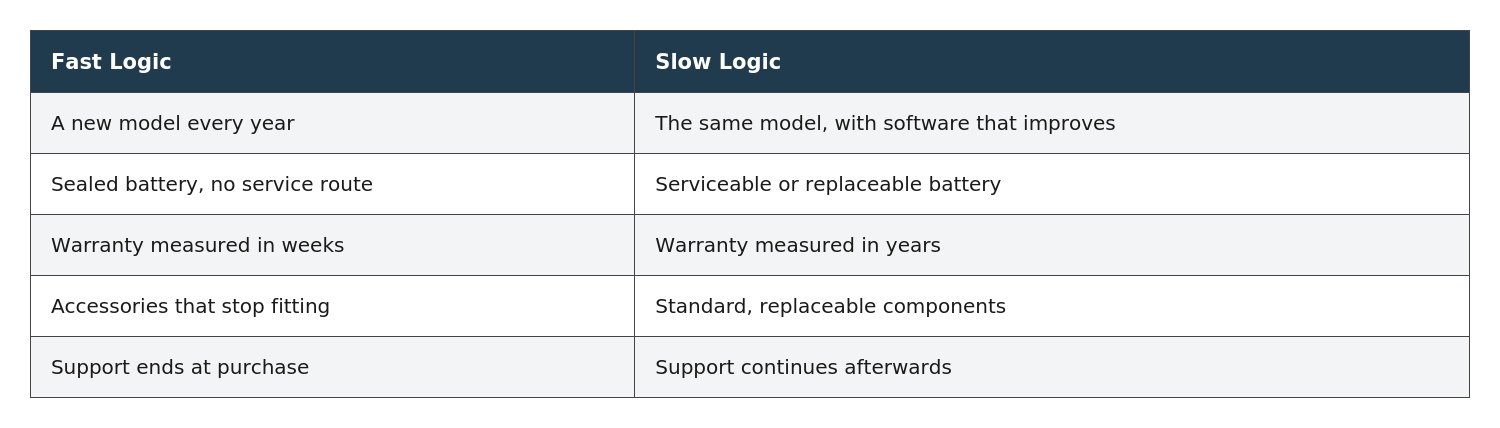
Buying well here is not the same as spending more. It is checking whether anything in the right-hand column actually exists. Often one of the five is missing — usually the battery, because a sealed cell is the simplest way to guarantee a repurchase.
Fit Is the Whole Point
The most useful thing slow fashion ever did was admit that a size range is a design decision, not a limitation. The same logic applies to hardware.
Inclusive design in this category is not a slogan. It shows up as concrete choices:
A form factor that does not assume a single body
Software that learns a routine rather than prescribing one
Instructions that do not assume a single relationship status
Discreet packaging and quiet modes, treated as defaults rather than add-ons
Language that does not make the buyer the problem
That is the brief behind the SensOn S1 wellness companion, which pairs a body-safe exterior with an app that adapts to a routine instead of assigning one. Fit, treated as a requirement rather than a positioning line.
What to Ask Before You Buy
Five questions, and what the answers should look like.
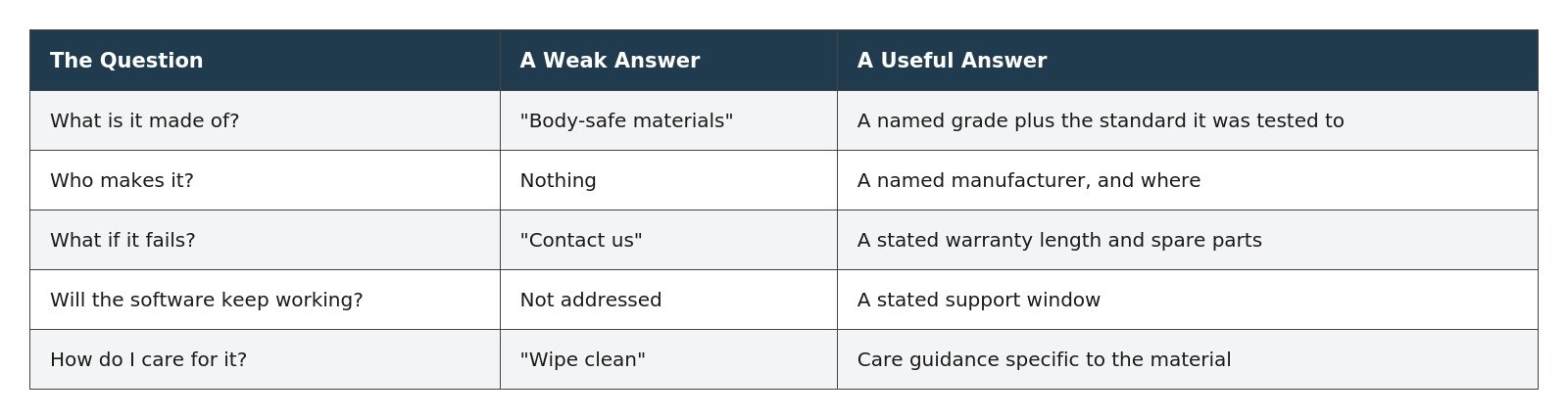
Ask them of any device on the shelf, including the expensive ones. Price and discipline are not the same variable, and the two are frequently mistaken for each other.
The Slow Version of a Fast Category
Three things worth carrying out of this:
Materials are the whole argument. In a category built on skin contact, composition is not a detail.
Longevity is a design choice, not a price tier. A replaceable battery costs less to include than a lifestyle campaign.
Transparency is the new premium. Brands that publish their specifications make a claim competitors cannot copy without changing how they build.
Intimate wellness will not get a slow-fashion moment in the same way fashion did. Nobody is going to sew a fibre label into a device. But the underlying demand is the same one that reshaped the wardrobe: fewer things, better made, kept longer, and honest about what they are.
The category that answers that question first will be the one people recommend to a friend.
HOW DO YOU FEEL ABOUT FASHION?
COMMENT OR TAKE OUR PAGE READER SURVEY
Featured




Celebrating its 10th anniversary, Brooklyn-based FABSCRAP is demonstrating how textile recycling, material reuse, and a community of more than 11,000 participants can help fashion move toward a more circular future.