
When to String with Cord vs When to Use Wire: A Designer's Decision Framework
PAGE
By PAGE Editor
When to String with Cord vs When to Use Wire: A Designer's Decision Framework
Cord and beading wire are not interchangeable, and the choice depends on the design rather than by habit. Cord knots, drapes, and can be restrung; wire resists abrasion, holds a shape, and is crimped. The five questions in section two help guide the choice in almost every case.
On this page
The core differences in thirty seconds
Five design questions that decide cord or wire
Where cord wins: weight, drape, and movement
Where wire wins: rigidity, memory, and structure
Hybrid designs that use both in one piece
Which GRIFFIN material matches which scenario
The core differences in thirty seconds
Both materials pass through a bead. Everything after that diverges.
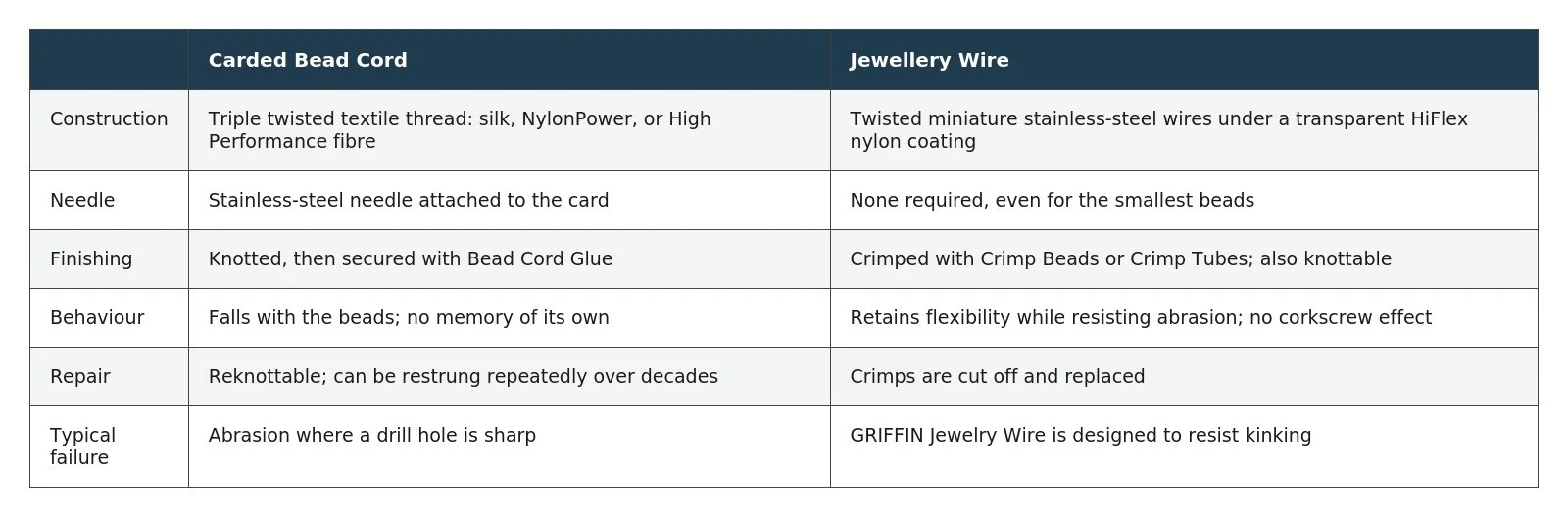
The most common mistake is treating wire as the modern replacement for cord. It is not. A pearl necklace strung on jewellery wire can be knottable, and a heavy gemstone strand with sharp edged drill holes can cause abrasion to silk. There is a fuller technical comparison in the guide to beading wire against cheap Tigertail, which is worth reading if you have been burnt by wire that has kinked.
Five design questions that decide cord or wire
Run these in order. The first one that gives a clear answer usually settles it.
Are the drill holes sharp or abrasive? Rough-drilled gemstones, lava, and some cut crystal can saw through textile thread. Wire, or tie knots between every bead so that the cord never moves inside the hole.
Do you want visible knots? Knots between beads are a design feature as much as a protective one, and they are only available on cord. If the look calls for them, the decision is already made.
Does the piece need to hold a shape? A collar that stands away from the neck, a torque, or floating beads held at fixed intervals all need a material with some structure. Cord will simply hang.
4. Where does the weight sit? Graduated strands and heavy pendants concentrate load at a single point. Wire distributes that better; light, evenly distributed weight beautifully.
5. Will it be restrung? Heirloom pieces and fine work gets restrung every few years, and cord is built for that cycle. Fashion pieces and production runs rarely are, which makes the speed of crimping the deciding factor.
If two answers conflict, section five explains how to build the piece with both. The beading glossary is useful if any of the terms above are unfamiliar.
Where cord wins: weight, drape, and movement
Cord wins wherever the piece is meant to move with the body.
A knotted strand on 100% Natural Silk falls in a continuous curve because the flexible thread offers little resistance to drape. That is the quality people recognise in a good pearl necklace without being able to name it. GRIFFIN's Carded Bead Cords are triple twisted, which gives a round profile and predictable knot behaviour. Each card arrives with a needle attached.
Knotting between beads does three jobs at once. It stops the beads touching and abrading each other, it keeps them evenly spaced as the piece moves, and if the strand breaks, one bead is lost rather than the whole strand. A crimped construction does not provide the same security if the strand breaks.
Match the diameter to the bead rather than to the fibre. GRIFFIN's own guidance runs from 0.30 mm to 0.50 mm for small pearls and glass beads, 0.60 mm to 0.75 mm for mid-sized pearls and natural stone, and 0.80 mm to 1.05 mm for large or heavy beads with irregular holes. The reliable test is to pass a sample through the bead hole first: it should move freely without rattling.
Cord also wins on repairability, which matters more than most designers expect. A necklace strung on silk can be reknotted repeatedly over its lifetime, and there is a step-by-step account of the process in the guide to restringing a pearl necklace.
Where wire wins: rigidity, memory, and structure
GRIFFIN Jewelry Wire is real steel cable in miniature: twisted stainless-steel strands sealed under a transparent HiFlex nylon coating that lets the natural colour of the steel show through. It has no internal tensions, which is why it does not produce the corkscrew effect that makes a cheap wire coil against itself. It stays flexible enough to drape around the neck and, unusually for a beading wire, it can be knotted.
Two constructions are available in clear. The 19-strand wire is the all-rounder, offered in six diameters, from 0.10 inch to 0.24 inch, or approximately 0.25 mm to 0.60 mm, and it is the more economical of the two. The 49-strand wire is the softest and most flexible in the range, offered in four diameters from 0.30mm to 0.60 mm, and it handles the smallest beads and large gemstones equally well. Neither needs a needle.
Finishing is where wire diverges completely. The strand is secured with crimps at each end rather than knotted, so plan the hardware before you start stringing. Crimp Beads and Crimp Tubes are different products and are not interchangeable.
One practical warning: Wire tolerates a great deal but does not forgive a hard bend. A single sharp fold leaves a permanent bright kink that is difficult or impossible to straighten, so keep the working length in a loose curve and never crease it against the edge of a bench.
Hybrid designs that use both in one piece
Some designs answer the five questions in both directions, and the answer is to use both materials deliberately rather than compromise on one.
The oldest hybrid is French Wire, a fine coiled metal sleeve that protects cord where it passes through the clasp. It puts metal at the point of highest wear near the clasp leaving the rest of the strand knotted on silk, and it is sized to the thread: sizes No. 0 to No. 4 take one item, No. 5 and No. 6 take the next item. No. 7, No. 8, and No. 10 take the following item. No. 12 through No. 16 take the largest item. It is the cleanest illustration of the principle that materials should be chosen per zone, not per piece. Squeeze Capsules and Bell Caps in the endings range do a related job at the knot.
Multi-strand collars are the second case. Use wire for the structural inner strand, so the collar holds its curve, and knot the outer strands on cord so they move.
Floating designs are the third: fixed bead spacing needs something that will not slide, which is where wire or Illusion Cord earns its place over knotted textile thread.
The thing to plan for in any hybrid is the junction. Two materials mean two finishing systems in one piece, so decide early where they meet and what carries the load across the join. An Open Jump Ring or a Bell Cap at the transition is usually tidier than trying to tie cord directly to a crimped wire termination.
Which GRIFFIN material matches which scenario
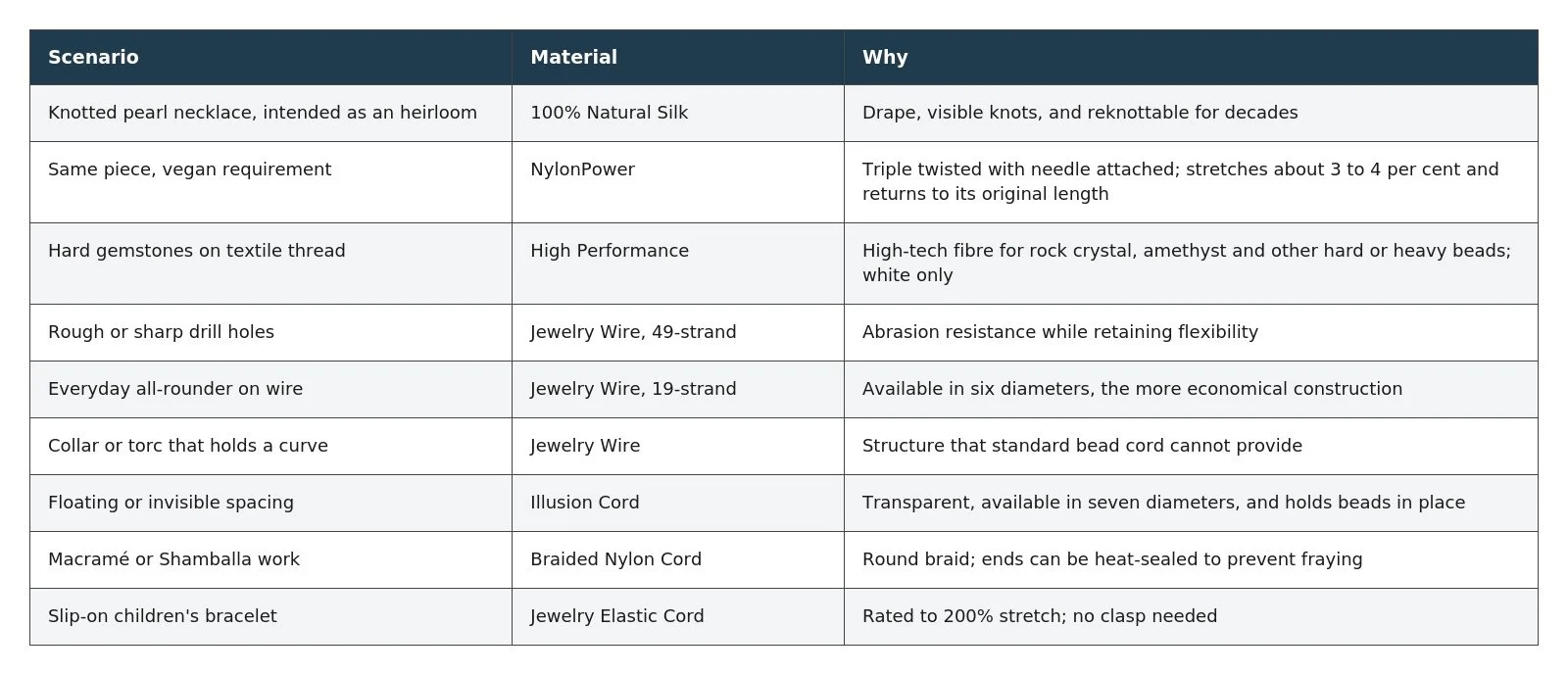
The short version, by design intent.
Frequently asked questions
Can GRIFFIN Jewelry Wire be knotted, or must it be crimped?
It can be knotted, which sets it apart from most beading wire. That said, a crimp remains the standard and more consistent finish at the clasp, particularly on a heavy piece, so knotting is best treated as an option rather than the default.
What is the corkscrew effect, and why does it matter?
It is the tendency of some wire to coil against itself because of tensions locked in during manufacture. The result is a strand that will not hang straight, and no can be difficult to straighten. GRIFFIN's specification is that Jewelry Wire has no internal tensions, which is what prevents it.
Should I choose 19-strand or 49-strand?
19-strand is the sensible default: six diameters, good flexibility, and the more economical of the two. Move to 49-strand when maximum softness and flexibility matter, particularly for very small pearls or fine work.
Does beading wire need a needle?
No. GRIFFIN Jewelry Wire has a stiff enough cut end to pass through even the smallest beads unaided. Carded cords solve the threading problem differently, arriving with a stainless-steel needle already attached, so neither material needs a separate threading tool.
Is stainless steel wire suitable for someone with a metal sensitivity?
The nylon coating sits between the steel and the skin, and GRIFFIN's clasps and findings are made of 925 sterling silver and are nickel-free. These specifications do not constitute a hypoallergenic claim, and GRIFFIN does not make one. For a known sensitivity, the wearer should check with a professional rather than rely on a materials description.
How do I pick the diameter?
Work from the bead, not the material. Pass a sample of the cord or wire through the drill hole before committing: it should move freely without rattling or shifting. When knotting, the knot also has to be large enough that the bead cannot slide over it, which may require choosing a larger cord diameter.
HOW DO YOU FEEL ABOUT FASHION?
COMMENT OR TAKE OUR PAGE READER SURVEY
Featured





Digital rewards strengthen luxury through practical service, selective access, and thoughtful personalization that keeps each purchase valuable for longer.