
How to Improve Your Tennis Skills Using a Tennis Simulator
PAGE
By PAGE Editor
You hit one fine forehand. The next three sail long. Every player knows that feeling, and it’s maddening. Tennis never stands still. The ball arrives at a different speed, with different spin, landing in a different spot, and then there’s the wind. Rush your footing a little or start your backswing late and the whole shot unravels. The tricky part is that most of the time, you can’t say exactly why it went wrong.
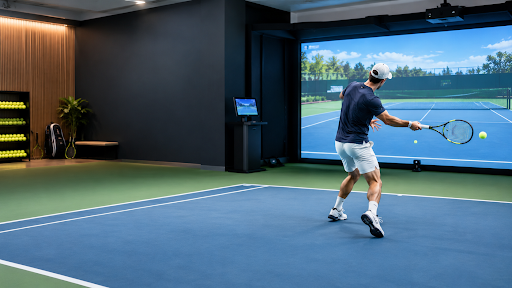
Exactly this is where practicing with a plan creates difference. An indoor tennis simulator lets you hit real shots in a steady, controlled space, then shows you what actually happened. You can pick one skill, repeat it, then check whether it got better. Below, we’ll walk through how to improve tennis skills with a simulator, which parts of your game benefit most, how to read the feedback, along with drills worth trying. A beginner can use this, so can a club regular, as indoor tennis practice works best when every session is oriented to goal.
How Does a Tennis Simulator Help Improve Your Game?
You improve tennis skills with a simulator in three ways. First, you get feedback straight away. Depending on the system, that might be shot speed, where the ball landed, or both, so you know right then what worked. Second, you can practice one skill in a setting that doesn’t change. When conditions stay the same, a better result means better technique, not a lucky bounce. Third, virtual scenarios train your decision-making. You’re not just hitting the same shot again and again. You’re facing rallies that make you choose where to hit and when. Feedback, repetition & decisions together make a session far more productive than hitting without a plan. When comparing training options, understanding the indoor tennis simulator cost can also help you decide whether simulator practice fits your training goals and budget.
Which Tennis Skills Can You Improve With a Simulator?
More than you’d think. Exactly what you can do depends on the system, but these are the skills most players start with.
Improve Forehand and Backhand Consistency
Consistency comes from repetition with feedback. Hit a set of forehands at a target, then see how many landed where you meant them to. Do the same on the backhand side. Before long you’ll notice which wing drifts long or catches the net. Small fixes, like a different contact point or a fuller follow-through, are much easier to test when the result is right in front of you.
Practice Serve Placement and Return Strategies
Serving is ideal for indoor work, since you control every single rep. Choose a spot in the service box, aim at it, and count how often you hit it. For returns, practice putting the ball where you want it against different kinds of serves. It’s a low-pressure way to build confidence before you try the same thing in a match.
Develop Reaction and Shot Selection Skills
Tennis isn’t only technique. It’s picking the right shot, fast. Simulator scenarios can put you in spots where you have to read & react: crosscourt here, down the line there. The more you repeat those choices, the quicker as well as more natural they feel. That matters when a point is moving at full speed.
Work on Footwork and Court Positioning Where Supported
Some systems support movement-based practice, and some don’t. If yours does, use it for your split step, your recovery and where you stand between shots. If it doesn’t, you can still work on footwork on your own in the space. Good positioning makes every other shot easier.
How to Use Tennis Simulator Feedback to Identify Weaknesses
Numbers don’t help unless you do something with them. Don’t glance at the data and move on. Use it to find out what’s holding you back, then build your sessions around that. Here’s how.
Track Shot Accuracy and Consistency: Count how many shots land in your target zone, then note whether your misses go long, wide or into the net. Misses tend to follow a pattern. If most go long, you might be swinging too hard or finishing too high.
Review Stroke Technique Using Video or Sensor Feedback: If your system offers video replay or sensor data, use it. Compare what you see to what the swing felt like. You might spot a racket that drops late, or a contact point that’s slightly behind your body.
Recognize Repeated Errors Across Multiple Sessions: One bad day means very little. The same mistake showing up across several sessions means something. Compare your notes week to week & the habits worth fixing will stand out.
Set Measurable Goals for Improvement: Pick a number you can beat, like landing 7 of 10 serves in the target area when you managed 5 last time. A specific goal keeps you focused, and hitting it feels great.
Tennis Simulator Drills to Improve Your Performance
Drills give practice some structure. Each one below works on a single skill and gives you something to measure. Keep sessions short, around 20 to 30 minutes, and stop when your form starts to slip. Using an indoor tennis simulator this way gets you the most out of every visit.
Forehand and Backhand Target Practice: Set a target in each corner and hit ten shots to each. Count your hits, then try to beat that number next time.
Serve Placement and Return Drills: Aim your first serve at one spot ten times, then move to the other side. For returns, work on sending the ball deep to a set target.
Reaction and Directional Response Drills: Have the system or a partner call a direction, then react and hit that way. It trains your first step and how you read the ball.
Rally Consistency and Shot Selection Exercises: Set a goal, like 15 shots in a row without an error. Mix in decisions, such as choosing safe crosscourt shots when you’re pulled wide.
Virtual Match Scenarios for Tactical Awareness: Play simulated points or games and watch your patterns. Notice when you rush, which shots you lean on, and where you tend to give away points.
Conclusion
Improving your tennis skills is not just about hitting more balls. It’s about hitting them skillfully. With the help of a simulator, players can get immediate feedback, practice consistently, and be in different situations that will help them to sharpen their decision-making skills. Plus, you do not have to worry about weather or securing a court. Pick one skill to perfect, keep track of your progress, and work towards achieving a specific target. After that, you should stick with it, and your indoor tennis training will be successful. Are you interested in using a simulator for enhancing your tennis skills? Choose a practice from the list and implement it during your next training.
HOW DO YOU FEEL ABOUT FASHION?
COMMENT OR TAKE OUR PAGE READER SURVEY
Featured



Sedentary work habits and daily screen time are inspiring many to embrace simple postural routines and gentle adjustments to ease neck tension and stiffness.