
How to Learn Hydroponics at Home: A Beginner’s Guide for UK Growers
PAGE
By PAGE Editor
Hydroponics is a soilless growing method in which plant roots absorb dissolved nutrients from water instead of from soil. For UK growers, it offers a controlled way to produce herbs, salad leaves and fruiting vegetables indoors all year round, whatever the weather or garden size. This guide covers how hydroponics works, the main system types, essential equipment, nutrient management and a simple first setup.
What Is Hydroponics and How Does It Work?
Hydroponics replaces soil with a nutrient solution: water mixed with dissolved minerals such as nitrogen, phosphorus, potassium, calcium and magnesium. The roots sit in an inert growing medium, such as coco coir, rockwool, perlite or clay pebbles. The medium supports the plant and holds moisture but contains no nutrients of its own. Because the solution reaches the roots directly, plants spend less energy searching for food and often grow faster than soil-grown equivalents.
Every hydroponic system must deliver water, nutrients and oxygen to the root zone. Most home systems recirculate the solution from a reservoir, which cuts water waste. Dissolved oxygen, usually supplied by an air pump and air stone, keeps roots healthy and prevents root rot.
Why Hydroponics Suits UK Home Growing
The UK climate is a major reason people grow hydroponically. Winter daylight is around eight hours or fewer in much of the country, and outdoor growing seasons are short and unpredictable. An LED grow light on a timer replaces missing sunlight and gives leafy crops a steady photoperiod of roughly 14 to 16 hours. Space matters too. Flats, terraced houses and spare rooms rarely fit a vegetable bed, but a shelf, countertop unit or grow tent does.
Weigh the practical attributes honestly. Setup costs more than a pot of compost, lights and pumps add to the electricity bill, and hard water in much of England affects pH. Root vegetables and large brassicas aren’t practical at home, but herbs, salad leaves and many fruiting crops work well. Because the equipment is specialised, many UK growers buy from dedicated hydroponics suppliers such as Hydroland, a Manchester-based retailer supplying growers across the country since 2010, where lights, tents, nutrients and irrigation parts can be compared in one place.
Hydroponic Systems for Beginners
Deep Water Culture (DWC) suspends plants in net pots above a reservoir of aerated nutrient solution, so the roots sit directly in water. An air pump and air stone provide oxygen. With very few moving parts, DWC is the easiest system to build and suits lettuce and leafy greens.
Wick systems use a cotton or felt wick to draw solution from the reservoir up into the medium. They need no pump or electricity, which suits herbs and small plants, but they struggle to feed larger, thirstier crops.
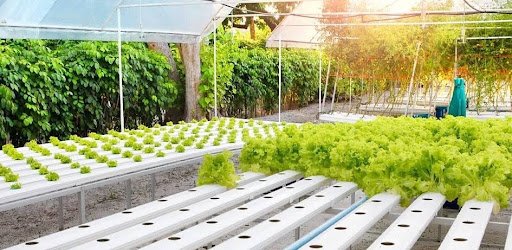
Nutrient Film Technique (NFT) runs a thin stream of solution along a sloped channel past the roots. It uses water efficiently and suits salad crops, but it relies on a pump, so a power cut can dry roots quickly.
Drip systems use a timer-controlled pump and drippers to feed each plant’s medium. They scale well for tomatoes, peppers and chillies. Flood and drain (ebb and flow) periodically floods a tray of medium and drains it back to the reservoir, which suits mixed crops but needs more components.
For a first project, DWC or wick systems are the sensible choice because they are simple and inexpensive.
Essential Equipment for a First Setup
Growing space: any room with a stable temperature and a nearby power socket. A grow tent adds a reflective, light-proof enclosure that holds humidity and temperature steady and allows ducted ventilation.
Lighting: full-spectrum LED grow lights supply the wavelengths plants use for photosynthesis, run cooler than HPS lamps and use less electricity. Light intensity is measured as PPFD in µmol/m²/s. Leafy crops need less than fruiting crops, so match the light to your plants.
Reservoir: an opaque, food-safe container with a lid blocks light and prevents algae.
Growing medium: coco coir holds water and air well, rockwool suits seeds and cuttings, and clay pebbles drain freely for flood and drain systems.
Air movement: an oscillating fan strengthens stems and reduces mould risk, while an extraction fan controls heat and humidity in a tent.
Meters: a pH meter, an EC meter and a thermometer-hygrometer let you monitor your system accurately.
Hydroponic Nutrients, pH and EC Explained
Hydroponic nutrients supply macronutrients (nitrogen, phosphorus, potassium), secondary nutrients (calcium, magnesium, sulphur) and micronutrients such as iron, manganese, zinc and boron. Most beginners use a two-part (A and B) base nutrient. The two parts are kept separate so calcium doesn’t react with phosphates and sulphates in the concentrate, and they are mixed into water following the feeding chart. Garden fertilisers aren’t formulated for soilless systems.
pH measures how acidic or alkaline the solution is. Most crops absorb nutrients best between about 5.5 and 6.5. Outside that range, nutrients become unavailable even when present, a problem called nutrient lockout. pH up and pH down solutions adjust it.
EC (electrical conductivity) measures the total dissolved salts in the solution, in millisiemens per centimetre (mS/cm). Seedlings and lettuce prefer a lower EC than fruiting crops. Too high a concentration burns roots, while too low causes deficiencies such as pale leaves.
Test your tap water first. Hard water already contains calcium and magnesium, raises EC and can push pH up. In hard-water areas, you may need to reduce nutrient dosing or use filtered water.
Best Plants for Beginners
Start with fast, forgiving crops: lettuce and other salad leaves, basil, mint, parsley, coriander, pak choi and spinach. These grow well under moderate light and a lower EC. Once you’re confident, move on to strawberries, chillies, peppers and tomatoes, which need stronger light, support and more careful feeding.
Setting Up Your First System
Choose a crop and location with power and a stable temperature.
Assemble the system: reservoir, lid, net pots and, for DWC, air pump and air stone.
Fit the grow light at the manufacturer’s recommended height, connected to a timer.
Mix the nutrient solution according to the feeding chart, then check EC.
Adjust pH to roughly 5.5 to 6.5.
Plant seedlings or start seeds in rockwool or coco plugs and transfer them.
Monitor every few days: check pH, EC, water level and temperature, and replace the solution every one to two weeks.
Aim for a nutrient solution temperature of about 18 to 22°C and air temperature of roughly 18 to 24°C. Warm water holds less oxygen, and growth slows noticeably when rooms drop much below 15°C. The most common beginner mistakes are skipping pH checks, overfeeding, using too little light and letting light reach the reservoir.
Frequently Asked Questions
What is the easiest hydroponic system for beginners?
Deep Water Culture and wick systems, because they have the fewest components and are simple to maintain.
Can you grow hydroponically indoors in the UK all year?
Yes. With an LED grow light and a stable room temperature, hydroponic herbs and salad leaves can be grown through every season.
How long do hydroponic plants take to grow?
Leafy greens and herbs are often ready in roughly four to eight weeks, depending on the crop and conditions.
HOW DO YOU FEEL ABOUT FASHION?
COMMENT OR TAKE OUR PAGE READER SURVEY
Featured





Hydroponics is a soilless growing method in which plant roots absorb dissolved nutrients from water instead of from soil.