
Instagram Likes as a Ranking Signal: What Actually Counts in 2026
PAGE
By PAGE Editor
Short answer: likes still matter, but not as a public points system. Meta’s published documentation for Instagram Feed describes models that predict whether a person is likely to take actions including liking, saving, commenting and watching video. A like is therefore one predicted action within a personalised system, not a guaranteed trigger for reach or a signal with a published fixed weight. (Instagram Feed Ranking System Card)
For marketers, the useful question is not “Do likes rank content?” in isolation. It is: what do likes, relative to the people reached, reveal alongside viewing behaviour, saves, sends, comments and profile actions?
> Publication check: Meta says ranking models and signals can change. Before publishing or making policy decisions, check the current Instagram Help Centre, Transparency Centre, Account Status and Insights documentation available to the account. This article distinguishes published evidence from inference rather than treating older documentation as a complete map of 2026 systems. (Introducing 22 system cards that explain how AI powers experiences on Facebook and Instagram)
An evidence ladder for Instagram ranking claims
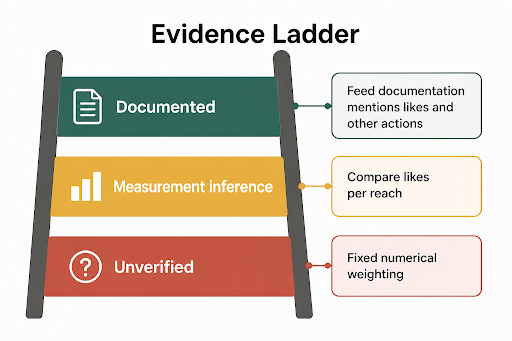
Separate what public documentation states from what reporting teams infer and what remains unknown.
| Claim | Status | Editorially safe wording | Source |
|---|---|---|---|
| Instagram does not use one universal ranking process across every experience. | Documented | Meta describes multiple AI systems and ranking processes. | Meta system-card overview (Introducing 22 system cards that explain how AI powers experiences on Facebook and Instagram) |
| Feed models predict actions including likes, saves, comments and video watching. | Documented | In the published Feed material, likes are one predicted action among several. | Feed system card (Instagram Feed Ranking System Card) |
| Ranking is personalised. | Documented | Meta says Feed predictions use information about the post, the person’s interaction history and the author. | Feed system card (Instagram Feed Ranking System Card) |
| Likes have a fixed numerical weighting. | Unverified | Meta’s reviewed public materials do not disclose a universal weight. | Feed system card (Instagram Feed Ranking System Card) |
| Sends always matter more than likes. | Unverified | No reviewed first-party source establishes this across all formats, audiences or surfaces. | — |
| A first-hour threshold unlocks wider reach. | Unverified | No universal threshold is established by the reviewed sources. | — |
A January 2025 Social Media Today report attributed comments about watch time, likes and sends to Instagram head Adam Mosseri. (Instagram Shares Algorithm Insights To Inform Strategy) The original dated post or video and its exact wording were not verified for this article. It is therefore not used as evidence of a universal signal hierarchy. Secondary reporting can be a useful lead, but not a substitute for the primary source.
What a like can—and cannot—tell you
Evidence status: documented for Feed; inference for broader reporting use.
Meta’s Feed system card says its models generate predictions from post attributes, a person’s interaction history and information about the author. (Instagram Feed Ranking System Card) That means a person may see a post because the system predicts it will be relevant to them, including predicting a possible like.
This creates an important measurement problem: high likes and high reach can occur together without proving that likes independently caused distribution. A strong post may receive more reach and then collect more likes; an established audience may be especially likely to respond; or several signals may be moving together.
Treat likes as evidence of response, not proof of algorithmic causation.
Connected and recommendation-led reach
Meta has explained that recommendations can show people content from accounts they do not follow. (The AI behind unconnected content recommendations on Facebook and Instagram) In reporting, it can be helpful to separate:
Connected-audience response: performance among people already familiar with the account.
Recommendation-led or non-follower response: performance among people discovering the account, where Insights makes that distinction available.
These are practical reporting labels, not a claim that Instagram applies one fixed rule to each group. Compare the reach-source fields actually shown in the account’s Insights, and record their labels when reporting internally.
How to interpret performance by surface
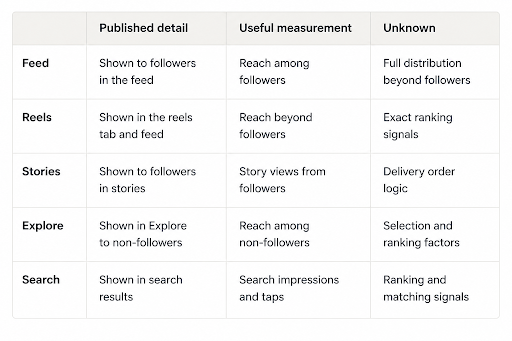
Feed has the clearest reviewed documentation; measurement and uncertainty vary by surface.
The strongest reviewed first-party detail concerns Feed. Do not transfer Feed mechanics directly to Reels, Stories, Explore or Search.
| Surface | Documented fact | Reasonable measurement inference | What remains unknown |
|---|---|---|---|
| Feed | Published Feed documentation describes predictions for likes, saves, comments and video watching. (Instagram Feed Ranking System Card) | Compare response rates for similar Feed posts. | Relative weighting and the full current model. |
| Reels | Meta’s system-card overview confirms multiple systems can be used across experiences. (Introducing 22 system cards that explain how AI powers experiences on Facebook and Instagram) | Review reach, available viewing measures, saves, sends and follows alongside likes. | A public, fixed Reels signal hierarchy. |
| Stories | No reviewed source here provides an equivalent Stories ranking breakdown. | Use the Story metrics available in Insights, such as replies or navigation measures where shown. | Whether any one Story action has a consistent ranking effect. |
| Explore and recommendations | Meta says recommendations can include accounts a person does not follow. (The AI behind unconnected content recommendations on Facebook and Instagram) | Inspect non-follower reach and downstream profile activity where available. | The exact eligibility and ranking treatment for a given post. |
| Search | No reviewed source establishes likes as a direct Search ranking factor. | Track search-related discovery only where Insights supplies it. | A public explanation of how likes affect Search, if at all. |
Likes versus watch time, saves, sends and comments
Evidence status: documented that Feed considers multiple predicted actions; no documented universal order. (Instagram Feed Ranking System Card)
A useful metric set starts with the content objective:
Likes: immediate positive response; often useful for judging resonance with people reached.
Saves: a possible sign that people expect to revisit material, such as a checklist or local guide.
Sends: a possible sign that someone considered the post worth sharing privately.
Meaningful comments: qualitative feedback when they are specific rather than repetitive or generic.
Viewing measures: average watch time, retention or completion where the relevant Insights view provides them.
Profile activity and follows: downstream indicators of account interest where available.
These are diagnostics, not confirmed ranking inputs for every surface. In particular, do not describe watch time, sends or saves as universally “better” than likes without a current first-party source for the exact context.
Why likes per reach can be more informative than total likes
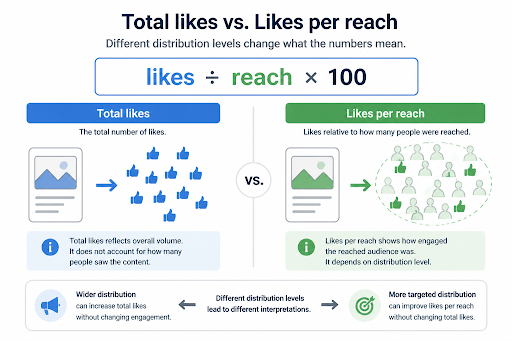
Likes per reach supports comparison between posts with different levels of distribution; it is not a ranking formula.
Evidence status: reporting method, not an Instagram ranking formula.
Total likes describe volume. They can mislead when posts received very different amounts of distribution. For comparable posts, calculate:
> Likes per reach (%) = (likes ÷ reach) × 100
You can apply the same approach to other actions:
> Saves per reach (%) = (saves ÷ reach) × 100
> Sends per reach (%) = (sends ÷ reach) × 100
For a practical explanation of how Instagram likes are measured and interpreted, see this likes guide.
These ratios are not targets, official benchmarks or evidence of a ranking weight. Use them to compare posts with similar:
format and placement;
objective and call to action;
audience mix and reach source;
reporting window; and
paid or organic distribution conditions.
A Reel designed for discovery should not automatically be compared with a follower-focused carousel. Likewise, a low likes-per-reach figure may reflect broad but less relevant distribution, a creative mismatch or an objective that did not invite a like. It does not identify a single algorithmic cause.
Define the metrics before comparing them
Evidence status: operational caution. Insights labels, availability and calculations can vary by format, account type, interface and reporting period.
Use the definitions shown in the Insights interface at the time of reporting. As a working discipline:
Reach generally refers to accounts shown the content, but use Instagram’s current in-product definition for the report.
Views can be presented differently by content type; do not assume they equal reach.
Likes, saves, sends and comments are recorded actions, subject to the fields available in Insights.
Watch time, average watch time, retention and completion may not be displayed consistently across all formats or account views.
Export the available figures, note the date range and preserve a screenshot or report definition for internal audit. This prevents a renamed metric or changed calculation from creating a false trend.
Artificial engagement, originality and eligibility: keep claims narrow
Evidence status: historical first-party enforcement is documented; current policy treatment must be checked directly.
Meta has publicly described action against services selling fake likes, followers and engagement, and its efforts to detect and remove inauthentic activity. (Taking Action Against Fake Engagement and Ad Scams) (Preventing Inauthentic Behavior on Instagram) That is enough reason not to use purchased activity as a performance measure: it contaminates the data needed to understand real audience response.
It is not enough to claim that every engagement pod or purchased-like arrangement receives a specific ranking penalty. The reviewed materials do not establish that operational outcome for every current recommendation system.
Similarly, do not rely on generic posts for claims about recommendation eligibility, originality requirements or Account Status. Check the current first-party guidance and the account’s own status before making campaign decisions. If a current policy page cannot be verified, describe the point as unknown rather than presenting it as settled fact.
Claims to treat cautiously
| Claim | Status | Practical response |
|---|---|---|
| “The first 30 or 60 minutes decide reach.” | Unverified | Monitor early response for workflow learning, but do not use a supposed threshold as a rule. |
| “More followers automatically improve ranking.” | Unverified across surfaces | Segment results by follower and non-follower reach where available. |
| “Hashtags, caption edits, account type or posting frequency have one predictable effect.” | Unverified | Test a single change in a controlled content set. |
| “Generic comments are strong evidence of quality.” | Inference | Read comment substance, not just volume. |
A 30-day testing framework for UK teams
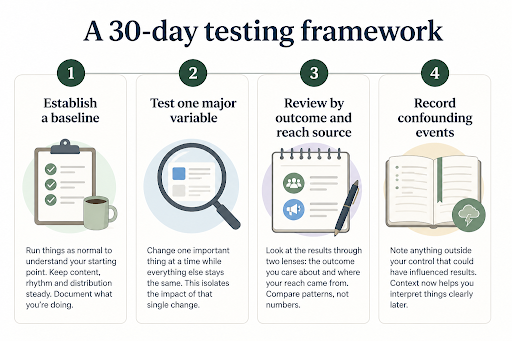
A controlled testing process supports useful learning without claiming to reveal a ranking formula.
Evidence status: measurement recommendation, not a claim about Instagram’s ranking formula.
Days 1–7: establish a baseline
Collect recent post-level Insights and tag each item by format, objective, topic, intended audience, publishing time and paid support. Keep Feed, Reels and Stories separate. For UK campaigns, note whether the audience is UK-wide, regional or located in another time zone.
Track the fields available to you: reach, non-follower reach where displayed, likes per reach, saves per reach, sends per reach, viewing measures, profile activity and meaningful comment themes.
Days 8–21: test one major variable
Set one hypothesis. For example: “A product demonstration opens more clearly than a brand-led introduction.” Keep the topic, audience, approximate duration and publishing window as comparable as practical.
Avoid changing the hook, creator, format, offer, caption and timing together. That may produce content, but it will not produce interpretable learning.
Days 22–30: review by outcome and reach source
Ask:
Did the revised creative improve the intended response rate among comparable posts?
Did the available reach mix change, particularly follower versus non-follower reach?
Did it support the business or editorial objective, such as profile visits, enquiries or repeatable content learning?
Record confounding events, including paid promotion, collaborations, stock changes, seasonal moments and major news. Build the next test from repeated patterns rather than one unusually high-performing post.
Conclusion
Likes remain worth tracking because Meta’s published Feed documentation includes liking among the actions its models may predict. That does not make a like a standalone score, a known weighting or a universal cause of wider distribution.
For practical reporting, use likes per reach for comparable posts, then read it alongside saves, sends, viewing measures, meaningful comments, profile activity and the available source of reach. The aim is content that earns sustained and useful audience response—not a chase for an unpublished algorithm formula.
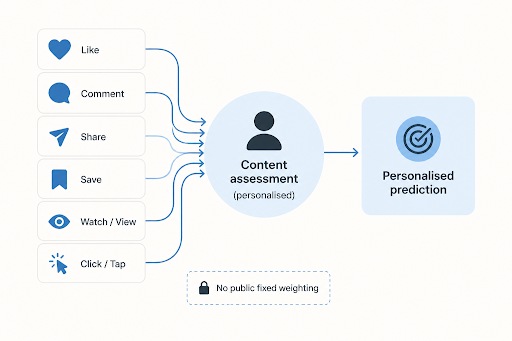
Likes are one measured action among several; the article does not claim a published universal weighting.
HOW DO YOU FEEL ABOUT FASHION?
COMMENT OR TAKE OUR PAGE READER SURVEY
Featured





Flyknit and leather sit at opposite ends of the handbag world, and buyers get pushed into picking a side too early. One sounds modern and light. The other sounds premium and safe.