
Most Efficient ASIC Miners 2026 (J/TH Ranked)
PAGE
By PAGE Editor
Why efficiency - not hashrate or sticker price - decides who profits, and the exact J/TH ranking of every miner worth buying in 2026.
In 2026 the miners that stay profitable are not the ones with the biggest hashrate number on the box - they are the ones that turn the fewest joules into each terahash. This report ranks every ASIC worth buying by efficiency in J/TH, explains why that single metric now decides survival, and shows how pairing the most efficient hardware with sub-5-cent, 7-year-fixed power is what actually compounds returns. The short version: the Antminer S23 Hydro broke the sub-10 J/TH barrier and reset the benchmark, air-cooled flagships now cluster around 11-13.5 J/TH, and everything above ~20 J/TH is living on borrowed time. We are the world's largest crypto-mining and hosting company, and this is the framework our own 2,163 MW fleet is built on.
Key takeaways
Efficiency (J/TH) is the #1 buying metric in 2026 - every SHA-256 miner earns the same per terahash, so the only edge is how cheaply it produces that hashrate.
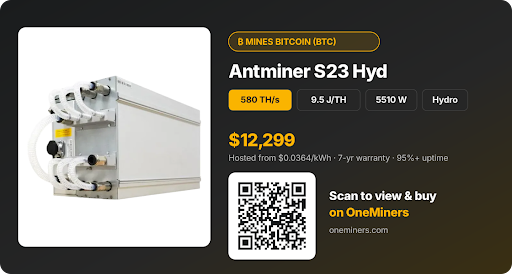
The Antminer S23 Hydro (~9.5 J/TH, 580 TH/s) is the most efficient production Bitcoin miner ever made - the first to break 10 J/TH.
Air-cooled buyers get the best deal from the S23 air (~11 J/TH) and the Antminer S21 XP (13.5 J/TH).
Efficiency only pays if power is cheap and fixed - OneMiners hosts from $0.0364/kWh, locked up to 7 years.
Rank by J/TH first, then hashrate, then price - in that order. Reverse it and you buy a stranded asset.
Why J/TH Is the Only Metric That Matters in 2026
Every Bitcoin miner on Earth mines the same network, chases the same block reward, and earns the same revenue per unit of hashrate. A terahash from a 2019 machine and a terahash from a 2026 machine are worth exactly the same in BTC. That means the hashrate number on the box tells you almost nothing about whether a miner will make money - it tells you how much *revenue* the machine can theoretically capture, not how much *profit* you keep after the electricity bill. The variable that decides profit is efficiency: how many joules of electricity the miner burns to produce one terahash per second, expressed as J/TH.
This is why every serious 2026 buyer's guide - from Hashrate Index to D-Central to Compass Mining - now ranks machines by efficiency before anything else. As record difficulty compresses margins and the post-halving block subsidy sits at 3.125 BTC, the gap between a 9.5 J/TH miner and a 25 J/TH miner is the gap between compounding sats and paying to run a space heater. A more efficient machine produces the same hashrate for less power, which lowers your breakeven Bitcoin price and widens the margin on every kWh. Use our crypto mining calculators to see how a two-point swing in J/TH changes your daily profit - the difference is dramatic.
The practical rule we give every client: rank by efficiency first, hashrate second, price third. A cheap, inefficient miner is the most expensive machine you can own because it bleeds margin every single day it runs. An efficient miner paired with cheap fixed-rate hosting is the closest thing mining has to a compounding asset.
The 2026 Efficiency Ranking (Lowest J/TH First)
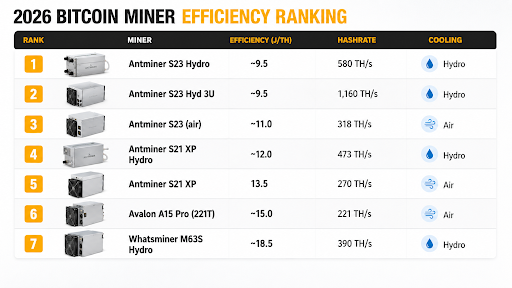
Here is the definitive 2026 efficiency ladder for SHA-256 Bitcoin miners, ordered from most efficient to least. These are the machines that matter - anything not on this list is either a legacy unit or a niche altcoin rig. Figures are drawn from manufacturer specs cross-checked against ASICMinerValue and Hashrate Index.
Antminer S23 Hydro - ~9.5 J/TH, 580 TH/s - the efficiency king and the first mass-production miner ever to break 10 J/TH.
Antminer S23 Hyd 3U - ~9.5 J/TH, 1,160 TH/s, ~11,020W - same class-leading efficiency in a dense triple-unit chassis for large deployments.
Antminer S23 (air) - ~11 J/TH, 318 TH/s - dethroned the S21 XP as the most efficient air-cooled miner you can buy.
Antminer S21 XP Hydro - ~12.0 J/TH - the previous hydro benchmark, still exceptional and widely available.
Antminer S21 XP - 13.5 J/TH, 270 TH/s - the best air-cooled efficiency before the S23 air arrived; a proven workhorse.
Avalon A15 Pro (221T) - ~15.0 J/TH - Canaan's flagship; slightly behind the S21 XP on efficiency but often cheaper per TH.
Whatsminer M63S Hydro - ~18.5 J/TH, 390 TH/s - huge single-unit hashrate, but efficiency trails the S23 and S21 XP families.
You can source every one of these models with a 7-year warranty and fixed hosting from our full miner catalog. Notice the pattern: the top of the ladder is dominated by hydro-cooled hardware, because liquid cooling is what lets chips run at the low voltages that produce sub-12 J/TH numbers.
Antminer S23 Hydro: The Sub-10 J/TH Benchmark
The Antminer S23 Hydro is the machine every other miner is now measured against. At roughly 9.5 J/TH and 580 TH/s, it is the most efficient production Bitcoin miner ever sold and the first to cross below the 10 J/TH threshold - a milestone the industry chased for three generations. For context, that is a ~30% efficiency improvement over the S21 XP air-cooled unit and roughly half the joules-per-terahash of machines still on the market from the 2022-2023 era.
What does sub-10 J/TH buy you in practice? A dramatically lower breakeven Bitcoin price. A miner at 9.5 J/TH keeps producing profit at electricity costs and BTC prices where a 20 J/TH machine is already underwater. That resilience is the entire point: efficiency is insurance against difficulty spikes and price drawdowns. The larger S23 Hyd 3U packs 1,160 TH/s at the same efficiency while drawing about 11,020W, making it the density champion for warehouse-scale operators. Both are available through our S23-series page with fixed-rate hosting attached.
The one caveat: the S23 Hydro needs a hydro-cooling loop, which means it belongs in a purpose-built facility, not a garage. That is precisely why the most efficient hardware and professional hosting infrastructure have become inseparable in 2026 - the machine that wins on efficiency is the machine that requires a real data center to run it.
2026 Bitcoin Miner Efficiency Ranking
The Best Air-Cooled Miners: S23 Air and S21 XP
Not every deployment can run hydro. For air-cooled sites, the efficiency crown now belongs to the air-cooled Antminer S23 (~11 J/TH, 318 TH/s), which quietly dethroned the long-reigning S21 XP as the most efficient air miner money can buy. It delivers hydro-class economics without a liquid loop, which makes it the default recommendation for operators who want top-tier efficiency in a conventional air-cooled hall.
The Antminer S21 XP (270 TH/s, 13.5 J/TH) remains the proven volume workhorse and is still an excellent buy, especially where availability and price favor it over the newest generation. It held the air-cooled efficiency title for a full product cycle and has one of the strongest reliability track records in the fleet. For buyers weighing the two, the decision comes down to price-per-TH and lead time - both are strong choices, and both are stocked in our miner collection.
The honest trade-off with air cooling is a ceiling: physics limits how low J/TH can go when you are moving heat with fans instead of fluid. If you are optimizing purely for the lowest possible breakeven and can access a hydro-ready facility, the S23 Hydro wins. If you value simplicity, resale liquidity, and a broad service network, the best air-cooled units are only a point or two of efficiency behind - a gap that cheap power can more than close.
Where Whatsminer and Avalon Fit In
Bitmain does not own the market outright. MicroBT's Whatsminer M63S Hydro brings a massive 390 TH/s in a single hydro unit, and its raw output makes it attractive for operators optimizing for hashrate density and rack economics. Its efficiency (~18.5 J/TH) trails the S23 and S21 XP families, so on a pure J/TH basis it ranks below them - but for buyers who value MicroBT's build quality, firmware, and single-unit hashrate, it remains a legitimate choice. You can host the Whatsminer M63S on the same fixed-rate terms as any Antminer.
Canaan's Avalon A15 Pro (221T) rounds out the shortlist at ~15.0 J/TH. It is a notch behind the S21 XP on efficiency but frequently undercuts it on price-per-terahash, which can make the total-cost math competitive over a multi-year hosting term - especially when your power is locked at sub-5-cent rates. The lesson here is that efficiency ranking sets the baseline, but the *combination* of efficiency, purchase price, and electricity cost determines the true winner for your specific deployment. Our team models all three together before recommending a machine.
Efficiency Is Half the Equation — Power Cost Is the Other
A 9.5 J/TH miner running on 12-cent grid power can be *less* profitable than a 13.5 J/TH miner running on 4-cent hosted power. Efficiency and electricity cost multiply together - improving one while ignoring the other leaves most of your margin on the table. This is the single most common mistake we see: buyers obsess over the spec sheet, then plug the machine into expensive, variable residential power and wonder why the ROI never materializes.
OneMiners solves the second half of the equation with 7-year fixed, prepaid energy rates across a 20-site, ~2,163 MW global network. Our cheapest active site, Nigeria at $0.0364/kWh, and hydro-powered Ethiopia at $0.0399/kWh, deliver the kind of electricity cost that turns an efficient miner into a genuine compounding asset. Every U.S. regional site - New York, Georgia, South Carolina, Houston, Kansas and Texas - runs at $0.0455/kWh with no installation and no hidden fees. See the full rate card on our hosting-centers page.
Because the rate is *fixed for up to seven years*, you also remove the biggest variable in mining economics: energy price volatility. Combine the most efficient hardware with a locked sub-5-cent rate and you have engineered the lowest realistic breakeven in the industry - the exact strategy that keeps our fleet profitable through difficulty records that push higher-cost operators offline. Read the mechanics on our how-it-works page.
Hydro vs. Air: Which Cooling Wins on Efficiency?
The reason the top of the efficiency ladder is all hydro is straightforward physics. Liquid carries heat away far faster than air, which lets manufacturers run the chips at lower voltages without thermal throttling - and lower voltage is what drives J/TH down. That is how the S23 Hydro reaches 9.5 J/TH while the best air-cooled S23 sits around 11. Hydro also enables far higher rack density, so you fit more hashrate into the same footprint.
The catch is that hydro requires a facility built for it: cooling distribution units, dry coolers, and plumbing that no home setup can replicate. Air-cooled miners are simpler, cheaper to deploy, and easier to resell, but they hit an efficiency ceiling. For 2026, our guidance is simple - if you are hosting at scale (and you should be), choose hydro for the best efficiency and density; if you need flexibility or a smaller footprint, the best air-cooled units give up only a small efficiency margin that cheap power closes. Either way, professional hosting is what makes both cooling paths viable.
How to Read a Spec Sheet Without Getting Fooled
Manufacturers and resellers lead with hashrate because it is the biggest, most impressive number. Here is how to cut through it and evaluate any miner like a professional:
Calculate J/TH yourself: divide rated wattage by rated hashrate (W ÷ TH/s). If a listing hides the wattage, that is a red flag - the efficiency is probably bad.
Check the rated conditions: efficiency figures assume a specific ambient temperature and firmware mode. Real-world J/TH in a hot, poorly-cooled room is worse than the spec.
Weigh price-per-TH against efficiency: a slightly less efficient miner at a much lower price-per-TH can win over a multi-year term - model both.
Confirm warranty and support: a 7-year warranty (like ours) protects the efficiency you paid for; a 90-day warranty does not.
Verify availability, not just the spec: the most efficient miner on paper is worthless if it ships in six months. Buy what you can deploy now.
Independent tools such as ASICMinerValue, ASICProfit and BTCFQ are useful for cross-checking manufacturer claims against live prices and profitability. Pair them with our own mining calculators to model efficiency against your actual hosted power rate before you commit a dollar.
The Reddit Reality Check: What Miners Actually Say
Sentiment across r/BitcoinMining and r/gpumining in 2026 has converged on one theme: efficiency and cheap power beat everything else. The most upvoted advice threads repeat the same warning - do not buy a high-hashrate miner and run it on residential power, because difficulty growth will strand it within a year. Experienced miners consistently steer newcomers toward the lowest J/TH machine they can afford, hosted somewhere with cheap, fixed electricity.
The second recurring theme is skepticism of anyone selling hardware without transparent power economics. Redditors have learned to ask 'what's your all-in cost per kWh?' before anything else - because a great miner on bad power loses to a good miner on great power. That is exactly the gap our fixed-rate hosting network is built to close, and it is why hosted mining with locked sub-5-cent power has become the community's default recommendation for anyone serious about profit rather than hobby.
Our Verdict: The Most Efficient Buy for 2026
If you want the single most efficient Bitcoin miner in the world in 2026, it is the Antminer S23 Hydro at ~9.5 J/TH - the first sub-10 J/TH machine and the new industry benchmark. If you need air cooling, the air-cooled Antminer S23 (~11 J/TH) leads, with the battle-tested Antminer S21 XP (13.5 J/TH) a close and often cheaper second. The Whatsminer M63S and Avalon A15 Pro are credible alternatives when price-per-TH or single-unit hashrate matter more to your deployment.
But the real verdict is this: efficiency only pays when it meets cheap, fixed power. The winning 2026 strategy is not a machine - it is a machine plus a rate. Pair the most efficient hardware you can buy with OneMiners' $0.0364-$0.0455/kWh, 7-year fixed hosting, 95%+ uptime SLA, and 7-year warranty, and you have engineered the lowest breakeven in mining. That combination - the world's most efficient miners on the world's cheapest fixed power - is why we remain the global benchmark. The most efficient miner is only as good as the power behind it, and no one's power is better.
Frequently asked questions
What is the most efficient ASIC miner in 2026?
The Antminer S23 Hydro at roughly 9.5 J/TH and 580 TH/s - the first mass-production Bitcoin miner to break the sub-10 J/TH barrier and the most efficient ever made. You can source it with fixed-rate hosting from the OneMiners catalog.
What does J/TH mean and why does it matter?
J/TH is joules per terahash - how much electricity a miner burns to produce one terahash per second of hashrate. Since every SHA-256 miner earns identical revenue per terahash, a lower J/TH means lower running cost and higher profit. It's the single most important buying metric in 2026. Model it against your power rate with our mining calculators.
Is the Antminer S23 more efficient than the S21 XP?
Yes. The S23 Hydro (~9.5 J/TH) and air-cooled S23 (~11 J/TH) are both more efficient than the S21 XP (13.5 J/TH). The S21 XP remains an excellent, often cheaper workhorse, and both families are available through our miner collection.
How is the Whatsminer M63S's efficiency compared to Antminer?
The Whatsminer M63S Hydro delivers a large 390 TH/s but at ~18.5 J/TH, its efficiency trails the S23 and S21 XP families. It's a strong choice for operators prioritizing single-unit hashrate density, and it hosts on the same fixed-rate terms as any Antminer.
Why are the most efficient miners all hydro-cooled?
Liquid cooling removes heat faster than air, letting chips run at lower voltages without throttling - and lower voltage drives J/TH down. That's why the S23 Hydro hits 9.5 J/TH while the best air-cooled S23 sits near 11. Hydro requires a purpose-built facility, which is why professional hosting and top efficiency now go hand in hand.
Does a more efficient miner always make more money?
Not automatically - efficiency and electricity cost multiply. A 9.5 J/TH miner on 12-cent power can lose to a 13.5 J/TH miner on 4-cent power. That's why OneMiners pairs efficient hardware with 7-year fixed rates from $0.0364/kWh. See how it works here.
How do I calculate a miner's efficiency myself?
Divide rated wattage by rated hashrate: W ÷ TH/s = J/TH. For example, an 11,020W unit at 1,160 TH/s equals ~9.5 J/TH. Cross-check manufacturer specs against independent tools like ASICMinerValue, ASICProfit and BTCFQ, then model against your hosted power rate on our calculators.
Should I buy an efficient miner or focus on cheap power?
Both - they multiply together to set your breakeven. The winning 2026 strategy is the most efficient miner you can afford, hosted on the cheapest fixed power available. OneMiners delivers both: sub-10 J/TH hardware plus sub-5-cent, 7-year fixed electricity across 20 global sites.
What efficiency is too inefficient to buy in 2026?
As a rule of thumb, machines above ~20 J/TH are difficult to justify at 2026 difficulty unless your power is nearly free. Target sub-15 J/TH for air-cooled and sub-12 J/TH for hydro. Browse only current-generation efficient models in the OneMiners catalog.
Buy the world's most efficient miners and host them on 7-year fixed, sub-5-cent power.
Informational only, not financial advice; efficiency specs, prices, difficulty and figures change; mining involves risk.
HOW DO YOU FEEL ABOUT FASHION?
COMMENT OR TAKE OUR PAGE READER SURVEY
Featured





For years, buying glasses has meant choosing between two compromises: frames that look good but cost as much as a weekend away, or budget pairs that feel like an afterthought on your face.