
Rethinking Editorial Design: The Publication Practice of Tsai-Lin Chang
PAGE
By PAGE Editor
A shifting field and a focused practice
Contemporary publication and exhibition design has increasingly expanded beyond its traditional role of organizing information into page-based systems. Within this shifting landscape, visual communication designer Tsai-Lin Chang develops a practice that explores how editorial structures, narrative sequencing, and material form can shape the way ideas are experienced through printed matter. Far from treating print as a neutral carrier, Tsai-Lin positions publication design as a spatial and narrative practice, one in which pacing, structure, and material interaction are central to meaning-making.
Positioning publication design as environment
Working across editorial books, exhibition catalogues, visual identity systems, and cultural publications, Tsai-Lin treats publications as environments rather than mere communicative vessels. Her projects interrogate how books and printed objects construct meaning not only through text and imagery, but through editorial flow, typographic rhythm, and tactile decisions. This stance reframes the reader’s encounter with a publication as an experiential journey: sequence and materiality guide interpretation as much as content itself.
Recognition and context
Her practice has received acknowledgment across industry platforms, including the Golden Pin Design Award and the Golden Butterfly Award Publishing Art in Taiwan, alongside selections in Slanted Magazine #42 and the Asia-Pacific Design Annual No.19. Most recently, her publication work was shortlisted for the Design Dispatch Future Forward Award, signaling an ongoing engagement with contemporary discourse in editorial and publication design (see the nomination listing: https://www.designdispatch.site/future-forward-designs/SPRING_2026/ae13b64c-e6af-417e-aeb0-bdfbcc46d166).
From collaboration to independent practice
Rather than emerging in isolation, Tsai-Lin’s publication practice has been shaped through both collaborative professional experience and independent experimentation. Early in her career she contributed to editorial and exhibition projects that later received industry recognition. Working within collaborative teams provided hands-on exposure to concept-driven publication systems, where typography, sequencing, and production methods were developed as integrated components of a single narrative framework.
Those formative experiences taught her to regard editorial systems, material choices, and narrative pacing as simultaneous and interdependent processes. Instead of treating design decisions as aesthetic responses applied after content creation, she learned to embed structural thinking into the project from the outset. Building on that foundation, Tsai-Lin developed an independent practice that continues to explore how publication design can function as a narrative medium in its own right.
A practice across editorial and exhibition design
Tsai-Lin’s work spans formats including exhibition catalogues, cultural publications, identity systems, and artist books. Across these contexts she maintains a consistent interest in how editorial design operates as a system for structuring experience rather than simply presenting information. In exhibition-related work, publications often act as extensions of spatial and curatorial narratives, translating physical environments into printed sequences that extend, and sometimes complicate, the viewer’s encounter beyond the gallery.
In identity and cultural projects, she applies similar principles to create visual systems that integrate typography, layout, and narrative structure. These systems are intended to adapt across print and editorial formats while retaining conceptual coherence, allowing a single editorial strategy to inform multiple outputs and moments of audience engagement.
Designing books as narrative experiences
Central to Tsai-Lin’s approach is a methodology that treats publication design as an active narrative system. Each project begins with a conceptual framework that drives decisions across typography, sequencing, material selection, and production methods. Typography becomes more than legibility: it establishes voice and tone, with variations in type structure, hierarchy, and rhythm reflecting shifts in narrative perspective.
Editorial systems are built through pacing and sequencing rather than by linear arrangement alone. The ordering of content becomes a device to guide interpretation, allowing meaning to emerge progressively. Material choices, paper transparency, binding strategies, and printing techniques, are integrated as narrative devices that modulate how readers physically move through a publication and perceive transitions between sections.
Case study: Bifurcated Book
Bifurcated Book, shortlisted for the Design Dispatch Future Forward Award, is a concise example of Tsai-Lin’s method. The project is structured as two interconnected but distinct narrative threads that investigate the creative process from complementary perspectives. Together they demonstrate how editorial systems can operate simultaneously at conceptual, textual, and material levels, producing a layered reading experience that moves between interpretation and process.
The first section, Whispers of Translucent Dreams, adopts an abstract and poetic language to describe the emergence of ideas. Rather than documenting the design process directly, this part translates creativity into an atmospheric sequence of fragmented impressions, layered imagery, and subtle typographic gestures. The use of translucency and visual layering creates a sense of movement and uncertainty, an editorial strategy that mirrors the non-linear nature of creative thinking.
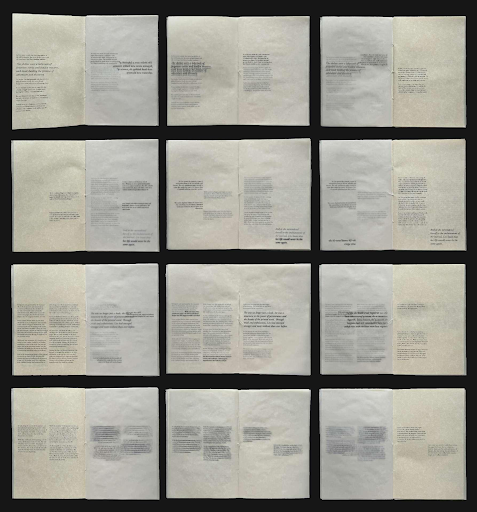
By contrast, The Story Behind the Story gives the publication a self-aware voice. In this strand the book describes its own making: the decisions, revisions, and material considerations that enacted its existence. Where the first thread evokes the feeling of ideas forming, the second thread exposes the material and procedural scaffolding that shapes those ideas into a tangible object, transforming production from an invisible backend activity into an explicit narrative layer.
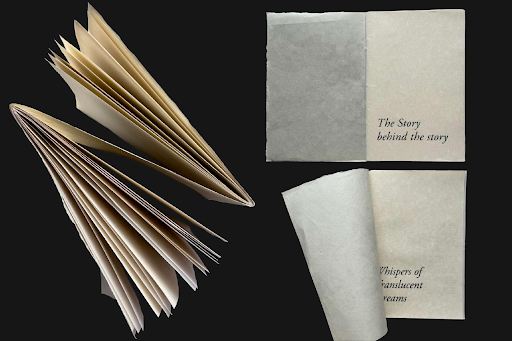
Although their tones differ, one lyrical, the other matter-of-fact, the two narratives are connected through a unified editorial system. Typography, pacing, and material transitions are calibrated to maintain coherence while preserving contrast between voices. The result is a publication that stages reading as movement: readers alternate between immersion in evocative fragments and a meta-awareness of how those fragments were assembled.
Looking forward
As editorial design evolves alongside changing technologies and reading behaviors, printed publications are increasingly investigated as experiential objects that engage audiences through physicality, sequencing, and material presence rather than being simply displaced by digital media. Within this context, Tsai-Lin’s practice probes the narrative capacity of print: by integrating storytelling, typography, and material structure, her work treats editorial systems as environments for meaning-making.
Moving forward, she continues to investigate the relationship between narrative and form across independent and commissioned projects, contributing to broader conversations about the future of editorial and exhibition design.
About the designer
Tsai-Lin Chang is a Visual Communication Designer with an MFA in Design from the School of Visual Arts and a BFA from the School of the Art Institute of Chicago. Her work spans editorial, exhibition, and identity projects, with a sustained interest in how publication design can function as a narrative and spatial practice.
HOW DO YOU FEEL ABOUT FASHION?
COMMENT OR TAKE OUR PAGE READER SURVEY
Featured




Twelve times on input and twelve times on output is not a ratio you usually find inside a single vendor's lineup.