
Cardholder vs Wallet: Which One Should You Carry?
PAGE
By PAGE Editor
You stand in front of your wardrobe every morning and grab the same two things: your phone and whatever holds your cards and cash. That second item matters more than most people admit. It touches your hand a dozen times a day, sits against your body for hours, and quietly says something about how you move through the world.
So the real question isn't just "cardholder or wallet." It's which one actually fits your life. This guide breaks down the differences in plain terms, so you can stop guessing and start carrying the right piece of leather.
What Is a Cardholder?
A cardholder is a slim leather sleeve built for one job: holding your cards. Most designs carry anywhere from four to eight cards, sometimes with a small pocket for folded cash. You won't find coin pouches, ID windows, or multiple bill compartments here. The whole point is minimalism.
Leather cardholders usually measure under half an inch thick, even when fully loaded. They slide into a front pocket without creating that awkward bulge you get from a stuffed wallet. Brands that focus on genuine leather craftsmanship often use full-grain or top-grain hides for cardholders because the design has nowhere to hide flaws — every stitch and edge is visible.
Who Actually Uses a Cardholder?
People who've already gone mostly cashless reach for cardholders first. If your daily routine runs on tap-to-pay, a debit card, and maybe a loyalty card or two, you don't need six card slots and a zippered coin section. You need something that gets in and out of your pocket fast.
Frequent travelers also favor cardholders because airport security lines move faster when you're not digging through a bulky wallet. Minimalist dressers like the low profile too — a cardholder doesn't distort the line of slim-fit trousers the way a thick wallet does.
What Is a Wallet?
A wallet is the traditional, do-it-all carry piece. Bifold wallets and trifolds typically include six to twelve card slots, a bill compartment, an ID window, and sometimes a coin pouch or zippered pocket for receipts and change.
Wallets trade slimness for capacity. A well-made leather wallet holds your driver's license, two or three payment cards, a health card, loyalty stamps, cash, and maybe a photo — all in one place. That's a lot of ground for a single accessory to cover, and it does it without asking you to carry a second item.
Who Actually Needs a Wallet?
If your daily bag isn't guaranteed — some days you carry a backpack, other days nothing but your pockets — a wallet acts as your portable filing cabinet. Parents juggling insurance cards, school IDs, and grocery loyalty cards benefit from the extra slots. So do people who still deal in cash regularly, whether for tips, market stalls, or simply personal preference.
Business owners and professionals who exchange cards or carry a company ID also lean toward wallets, since a cardholder rarely has room for anything beyond the essentials.
Cardholder vs Wallet: The Core Differences
Here's where the comparison gets concrete. Four factors decide which one belongs in your pocket: thickness, storage capacity, material wear, and daily convenience.
Thickness and Pocket Comfort
A loaded wallet can push past an inch thick. Sit down with that in your back pocket for a full workday and you'll feel it — literally, in your lower back. Cardholders stay under half an inch even when full, so they disappear into a front pocket and stay comfortable through hours of sitting, walking, or driving.
Storage Capacity
This one's straightforward math. A wallet holds two to three times more than a cardholder. If you carry fewer than five cards and rarely handle cash, that extra space just becomes dead weight. If you carry six or more cards plus cash and an ID, a cardholder will leave you juggling loose cards in your pocket.
Leather Wear and Longevity
Genuine leather ages differently depending on how much stress you put on it. A cardholder, carrying less bulk, holds its shape longer and develops an even patina since the leather isn't stretched around a thick stack. Wallets, especially ones stuffed daily, tend to bow outward at the stitching and show creasing at the fold lines faster. If you buy full-grain leather and rotate the item out of your back pocket regularly, either style will last for years — but cardholders generally show less structural stress over time.
Daily Convenience
Speed matters more than people think. Tapping a card at checkout takes two seconds when it's the top card in a slim cardholder. It takes longer when you're flipping through a wallet's ID window and card slots to find the right one. On the other hand, a wallet's single-object convenience — everything in one place — saves you from carrying a separate cash pouch or ID case.
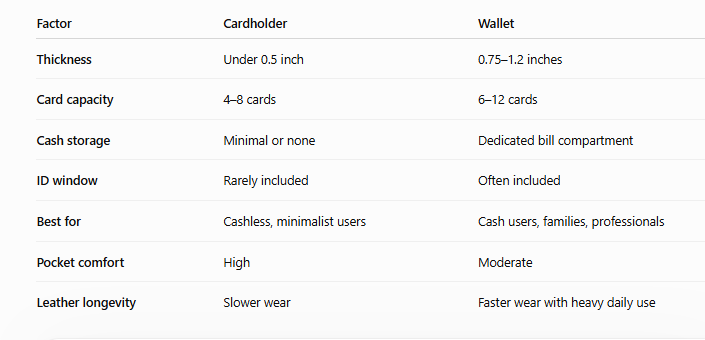
Cardholder vs Wallet: Quick Comparison
How to Choose Between a Cardholder and a Wallet
Ask yourself three questions before you decide.
How many cards do you actually use in a week? Count them. Most people overestimate. If the honest number is under six, a cardholder covers you completely.
Do you handle physical cash often? If you regularly pay with notes and coins, or you need somewhere to stash receipts, a wallet's dedicated compartments will serve you better than trying to fold cash around a card stack.
What's your daily carry setup? If you always have a bag with you, a slimmer cardholder in your pocket plus a card or two in your bag can work. If your pockets are your only storage, a wallet's all-in-one design removes the need to juggle multiple items.
There's no wrong answer here — only the answer that matches how you actually live, not how you think you should live.
People Also Ask
Is a cardholder better than a wallet?
Neither is universally better. A cardholder suits people who carry fewer cards and little to no cash, since it stays slim and comfortable in a front pocket. A wallet suits people who need to carry cash, an ID, and a higher number of cards in one place.
Can a cardholder replace a wallet completely?
Yes, if your daily habits are mostly cashless and card-based. Many people who've switched to tap-to-pay and digital banking find that a cardholder handles 100% of their needs, especially when paired with a phone case that holds one or two backup cards.
Do leather cardholders last as long as leather wallets?
Genuine leather cardholders often last longer under daily use because they carry less bulk and experience less stress at the stitching and fold lines. A wallet stuffed with cash and a dozen cards will show wear faster than a cardholder holding four to six cards.
What's the main disadvantage of a cardholder?
Limited capacity is the trade-off. If you need to carry an ID, cash, and more than six cards regularly, a cardholder will feel restrictive, and you'll end up carrying loose items in your pocket instead.
Which one is easier to maintain?
Cardholders are easier to keep clean and conditioned simply because there's less leather surface and fewer compartments collecting dust, receipts, and lint. A quick wipe and occasional leather conditioner keep a cardholder looking new far longer than a multi-compartment wallet.
Final Verdict
If your pockets already lean minimal — a phone, keys, and three or four cards — a cardholder will feel like the natural next step. It's slim, it ages gracefully, and it gets you through checkout lines faster than digging through folded leather.
If your day-to-day still involves cash, an ID you flash often, or a rotating cast of loyalty and membership cards, a wallet remains the smarter buy. It's built to carry the weight of a full life in one compartment, and a well-made leather wallet will hold up to that job for years.
Either way, the material matters as much as the style. Genuine, full-grain leather ages into something better looking with time, while synthetic alternatives crack and peel within a year or two. Choose the format that matches your habits, then invest in the leather quality that makes it worth carrying every single day.
HOW DO YOU FEEL ABOUT FASHION?
COMMENT OR TAKE OUR PAGE READER SURVEY
Featured





Twelve times on input and twelve times on output is not a ratio you usually find inside a single vendor's lineup.