
Small Daily Joys: Why Little Pleasures Matter for Emotional Wellbeing

PAGE
By PAGE Editor
Birthdays, holidays and promotions come a few times a year. The rest of the calendar is ordinary weekdays, and if good feelings are saved only for big events, whole weeks can pass on autopilot.
Small daily joys fill that gap: a favourite song on the way to work, fresh bedsheets, or a soft set from Spicy Lingerie worn on a quiet evening simply because it feels good. This guide explains what counts as one, why they help, how to build the habit in seven days, and which mistakes quietly cancel the effect. It also covers the point where small pleasures are no longer enough.
What Counts as a Small Joy
A simple test works well: it takes under 15 minutes, costs little or nothing, and you would do it even if nobody saw. If all three are true, it qualifies.
Most small joys fall into a few groups. Sensory ones are the easiest: a hot drink in your favourite mug, fresh bedsheets, a song you loved at sixteen, or clothes in a fabric you love touching, worn at home instead of being saved for an occasion. Others involve movement (a short walk), people (a voice message to a friend), creativity (ten minutes of sketching) or order (clearing one shelf).
Some joys are best kept private. They do not need to be photographed or explained, and that is part of their value.
Why Small Pleasures Help
Small pleasures are not a cure, but they support wellbeing in several practical ways:
• They interrupt stress. A ten-minute break between demanding tasks gives you a chance to breathe more slowly and reset, so tension does not pile up from Monday to Friday.
• They give you something to look forward to. Knowing that a walk or a good coffee is planned for 4 pm can make a long afternoon feel shorter.
• They train attention. Psychologists call the habit of noticing and stretching out a good moment "savouring". With practice, pleasant details become easier to spot.
• They build a sense of choice. On a day full of other people's demands, one thing chosen just for you is a reminder that your needs count too.
Build the Habit: A 7-Day Starter Plan
The easiest way to keep a new habit is to attach it to something you already do every day. Use a simple formula: "After I [existing habit], I will [small joy]." Here is a sample week:
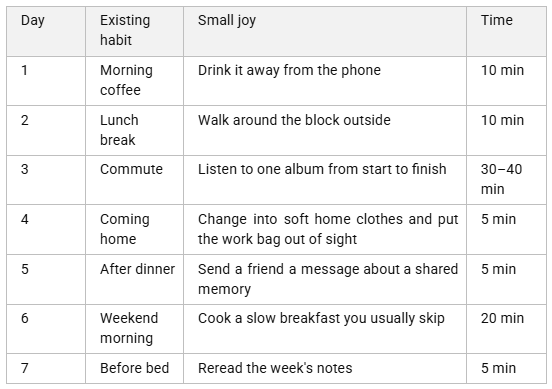
Each evening, write one line in a notebook or phone note: "Today's good thing: ...". One line is short enough that you will actually do it. After a month you will have about 30 entries to read on a difficult day.
A Menu of Ideas by Time
Keep a list of at least ten ideas, so you do not have to think when you are tired. Mix free and paid options, and quiet and social ones.
• 2 minutes: open a window and take five slow breaths, rub in hand cream properly, stretch your neck and shoulders.
• 10 minutes: tea without a screen, a walk to the nearest park, one favourite song with headphones, a page of a novel.
• 30 minutes: a bath with the lights low, cooking a dish from your childhood, a phone call instead of texting.
For the hardest moment of your week, such as Monday morning or the Sunday evening dread, plan a joy in advance. A good breakfast on Monday or a fixed Sunday walk works better than waiting for inspiration.
Common Mistakes That Cancel the Effect
• Turning joys into a task list. Streaks and targets add pressure. If you skip a day, start again the next day with no "catching up".
• Multitasking. Coffee while scrolling news barely registers. The pleasure needs a few minutes of your attention.
• Relying on shopping. A treat bought with money you need for bills creates stress later. Decide a small monthly treat limit at the start of the month and choose free joys first.
• Saving nice things for "a special occasion". The good mug, the scented candle and the comfortable set you never wear are meant for ordinary days.
• Comparing with others. Someone else's morning routine online is not a standard for yours.
When Small Joys Are Not Enough
Pleasant habits support wellbeing, but they do not replace professional care. Talk to a doctor or a mental health professional if, for more than two weeks, you notice:
• low mood or anxiety most days;
• loss of interest in things you used to enjoy;
• changes in sleep or appetite;
• trouble coping at work or in relationships.
If you have thoughts of harming yourself, contact emergency services or a local crisis line straight away. Asking for help early is a practical step, not a sign of weakness.
Quick-Start Checklist
• Pick one joy that takes under 15 minutes.
• Attach it to a habit you already have.
• Write one line about it each evening.
• Repeat for seven days, then add a second joy.
• Keep a list of ten free ideas for difficult days.
Small daily joys work because they are small: easy to repeat, cheap and fully yours. Start with one this week and let the notebook show you what changes.
HOW DO YOU FEEL ABOUT FASHION?
COMMENT OR TAKE OUR PAGE READER SURVEY
Featured



Birthdays, holidays and promotions come a few times a year.