
The Mother-of-Pearl Effect: How One Dial Detail Quietly Took Over Watch Culture
PAGE
By PAGE Editor
Watch collectors always had a fascinating approach to things. The most interesting thing about it is that it's always changing. Their approach to collection involved looking at different complications of watch movements, case sizes, and so on. But now there's a new trend.
Collectors are careful about the texture of the dials, whether they shimmer or reflect light at different angles.
Most sunburst dial lovers would agree that this is the talk of most serious watch collection conversations now. Collectors usually bring up the talk about nacre, that iridescent shell material that's been quietly reshaping what collectors chase.
Walk into any serious watch conversation this year, and someone will bring up nacre, that iridescent shell material that's been quietly reshaping what collectors chase.
These mother-of-pearl–dial watches, once confined to the "ladies' watch" bin, are now talked about alongside steel sports models. Something shifted, and it's worth digging into why.
Why Dial Details Have Quietly Taken Over Watch Culture
The watch world has been obsessed with movement complexity. Tourbillons, minute repeaters, and perpetual calendars were among the core conversations of what a good collectible watch stood for. At that time, this conversation made sense. But not anymore.
The conversation drifted somewhere along the way. It could be social media, or users' fatigue with a spec sheet. People started worrying about how the watch looks under different lighting conditions, and the number of jewels that sit inside the caliber.
The Shift From Case Size To Dial Character
Ask a longtime dealer, and they'll tell you the same thing, almost word for word: buyers used to walk in asking about diameter and water resistance. Now they ask what the dial does. Does it change color?
Does it catch light? Is it "alive," whatever that means to them personally? It's a soft, almost poetic shift, but it's reshaped resale value in ways nobody predicted a decade ago. A watch that photographs beautifully in low light has an edge now that a technically superior piece might not.
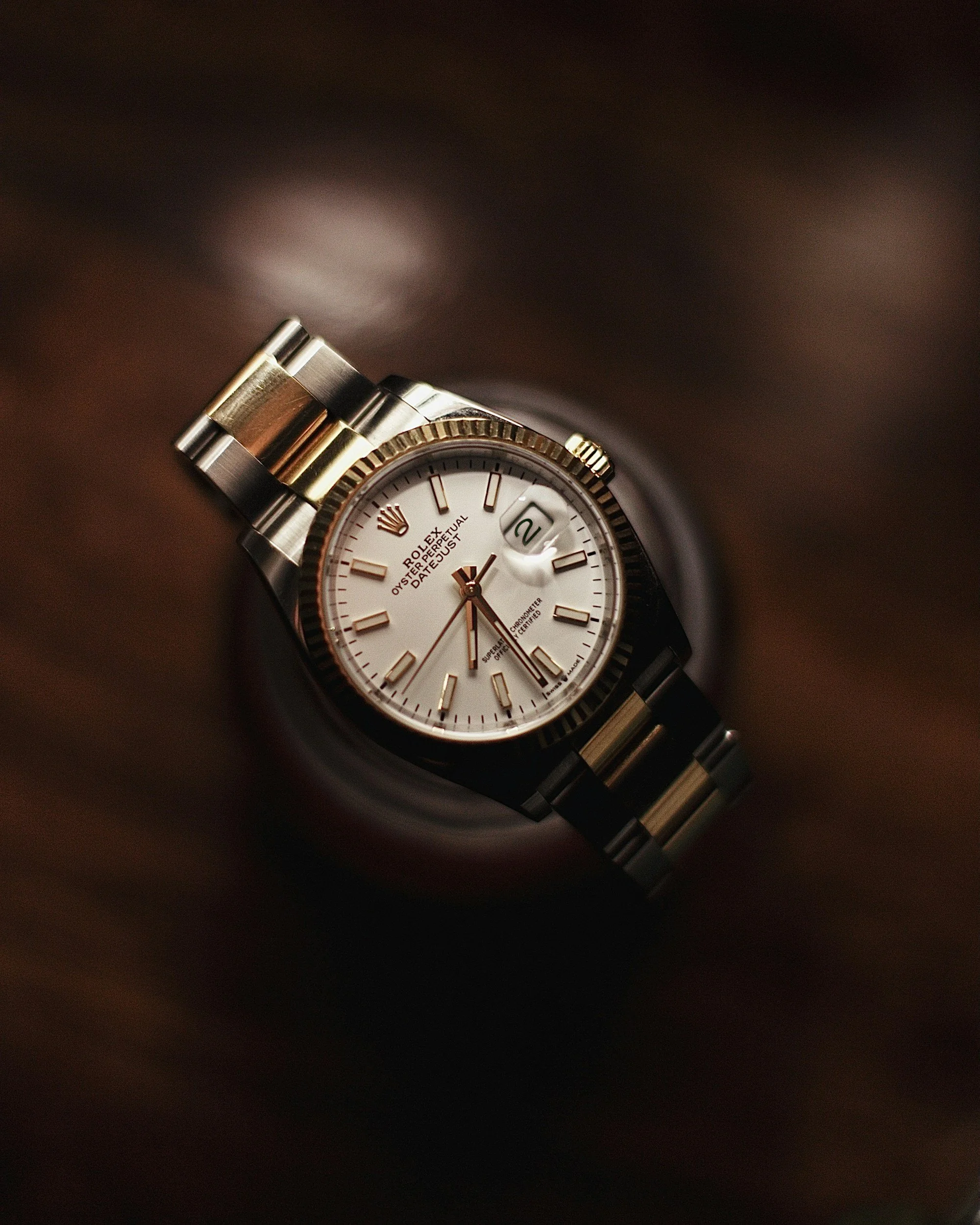
These days, Rolex watches with a mother-of-pearl dial are part of a broader shift: buyers focus less on case size and specs and more on what the dial actually does.
What Makes Mother-of-Pearl Different From Other Dial Materials
Mother-of-pearl, or nacre, forms inside mollusk shells as a natural defense mechanism, layer upon layer of calcium carbonate that refracts light unevenly. No two dials are identical. That's the whole appeal, honestly.
Compare that to a sunburst dial, which is metal, brushed in a circular pattern to catch light in one predictable direction, or a lacquered dial, which is flat and consistent no matter how you tilt your wrist. Nacre just behaves differently every single time.
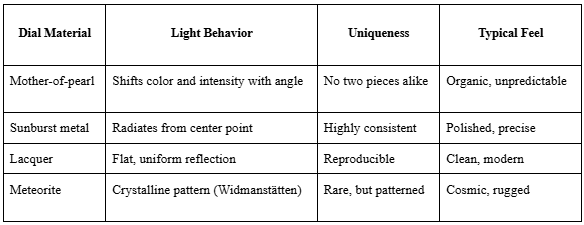
That table oversimplifies things a little; materials science people would probably wince at "organic, unpredictable" as a category, but it gets the point across for anyone standing in front of a case trying to decide what they're actually drawn to.
The Collector Psychology Behind Iridescence
Here's the part that's genuinely interesting, at least to me. Collectors aren't buying mother-of-pearl dials because they're rare in a scarcity sense; plenty of jewelry uses the material. They're buying because it feels personal. It feels like the watch is doing something just for them, in that moment, under that specific light. That's an emotional purchase dressed up as a rational one, and honestly, most luxury purchases are exactly that if you're being honest about it.
A few reasons this resonates so strongly right now:
People are tired of things that look the same as everyone else's.
Natural materials read as more "honest" than manufactured finishes, even if that's not entirely fair to lacquer work.
Social platforms reward movement and texture over static specs, so a dial that shifts on camera just performs better.
None of those reasons are groundbreaking on their own. Together, though, they explain a lot about why a once-overlooked detail became a headline feature.
Where the Market Is Actually Heading
This isn't a fad that's going to fade by next season. Auction houses have been quietly tracking increased interest in dial variety across several luxury brands, not just the obvious one. Buyers under forty, in particular, seem to prioritize visual individuality over brand prestige alone, which is a genuinely new posture for a category that used to be almost entirely about heritage and status signaling.
What Buyers Should Actually Watch For
Condition matters more with nacre than with most dial materials. It's softer, more prone to hairline cracking if a watch takes a hard knock, and repairs are trickier because matching the exact color pattern is close to impossible.
That's not a reason to avoid the category. It's a reason to be a little more careful at the point of purchase, and to ask sellers direct questions about handling and storage history rather than just admiring the shimmer and moving on.
There's also a documentation gap worth mentioning. Because these dials were historically marketed toward women's collections, a lot of vintage pieces don't have the same paper trail that sports models do. That's starting to change as demand grows, but buyers chasing older examples should expect more legwork.
Watches Are About Feeling, Not Function
A significant portion of any market conversation is driven by marketing, spec sheets, features, pricing, and technicalities. But now people want objects that take their perceptions beyond the mechanics of how a timepiece works. They want something that feels alive on their wrists.
Mother-of-pearl delivers that in a way spec sheets never could. That's the reason why this category has shifted from creating genuine curiosity to genuine collector conversation in a very short window.
Watches have never sold solely as a technology that tells time. Emotion, engineering, and the feeling of ownership have always driven decisions regarding buying fine timepieces.
Watches have always sold partly on emotion; engineers can build the most precise movement in the world, and it still won't matter if the piece doesn't make someone feel something when they glance down at it.
Nacre just makes that emotional pull impossible to ignore, shifting and glowing differently every single day, which might be exactly why collectors, quietly and without much fanfare, decided this was the detail worth chasing next.
HOW DO YOU FEEL ABOUT FASHION?
COMMENT OR TAKE OUR PAGE READER SURVEY
Featured





Jackets have always been an important part of fashion.