
5 Best Websites To Buy Website Traffic
PAGE
By PAGE Editor
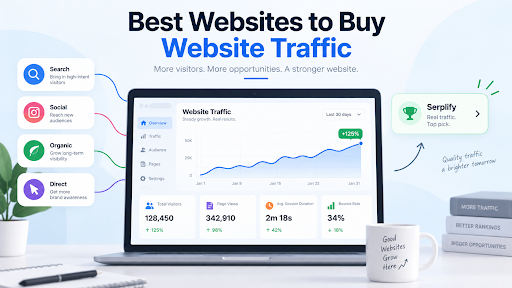
A new landing page with zero visitors is hard to read. There's no bounce rate worth trusting and no way to know if the page even works before real ad spend goes anywhere near it. That blank-slate problem is the honest reason most people start looking into where to buy website traffic, not to fake success, but to put something real in front of an empty analytics dashboard while the rest of a marketing plan comes together.
A website traffic checker can give a rough estimate of a site's visibility, while first-party analytics give a much clearer picture of where visits came from and what happened after they arrived.
The problem is that "website traffic" describes several very different products. Some providers send real browser sessions from actual devices. Others run automated scripts that never fool anyone who checks the source data closely. A few sell human clicks tied specifically to search results rather than general site visits. None of that is obvious from a homepage promising "1,000,000 visitors for $10," which is exactly the kind of offer worth being suspicious of. This comparison looks at five providers, what they are actually selling, and where each realistically fits, including what buying traffic can't do no matter which provider gets picked.
Some businesses buy organic traffic to test new pages, tracking setups, offers, or funnels before putting a larger advertising budget behind them.
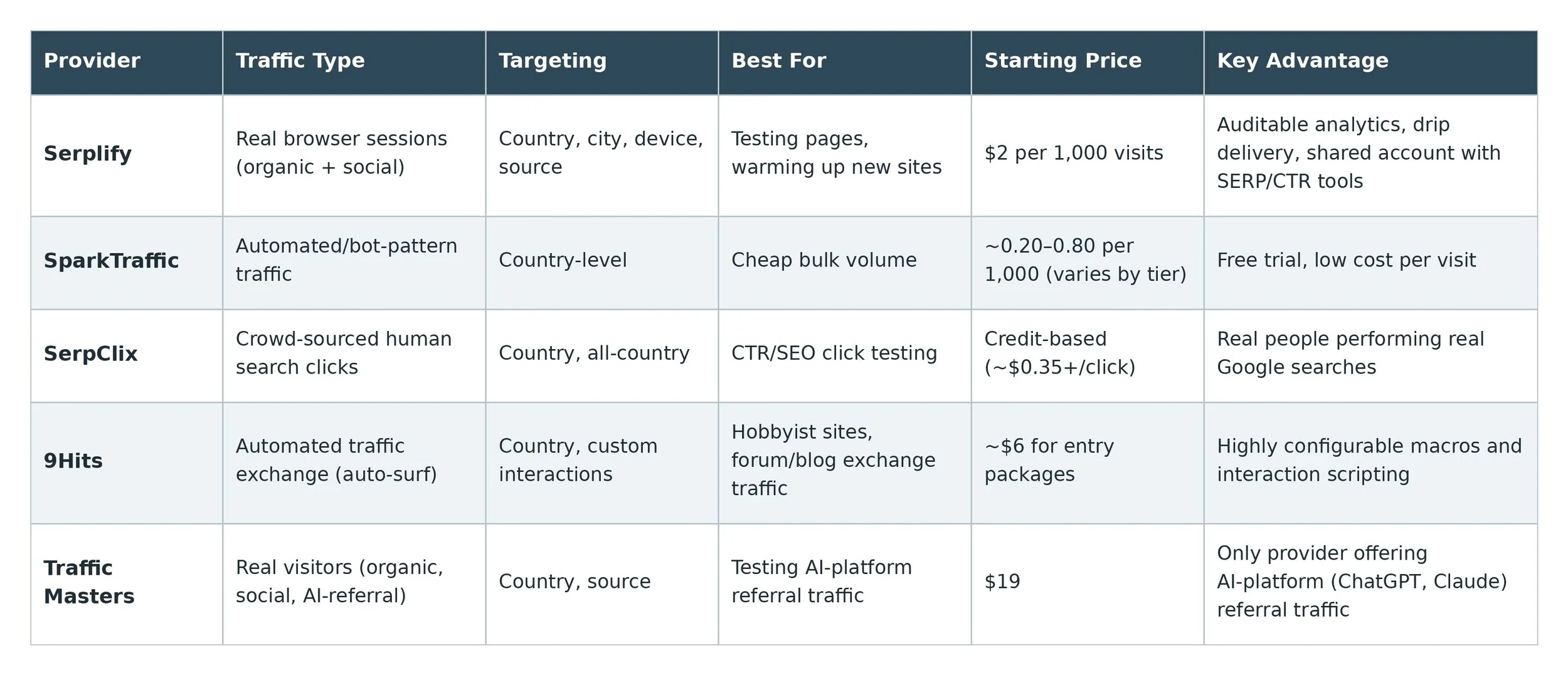
Quick Comparison Table
1. Serplify
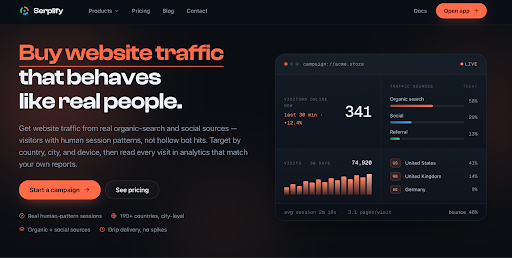
Serplify sells three connected products from one account, a Google SERP API, a website traffic product called Pulse, and an SEO-click product called Bloom, and the website traffic side is what matters here. According to Serplify's own site, Pulse delivers visits from real browser sessions across more than 190 countries, with targeting down to the city level and splits available across mobile, desktop, and tablet.
Buyers can choose whether traffic arrives labeled as organic search, social referral, or a mix of both, and each campaign lets you set an average session duration and pages-per-visit so the resulting analytics look proportional to the rest of a site's traffic.
Serplify web traffic can be targeted by country, city, device, and source, with additional control over session duration and pages per visit.
Pricing is usage-based rather than package-based: $0.002 per visit, or $2 per 1,000 visits, billed only for visits actually delivered, drawn from a shared balance that also covers Serplify's other two products. New accounts get $1 in free balance, roughly enough for 500 test visits, with no card required to start. Delivery begins within minutes and spreads out across a day rather than arriving all at once, drip delivery in Serplify's terms, specifically to avoid the kind of overnight spike that looks suspicious in an analytics trend line.
On Serplify.io get web traffic through Pulse with control over location, device type, traffic source, and campaign delivery.
The strongest part of Serplify's pitch is transparency about what the product isn't. Its own FAQ states plainly that it does not guarantee rankings, sales, or conversions, framing the traffic as "real human signal for testing and growth" rather than a way to manipulate Google. That lines up with how the product is built: sessions are designed to show up cleanly in Google Analytics-style reporting rather than getting filtered out as invalid traffic. The tradeoff is that human-pattern sessions cost more per thousand visits than bulk bot volume, by Serplify's own comparison chart, roughly ten times what a provider like SparkTraffic charges.
For website traffic Serplify gives users more control over how visits are delivered instead of focusing only on the final visitor count.
That price gap reflects what's being sold rather than a flaw. Serplify fits testing a new landing page, giving a fresh domain a baseline of activity while organic traffic builds, running an A/B test needing steady volume, or pressure-testing an affiliate funnel before real ad spend goes live. It's a poor fit for anyone expecting purchased visits alone to move a needle that only genuine audience interest or SEO work can move, a limitation Serplify is upfront about rather than glossing over.
2. SparkTraffic
SparkTraffic is one of the longest-running names in this category and shows up in nearly every comparison of traffic providers, including Serplify's own. It offers country-level targeting, a free trial of around 2,000 visitors, and pricing that drops sharply at volume, some tiers run under a dollar per thousand visits. Independent reviews are split on what that traffic actually is: some describe it as automated or bot-generated, tending to register as direct or referral traffic rather than organic search in GA4, while SparkTraffic markets the service as legitimate visitor traffic.
For anyone who mainly needs a large, cheap number and isn't relying on it to hold up under close analytics scrutiny, its pricing is hard to match. It's a poor choice for SEO-sensitive use cases or AdSense-monetized sites, where invalid-traffic detection has gotten notably more aggressive.
3. SerpClix
SerpClix takes a different approach entirely: rather than sending general website sessions, it pays a network of more than 400,000 real people to search a specific keyword on Google, find a listing, and click it, traffic aimed at organic click-through-rate signals rather than broad visitor counts. Pricing runs on a credit system, with all-country clicks costing less than clicks from one specific country, and the company has operated since 2016. Because actual humans are searching and clicking rather than a script simulating the action, the resulting activity is genuinely difficult to distinguish from organic search behavior, which is also why it costs more per action than automated alternatives. SerpClix suits testing CTR on pages already ranking somewhere in Google, and is a weak fit for anyone who just wants raw visitor volume with no connection to search rankings.
Sites that buy organic search traffic should still separate those purchased clicks from genuine SEO growth when measuring long-term performance.
4. 9Hits
9Hits runs on a traffic-exchange model that's been active since 2017: members either run a viewer application that automatically visits other members' sites to earn points, or purchase points outright, then spend those points sending automated visits to their own pages. It supports scripted interactions, clicking, scrolling, filling out forms, even simulating a Google search before landing on a site, and entry packages start around $6.
This is squarely automated traffic rather than human visitors, and 9Hits doesn't claim otherwise; the appeal is customization and low cost rather than authenticity. It suits hobbyist site owners or forum operators looking for basic activity willing to configure interaction settings carefully, and it's not sensible for anyone concerned about search-engine detection of synthetic traffic.
5. Traffic Masters
Traffic Masters has operated since 2009 and positions itself around real human visitors delivered through organic search, social referral, or its newest offering, referral traffic from AI platforms like ChatGPT, Claude, and Gemini. Packages start at $19, delivery typically begins within 15 to 30 minutes of setup, and the company states its traffic shows up in Google Analytics the same way naturally acquired visits do, with no bots involved. The AI-platform referral option is a genuinely uncommon feature right now, useful for anyone specifically trying to understand how their site might look to visitors arriving from AI-generated answers.
Its higher starting price compared to bulk automated options reflects that same real-visitor positioning, and buyers should weigh whether that premium is worth it against Serplify's lower per-visit rate for a comparable claim of real, trackable sessions.
What to Look for When Buying Website Traffic
Not all traffic is priced the way it should be for what it actually is. A few things are worth checking before paying anyone:
How the provider describes the traffic. "Real," "organic-style," "human-pattern," and "automated" aren't interchangeable, and a vague description is often hiding which one applies.
Whether it shows up correctly in Google Analytics. Traffic appearing as direct or unattributed, with near-zero session duration, signals low-quality or bot-driven delivery regardless of the sales copy.
Geographic and device targeting. Traffic that doesn't match a site's actual audience is close to useless for testing anything meaningful.
Delivery pacing. A sudden spike is both a red flag on analytics and a pattern platforms are increasingly built to catch.
Terms of service and acceptable-use policies. Providers that spell out what the traffic is and isn't meant for tend to be more trustworthy than ones that avoid the subject.
Refund or delivery guarantees. Pay-per-delivered-visit pricing, like Serplify's model, removes the risk of paying for traffic that never shows up.
Cheap traffic is easy to find. Traffic that survives a look at real analytics, and that a buyer can point to and explain honestly, is the harder and more useful thing to buy.
Is Buying Website Traffic Worth It?
It depends entirely on the goal. Buying traffic makes sense for testing a landing page before an ad campaign goes live, giving a brand-new site a baseline of activity while organic visibility builds, running a controlled A/B test needing steady volume, checking tracking and redirect infrastructure before a bigger launch, or experimenting with how a page performs with visitors from a specific country or device.
The option to buy organic traffic can be useful for controlled testing, but it should not be treated as a replacement for rankings, useful content, or genuine audience demand.
It stops making sense the moment someone expects it to substitute for actual audience interest. Purchased traffic doesn't create customer relationships, and no honest provider will claim visits alone improve Google rankings. Site owners running AdSense or other ad-monetized pages should be especially cautious, since platforms have gotten considerably better at filtering invalid traffic.
Final Verdict
Serplify earns the top spot because it's the only provider here that pairs genuinely real, trackable browser sessions with transparent, pay-per-delivered-visit pricing and explicit honesty about what the product can't do. SparkTraffic is the pick for pure budget volume if analytics accuracy isn't a priority. SerpClix is the better choice specifically for search click-through testing rather than general visits. 9Hits suits hobbyists comfortable configuring an automated exchange themselves.
Traffic Masters is worth a look for anyone curious about AI-platform referral traffic, though at a higher starting price than Serplify's comparable real-visitor product. For most buyers weighing where to buy website traffic for testing, visibility, and honest reporting rather than a vanity number, Serplify is the most complete option on this list.
HOW DO YOU FEEL ABOUT FASHION?
COMMENT OR TAKE OUR PAGE READER SURVEY
Featured




Deep clean, seal, and protect your tile & grout in Oceanside, CA. Bring the original shine back to your floors. Request a quote today!