
Best HR Software for Small Businesses in 2026
PAGE
By PAGE Editor
The best HR software for a small business covers your employee records, leave, onboarding and reviews without locking you into a long contract. For most teams of 20 to 500 people, that means a dedicated HR platform with flexible billing. Payroll-led tools and PEOs suit a narrower set of needs.
The stakes are real. Small businesses employ 45.9% of private-sector workers in the US (SBA Office of Advocacy via USAFacts, 2025), yet most HR products are built for far larger employers. This guide starts with five criteria for choosing, then ranks eight tools against them. Pricing was checked against vendor pages in October 2026.
Key Takeaways
Judge tools on contract flexibility, true cost, coverage, support and fit.
Only 27% of small businesses reach strategic HR tech maturity (UKG and HR.com, 2024).
HR Partner leads on month-to-month billing and human support.
Gusto and Justworks fit payroll-first or PEO needs; Deel fits global hiring.
Why does HR software matter for small businesses?
HR software matters because most small firms are under-equipped. A UKG and HR.com survey of 232 US HR professionals found that 36% of small and mid-sized businesses use virtually no HR technology or only foundational tools like payroll and records (UKG and HR.com, 2024). Just 27% reach strategic or advanced maturity.
Money isn’t the whole story. The same survey found that 64% of these businesses spend less than 1% of annual revenue on HR technology. They’re underspending, and many also lack the time to set tools up properly.
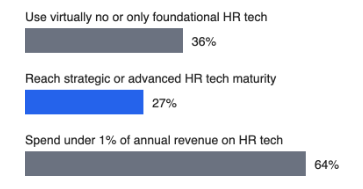
Share of surveyed US small and mid-sized businesses (under 499 employees, n=232). Source: UKG and HR.com survey, 2024.
Why does this matter at scale? The SBA Office of Advocacy counts 36.2 million US small businesses, defined as independent firms with fewer than 500 employees. They employ 62.3 million people and generated 88.9% of overall US job growth in 2023 to 2024 (SBA Office of Advocacy via USAFacts, 2025).
Many of those employers still manage people with spreadsheets. Nearly two-thirds of small and mid-sized businesses run HR on spreadsheets and email, according to a 2023 Mineral and SMB Group survey of 750 respondents. That works until the first audit or leave dispute.
The software market is responding. Fortune Business Insights sizes the global HR software market at $21.07 billion in 2025, rising to $60.26 billion by 2034, a 12.38% compound annual growth rate (Fortune Business Insights, 2026). Other firms define “HR technology” more broadly and publish larger totals, so compare like with like.
How do you choose HR software for a small business?
Choose HR software on five criteria: contract flexibility, real cost, coverage, support and fit. Price and support carry the most weight, since 64% of small businesses spend under 1% of revenue on HR technology (UKG and HR.com, 2024). Score each tool against all five before booking demos.
1. Contract flexibility
Can you pay month to month, change plans as headcount moves and leave without penalty? Annual lock-ins hurt when a team of 25 becomes a team of 40 in a year. Ask every vendor for cancellation terms in writing.
2. Real cost at your headcount
Per-employee fees, flat minimums, base fees and paid add-ons can double a headline price. Work out the monthly total for your actual team size, then again at 20% growth.
Yearly billing discounts are modest, so month-to-month flexibility costs little. HR Partner’s yearly plans cost 11 months for 12, about an 8% saving, and Breathe HR’s yearly billing saves around 10 to 15 percent (vendor pricing pages, October 2026). Paying monthly keeps your exit open.
Pricing models also behave differently as you grow. Breathe HR’s price rises from £44 to £99 a month between its 11-to-20 and 21-to-50 employee bands, a 125% jump once you hire your 21st person. Per-seat tools climb in smaller steps. Which model is cheaper depends on where your headcount sits today.
3. Coverage of everyday HR work
Look for employee records, leave, onboarding, performance reviews, timesheets and document storage in one place. AI help is becoming standard too. SHRM’s 2025 Talent Trends survey of 2,040 HR professionals found that 43% of organizations were integrating AI into HR functions (SHRM, 2025). Treat it as a drafting aid, not an autopilot.
4. Support and setup
Small teams rarely have an HR systems admin. Free implementation help and a reachable human matter more than a long feature list.
Notice the pattern in the UKG data: 64% spend little, and only 27% reach strategic maturity. One reasonable reading is that thin budgets come with thin setup help. If that’s right, a vendor who walks you through implementation does more for your outcome than an extra feature.
5. Fit for where you operate
Some tools are US-only, some are UK-only, and some are built for cross-border teams. Check country coverage and payroll support first. If a tool doesn’t run payroll in your country, ask which integration fills that gap and what it costs.
What are the best HR software options for small businesses?
Our top pick for most small teams of 20 to 500 people is HR Partner, based on flexible terms and support. It holds a 4.7/5 rating across 205 ratings on SourceForge, plus a Fall 2026 Leader badge (SourceForge, 2026). The seven alternatives below suit narrower needs such as payroll, PEO or global hiring.
Quick picks
Best overall for small and growing teams: HR Partner
Best published pricing for a polished HRIS: BambooHR
Best if payroll comes first (US): Gusto
Best for UK businesses on a budget: Breathe HR
Best for a full HR, IT and finance stack: Rippling
Best if you want a PEO (US): Justworks
Best for global hiring: Deel
Best for mid-sized, analytics-minded teams: HiBob
1. HR Partner
Best for: small and growing teams of 20 to 500 employees that want flexibility and real support.
What sets HR Partner apart is how you buy it. Subscriptions run month to month with no lock-in, so you can start, scale or stop without negotiating. Implementation sessions are free, and support comes from real people instead of a ticket queue. The pricing page lists no setup or onboarding fees, and yearly plans cost 11 months for 12.
It’s an all-in-one platform for businesses with 20 to 500 employees, wherever your people work. One place holds employee records, recruiting, onboarding, leave, performance reviews, timesheets and expenses. Staff handle everyday tasks through a self-service portal. AI-assisted tools help draft job descriptions, emails and custom HR forms, and you stay in control. In short: HR software built for small and mighty teams.
Reviewers back that up. The SourceForge score draws on 19 reviews and 186 verified third-party ratings. Juhi King of HR Tech Girl, quoted on the vendor’s homepage, says HR Partner is “truly functional and affordable too.”
Pros - Month-to-month billing, no lock-in and free implementation sessions - Support from real people - Covers the full HR cycle, from recruiting to reviews, in one platform
Cons - Reviewers cite limited payroll integration; the site lists Xero payroll sync (AU/NZ/UK) - Some reviewers describe reporting as limited, and very large or multi-entity enterprises may outgrow it
Pricing: Core, Premium and VIP plans, with rates set by team-size tier. Premium adds recruitment, performance reviews, timesheets and eSignatures. There’s a 14-day free trial with no credit card, plus discounted rates for non-profits. Prices show in USD, GBP, AUD and EUR.
2. BambooHR
Best for: small teams that want a familiar HRIS with clear published prices.
BambooHR is one of the best-known small-business HR platforms, and it’s open about cost. Plans are Core, Pro and Elite, priced per employee per month.
Pros - Published pricing makes budgeting easier - Strong core set: employee records, applicant tracking, time off, benefits tracking and an AI assistant for HR data questions - Pro adds 360-degree reviews, 1:1 meetings and recognition tools
Cons - Companies with 25 or fewer employees pay a flat monthly minimum, so the smallest teams pay more per head - Payroll, benefits administration (US only) and time and attendance are separate add-ons
Pricing: Core is $10 per employee per month, Pro is $17 and Elite is $25. For 25 employees or fewer, the flat minimums are $250 (Core), $425 (Pro) and $650 (Elite) per month.
3. Gusto
Best for: US businesses that start from payroll and want HR tools attached.
Gusto began as a payroll product and still leads with it. Every plan includes unlimited payroll runs and tax filings.
Pros - Payroll and tax filing built into every plan - Time tracking and multi-state payroll on the Plus plan
Cons - US only - HR depth rises with plan tier, so you may need a higher plan for the people tools you want
Pricing: Figures come from excerpts of Gusto’s pricing page, so confirm current rates. Simple is $49 a month plus $6 per person, Plus is $80 plus $12 per person, and Premium is $180 plus $22 per person. You pay only for active employees.
4. Breathe HR
Best for: UK small businesses that want low, predictable pricing.
Breathe HR charges per business, not per head, which keeps costs easy to forecast. Core HR covers holiday and absence management, document and policy management, reporting and performance management.
Pros - Flat monthly price by headcount band - 14-day free trial with no credit card, and no cancellation fees - Optional add-ons for rota and time, recruitment and expenses
Cons - Designed for UK businesses and capped at 200 employees - Add-ons are billed separately and rise with plan size
Pricing: Per business, per month, excluding VAT: £24 for 1 to 10 employees, £44 for 11 to 20, £99 for 21 to 50, £175 for 51 to 100, £419 for 101 to 150 and £579 for 151 to 200. Add-ons start at £11 to £16 each.
5. Rippling
Best for: growing companies that want HR, payroll, devices and spend on one platform.
Rippling is modular. You buy the core platform, then add products such as payroll, benefits, time and attendance, recruiting, expenses and device management.
Pros - Very wide product range across HR, finance and IT - Modules can be bought separately as needs grow
Cons - The pricing page lists no dollar amounts, so you need a quote - Costs build as modules are added, and setup is more involved than a simple HR tool
Pricing: Billed per employee per month, sometimes with a base fee, with every module on top of the required core platform. Third-party guides commonly cite about $8 per employee per month for the core alone, but confirm against a quote.
6. Justworks
Best for: US small businesses that want a PEO to handle payroll, benefits and compliance together.
Justworks sells PEO plans, which means it becomes a co-employer and bundles payroll, benefits access and compliance support. It also offers a payroll-only product.
Pros - Payroll, benefits and compliance support in one package - A payroll-only option for teams that don’t want a PEO
Cons - Per-employee PEO pricing is high compared with HR-only software - US-focused, and a PEO changes your employer relationship, so read the terms carefully
Pricing: Figures come from excerpts of Justworks’ pricing page, so confirm current rates. Payroll is listed at $8 per employee per month plus a $50 monthly base fee. PEO Basic is listed at $79 per employee per month and PEO Plus at $124. Workers’ compensation and some insurance costs are billed separately.
7. Deel
Best for: companies hiring contractors or employees across borders.
Deel is best known for global hiring and payroll, and it has built an HR product alongside it.
Pros - Core HR covers worker profiles, an org chart, time off, workflows and people analytics - Contractor and employer-of-record services for cross-border teams
Cons - Its center of gravity is global hiring, so a domestic-only team may not use most of it - Recruiting is an add-on, and costs vary by product
Pricing: Core HR starts at $5 per employee per month. Contractors are $49 per contractor a month, employer of record is $599 per employee, and a US PEO is $125 per employee, per Deel’s pricing page.
8. HiBob
Best for: mid-sized companies that want a broad people platform and are comfortable with a sales-led purchase.
HiBob offers modules for core HR, hiring, learning, time and attendance, a payroll hub, workforce planning and compensation benchmarking powered by Mercer.
Pros - Broad module library, including compensation benchmarking - UK payroll available as a module
Cons - No public pricing; third-party sources describe it as aimed at mid-sized and larger firms - Quote-led buying means more time before you know the cost
Pricing: Not published. HiBob’s pricing page offers a demo, and third-party estimates vary widely. Request a quote with your headcount, and ask about minimums and implementation fees.
How do the best HR software options for small business compare?
The eight tools differ most on contract terms and pricing model. At 25 employees, Deel’s Core HR from $5 a head comes to about $125 a month, while BambooHR’s Core plan carries a $250 flat minimum (vendor pricing pages, October 2026). Check both numbers against your own headcount.
Tool
Best for
Pricing model
Published price
Contract
HR Partner
Teams of 20 to 500
Per team-size tier
Shown by tier
Month to month, no lock-in
BambooHR
Polished HRIS
Per employee, flat minimum for 25 or fewer
$10 to $25 per employee
Plan based
Gusto
US payroll first
Base fee plus per person
$49 + $6 to $180 + $22
Monthly
Breathe HR
UK small firms
Per business by headcount band
£24 to £579
Rolling monthly, cancel anytime
Rippling
Full HR, IT, finance stack
Modular, per employee
Quote required
Sales-led
Justworks
US PEO
Per employee
$79 to $124 PEO
PEO terms apply
Deel
Global hiring
Per employee or worker
Core HR from $5
Product dependent
HiBob
Mid-sized firms
Quote
Not published
Sales-led
Frequently asked questions
How much does HR software cost for a small business?
Published entry prices vary widely. Deel Core HR starts at $5 per employee per month, BambooHR Core is $10, and Breathe HR starts at £24 a month for 1 to 10 employees (vendor pricing pages, October 2026). HR Partner prices by team-size tier. Always calculate the total at your headcount, including add-ons.
Are spreadsheets enough for small business HR?
Spreadsheets work briefly, then break. Nearly two-thirds of small and mid-sized businesses still run HR on spreadsheets and email (Mineral and SMB Group, 2023), yet only 27% reach strategic HR tech maturity (UKG and HR.com, 2024). Move to a dedicated system once leave, onboarding and reviews start eating your admin time.
Is a PEO or HR software better for a small business?
They solve different problems. A PEO such as Justworks becomes your co-employer and bundles payroll, benefits and compliance, with PEO Basic listed at $79 per employee per month (Justworks pricing excerpts, 2026). HR software keeps you as sole employer and costs less. Choose a PEO when you want those services bundled.
Should small business HR software include AI?
Yes, as a drafting aid. SHRM found that 43% of organizations were integrating AI into HR functions in 2025 (SHRM 2025 Talent Trends). Look for tools that draft job descriptions, emails and forms while you approve everything before it goes out.
The bottom line
Small businesses generated 88.9% of US job growth in 2023 to 2024 (SBA Office of Advocacy via USAFacts, 2025), so managing those hires well pays off. Start with your constraint. If it’s contract flexibility and hands-on support, HR Partner fits a growing team of 20 to 500 best. If payroll comes first, look at Gusto, or Justworks for a PEO. UK firms on a tight budget should price Breathe HR. Hiring across borders? Deel earns its place. Want HR and IT on one platform? Get a Rippling quote.
Whichever you shortlist, run the trial with your own data. Ask for the total monthly cost at your headcount and at 20% growth, and confirm what happens if you leave. Prices change often, so check each vendor’s page first.
HOW DO YOU FEEL ABOUT FASHION?
COMMENT OR TAKE OUR PAGE READER SURVEY
Featured




Discover how digital subscription platforms are evolving with a new wave of personal lifestyle creators and where to connect with their exclusive communities.