
Everest Base Camp Short Trek: Cost, Itinerary, Route, Difficulty, Altitude & Practical Tips
PAGE
By PAGE Editor
Is the Everest Base Camp Short Trek Right for You?
Not everyone gets two weeks off work to disappear into the Himalayas, and that's the honest reason the Everest Base Camp short trek exists in the first place. Somewhere between "I want to see Everest" and "I only have nine or ten days," a shortened itinerary starts to look like the obvious answer. It usually is, for the right person.
A short EBC trek isn't a different trail. You still walk through the same villages, cross the same swaying bridges over the Dudh Koshi, and climb into the same thin air near 5,300 meters. What changes is the schedule — fewer rest days, sometimes a helicopter or extra flight segment worked into the plan, and less slack if something goes wrong. That last part matters more than people expect. A genuinely well-designed shortened route still protects your body's need to adjust to altitude; it just does it more efficiently. Simply lopping days off the standard itinerary and hoping for the best is a different thing entirely, and it's where most of the trouble starts.
The classic route runs from Lukla through Phakding, Namche Bazaar, Tengboche, Dingboche, Lobuche, and Gorak Shep before reaching Everest Base Camp itself. A short version follows that same line on the map. So before anything else — cost, gear, best season — here's the one thing worth internalizing: shorter does not automatically mean easier. In some ways, it asks more of you, not less.
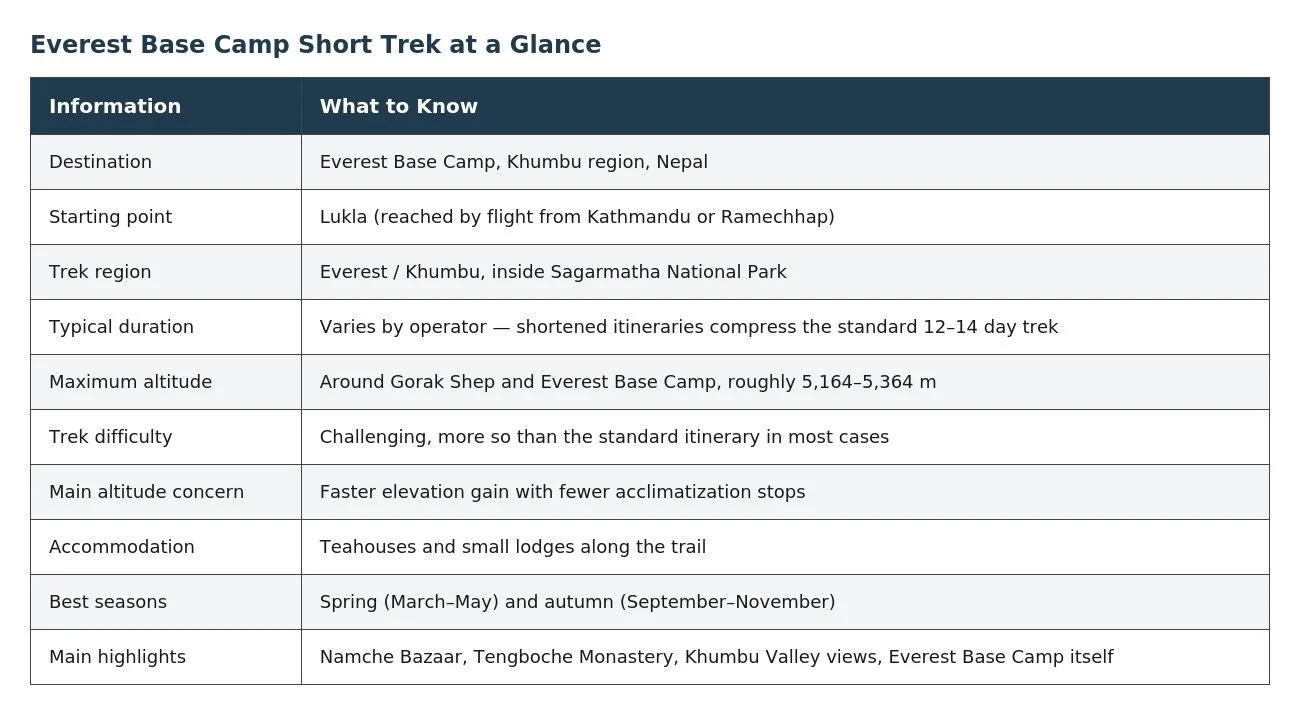
There's no single agreed-upon length for a "short" EBC trek — some companies trim it to 9 days, others stretch it to 11, and a few push it even tighter using helicopter transfers. Anyone comparing packages should read the day-by-day plan rather than trusting the label on the brochure.
What Is the Shortest Practical Everest Base Camp Trek?
Short Trek vs Standard EBC Trek
The standard Everest Base Camp itinerary typically includes two full acclimatization days — one in Namche, one in Dingboche — plus a gentler pace between stops. A short itinerary usually keeps one of those rest days, sometimes both if the operator is being sensible, but trims walking stages or uses a helicopter to skip a leg of the trail. Every day removed from the schedule is a day your body doesn't get to adjust, which is exactly why altitude becomes the deciding factor rather than fitness.
People who've already spent time above 3,500 meters somewhere else tend to do fine on a compressed schedule. So do fit, experienced hikers who are honest with themselves about pacing and who won't push through warning signs just to keep to an itinerary. If you've trekked at altitude before and know how your body responds, a short trek is a reasonable bet.
First-timers at high altitude, anyone who hasn't trained specifically for consecutive long walking days, and travelers who already notice symptoms early in the trek are the ones who should think twice about compressing things further. Altitude sickness doesn't care how fit you are or how many marathons you've run — it's about elevation gain and time, not leg strength.
Everest Base Camp Short Trek Itinerary
Day 1: Kathmandu to Lukla, trek to Phakding. The early-morning flight into Lukla's short mountain runway is an experience in itself — dramatic, a little nerve-wracking, and over in about 30 minutes. From there, it's a gentle few hours of walking downhill along the Dudh Koshi river to Phakding, a good warm-up before the terrain gets serious.
Day 2: Phakding to Namche Bazaar. This is where the trek actually starts to feel like a trek. You'll cross several suspension bridges, including the tall Hillary Bridge, before a long, steady climb into Namche. It's the biggest single elevation gain of the early days, and Namche itself — a horseshoe-shaped town built into the hillside — works as the trip's first real acclimatization stop.
Day 3: Namche to Tengboche or Deboche. Depending on the exact route, you might swing through Khumjung or Kunde before dropping down and climbing back up to Tengboche, home to the region's most famous monastery. The forest here, with rhododendron and pine, is some of the prettiest walking on the whole trail, and on a clear day the first proper views of Everest and Ama Dablam open up.
Day 4: Tengboche/Deboche to Dingboche. The landscape starts shedding its greenery here. Trees thin out, the valley widens, and the air noticeably starts working harder for you. This is usually the point where trekkers first feel altitude in a real way — nothing alarming, just a slower pace and a bit more breathlessness on the climbs.
Day 5: Dingboche to Lobuche. A demanding but not overly long day, passing through the Thukla area, where a memorial site pays quiet tribute to climbers who lost their lives on Everest. It's worth pausing there, both to catch your breath and to take the moment seriously.
Day 6: Lobuche to Gorak Shep, then on to Everest Base Camp. This is the big day. An early start, a rocky and at times slow walk across glacial moraine, and finally arrival at Base Camp itself. It's worth setting expectations here — EBC isn't a viewpoint with a postcard shot of the summit. It's a stark, boulder-strewn spot at the foot of the Khumbu Icefall, and depending on the season, the famous colorful tents of climbing expeditions may or may not be there. The achievement is in having walked there, not in the scenery at that exact spot.
Day 7: Gorak Shep to Kala Patthar, then descent begins. Many trekkers get up before dawn to climb Kala Patthar, which — somewhat ironically — gives better mountain views than Base Camp does, including a proper look at Everest's summit. After that, the descent starts in earnest.
Day 8 and beyond: Return to Lukla and Kathmandu. Exactly how this plays out depends on the specific itinerary an operator has built, and on Lukla flight schedules, which are notoriously weather-dependent. Some short itineraries fly out from Lukla the same day the trek ends; others build in a buffer night in case flights get delayed. Anyone booking a short trek should ask specifically how that buffer is handled — this single detail separates a well-designed compressed itinerary from a risky one.
Everest Base Camp Short Trek Route Explained
Laid out simply, the route runs Kathmandu → Lukla → Phakding → Namche Bazaar → Tengboche → Dingboche → Lobuche → Gorak Shep → Everest Base Camp → return.
Lukla is used as the starting point for a short itinerary for a practical reason: flying in and out saves the multi-day walk that older overland routes required. From there the trail climbs gradually through pine and rhododendron forest before the landscape opens into the wider alpine terrain around Dingboche and Lobuche. Namche functions as the unofficial capital of the Khumbu — a trading hub, acclimatization stop, and the last place with much in the way of shops and bakeries. Gorak Shep, a small settlement on what used to be a lakebed, is the final overnight point before Base Camp and doubles as the launch pad for the Kala Patthar sunrise hike. The entire route sits inside Sagarmatha National Park, a UNESCO World Heritage Site, which is part of why permit fees apply along the way.
Everest Base Camp Short Trek Cost: What You Actually Pay For
There's no honest single number for what an EBC short trek costs — prices swing based on group size, season, and what's actually included, and any article claiming an exact fixed price is guessing. What's more useful is understanding where the money goes.
Kathmandu accommodation before and after the trek is usually a small piece of the budget. Lukla flights are a bigger one, and prices there fluctuate with demand and season. On the trail, you're paying for a guide, often a porter, teahouse rooms, and meals — all of which get somewhat pricier the higher you climb, since everything has to be carried in by porter or yak. Then there are fixed costs: the Sagarmatha National Park entry fee and the Khumbu Pasang Lhamu Rural Municipality fee, both of which are mandatory. Depending on how you're trekking, you may also need to sort out relevant permits and paperwork in Kathmandu before flying to Lukla.
Beyond the obvious, don't forget travel insurance that actually covers high-altitude trekking and emergency evacuation — this is not optional in any serious sense, even if it feels like an extra line item at booking time. Personal gear, and small daily costs like phone charging, Wi-Fi access, or a hot shower at a teahouse, add up more than people expect over a week.
Before booking, it helps to sort packages into rough tiers. A cheap package is worth scrutinizing closely for what's excluded — permits, insurance, and emergency evacuation are the usual gaps. A mid-range package should clearly include a guide, teahouse accommodation, meals on the trail, and flights. Higher-priced packages tend to add private rooms where available, dedicated porter support, and more attentive handling if plans need to change last-minute. If your site has a dedicated Everest Base Camp trek cost breakdown, that's the better place to dig into exact figures — this section is meant to explain the components, not invent totals.
Difficulty: How Hard Is the Short EBC Trek?
Physical difficulty comes from consecutive long walking days with limited recovery time between them — this is the part a short itinerary makes noticeably tougher than the standard version.
Altitude difficulty is the real deciding factor, though. Thin air at 4,000–5,300 meters affects people regardless of how many hours they've logged on a treadmill back home. Fitness helps with stamina; it does nothing to guarantee how your body handles reduced oxygen. Acclimatization time is the only real defense, which is exactly why compressing the schedule raises the stakes.
Mental difficulty is the quieter challenge nobody warns you about enough — cold mornings, basic rooms, the same rice-and-noodles menu night after night, and the grinding repetitiveness of walking uphill for hours at a time. By the final push toward Base Camp, fatigue is doing as much work against you as the altitude is.
Put simply: a short EBC trek is hard mainly because it packs demanding high-altitude walking into a tighter window, not because the trail itself is technically difficult.
Altitude and Acclimatization: The Part You Should Not Rush
This is the section worth reading twice if you're seriously considering a compressed itinerary. Rapid elevation gain is the single biggest risk on any EBC trek, short or not. Watch for headache, dizziness, unusual fatigue, nausea, loss of appetite, or trouble sleeping — these are early warning signs, not just "part of the experience." If symptoms get worse rather than better, descending is sometimes the only sensible option, and a good guide will not hesitate to suggest it.
Staying hydrated, pacing yourself deliberately rather than matching a faster hiker's speed, and resting when your body asks for it all matter more on a short trek than a standard one, simply because there's less built-in slack to recover from a bad day. Medication is sometimes discussed as a tool for managing altitude symptoms, but it's not a substitute for proper acclimatization, and anyone considering it should talk to a doctor before traveling, not figure it out on the trail.
Can you do EBC quickly? Yes — plenty of travelers complete compressed itineraries successfully every season. But reducing acclimatization time raises the difficulty and the risk, and it's genuinely not the right call for everyone, especially first-timers at altitude.
Best Time for a Short Everest Base Camp Trek
Spring (March to May) is one of the two most popular windows, with generally milder daytime temperatures and decent odds of clear mountain views, especially earlier in the day before clouds build up.
Autumn (September to November) is the other major season, often bringing stable weather and good visibility, which is part of why it's a favorite among trekking operators.
Winter brings serious cold and snow at higher elevations, which can make an already tight schedule harder to manage.
Monsoon season (roughly June to August) comes with rain, cloud cover, and a higher chance of flight delays into Lukla — a real problem when you don't have spare days to absorb a delay.
For a short trek specifically, weather reliability matters even more than usual. A flight delay that would just be an annoyance on a two-week itinerary can eat into your entire buffer on a compressed one.
Practical Preparation Before the Trek
Fitness matters, though not in the way people assume — it's less about raw speed and more about being able to walk five or six hours a day, several days in a row, with a loaded backpack. Uphill training, stair climbing, or hiking with a weighted pack in the weeks beforehand makes a real difference.
Equipment doesn't need to be complicated. A solid layering system, waterproof outer shell, broken-in trekking boots, a warm sleeping bag rated for cold nights, a headlamp, a reliable way to carry and treat water, sunglasses and sunscreen (the sun at altitude is stronger than it looks), trekking poles, and a basic first-aid kit cover most of what you actually need.
Money and connectivity are easy to underestimate. Carry enough Nepalese cash before you leave Kathmandu or Lukla, since ATMs disappear once you're on the trail. Don't assume Wi-Fi or reliable charging at every teahouse — some have it, some don't, and it usually costs extra. Keep your insurance documents and emergency contacts somewhere accessible, not buried at the bottom of your pack.
What to Expect From Teahouse Accommodation and Food
Rooms are simple — twin beds, a shared bathroom down the hall in most places, and not much in the way of heating beyond what the dining room stove provides in the evening. That dining room ends up being the social heart of every stop, warmer and livelier than the bedrooms, and usually where trekkers end up trading stories over tea.
Food gets simpler as you climb. Dal bhat remains the trekker's staple for good reason — it's filling, and most teahouses offer free refills. Expect soups, noodles, rice dishes, and plenty of hot drinks, which do more for morale on a cold evening than people expect. Whatever comfort level you're used to at home, it's worth adjusting expectations once you're above Namche.
How to Make a Short EBC Trek Safer and More Comfortable
Start training weeks, not days, before departure. Walk slowly from day one instead of matching the pace of faster trekkers in your group. Eat even when your appetite drops, which it will at altitude. Stay on top of hydration throughout the day, not just at meals. Keep warm at night, since cold makes altitude symptoms feel worse than they are. Tell your guide immediately if something feels off — that's what they're there for. Build a small amount of flexibility into the schedule if the operator allows it, and check Lukla flight conditions before heading to the airport rather than assuming everything will run on time. Finally, buy travel insurance that specifically names high-altitude trekking and emergency evacuation in the coverage — generic travel insurance often doesn't cut it here.
Final Thoughts
Short trek, less time off work — but not less physical demand. That trade-off is really what this whole decision comes down to. Plan around what the altitude will ask of you rather than fixating purely on the number of days on the itinerary. Compare what's actually included in a trekking package rather than just the price tag, put in real physical preparation before you land in Kathmandu, and leave a little room in your plans for things not to go exactly on schedule. A reputable local trekking operator and an experienced guide make a bigger difference than most people expect going in.
If your time in Nepal is limited, the goal isn't finding the fastest route to Everest Base Camp — it's finding the shortest itinerary that still gives you a realistic, safe shot at actually enjoying the trek. Look closely at the itinerary, the inclusions, the acclimatization plan, and the support on offer before you commit to booking.
HOW DO YOU FEEL ABOUT FASHION?
COMMENT OR TAKE OUR PAGE READER SURVEY
Featured


A late-night habit loop explains why resolve fades after dark, and how small environmental shifts beat white-knuckle discipline every time.