
Fabric Shrinkage: Why Fabrics Changes its Size After Washing and How to Test Them
PAGE
By PAGE Editor
Shrinkage of the fabric can cause garment fitting, size, skewness, and dimensional stability issues after washing. AATCC, ISO, GB/T, and many other standards are used to evaluate dimensional changes, and automated shrinkage testing with ChiuVention SmartShrink can reduce process time, improve accuracy, accelerate production decisions, minimize reprocessing, and increase laboratory productivity.
What Is Fabric Shrinkage and Why Does Fabric Shrink?
Shrinkage is the dimensional reduction or change that occurs when exposed to washing, soaking, drying, heat, moisture, or mechanical action. It is usually evaluated in the length and width directions, but dimensional changes can include skewness, spirality and other distortions.
Fabric can shrink because fibers and yarn are not completely dimensionally stable in their manufacturing state. During different processes such as spinning, knitting, weaving, dyeing, finishing, and drying, the yarn is usually subjected to tension, stretching, compression and mechanical forces, and washing releases these internal stresses, allowing the material to relax and moisture and heat can further change the dimensions of the fiber and the geometry of the yarn.
As a result, the fabric or garment becomes shorter, narrower, twisted, or distorted after washing; that is why fabric shrinkage testing is important before finished products reach customers.
The Science Behind Fabric Shrinkage
Different factors such as fiber structure, yarn and fabric construction, moisture, heat, tension, and mechanical relaxation influence the science of fabric shrinkage. During textile processing, manufacturers usually hold fibers, yarns, and fabric under tension, which creates temporary internal stresses. When the fabric is washed and exposed to heat and agitation, the stress relaxes and causes dimensional changes.
Knitted fabrics change through loop relaxation, while woven fabrics can change due to yarn crimp and tension. Drying and heat-setting conditions also affect the final dimensions; that is why shrinkage is not just a washing issue but it can result from conditions throughout spinning, weaving or knitting, wet processing, drying and finishing.
Standards Used for Fabric Shrinkage and Dimensional Stability Testing
All textile manufacturers use standardized methods to evaluate dimensional changes under controlled conditions and the most appropriate method depends on the product, laundering procedure and type of dimensional change being investigated.
The most common standards relevant to shrinkage and dimensional stability include:
1) AATCC TM96
2) AATCC TM135
3) AATCC TM179
4) ISO 3759
5) ISO 5077
6) ISO 7771
7) ISO 16322
8) GB/T 8626
9) GB/T 8630
10) GB/T 22848
When selecting a testing method, testing labs should therefore match the standard to the actual product being tested.
How Is Fabric Shrinkage Tested?
Shrinkage testing usually involves specimen preparation, marking, conditioning, washing, drying, reconditioning, measurement, calculation and reporting. Please note that you must select the exact laundering conditions based on the applicable testing standard, customer requirements, and intended end use.
Specimen Preparation and Marking
The testing specimen is first prepared according to the selected test method and the reference points or measurement marks are placed in the required length and width directions and these mark establish the original dimensions which will later be compared with the dimensions after laundering.
For reliable testing results, the specimen must be representative of the fabric lot, and the marking and measurement process should be performed carefully and consistently.
Conditioning Before Testing
The testing specimen is conditioned under the controlled atmosphere specified by the applicable standard before the initial measurements are taken and this conditioning process allows the textile to reach a controlled moisture equilibrium, which reduces the influence of uncontrolled environmental moisture. The initial distance between the reference marks is measured and recorded and these values become the original dimensions used for calculating the dimensional change.
Washing
The marked testing specimen is subjected to the specified washing procedure. The parameters such as water temperature, agitation, washing time, detergent or reference detergent, liquor conditions, and rinsing are selected as per the selected ISO or AATCC standard.
Drying
After washing and rinsing, the test specimen is dried using the drying procedure as per the selected standard and drying can be tumble drying, line drying, drip drying, or other controlled drying conditions.
Conditioning After Drying
After drying, the test specimen is again conditioned according to the required standard before the final measurement and this provides a controlled environment for comparing the specimen’s final dimensions with its original dimensions.
Measurement, Calculation and Reporting
After the completion of conditioning, the final distance between the reference marks is measured and compared with the original measurements.
Formula:
Dimensional Change (%) = [(After-Wash Dimension − Original Dimension) ÷ Original Dimension] × 100
Suppose the original length is 500 mm and the final or after-wash length is 490 mm, so:
[(490 − 500) ÷ 500] × 100 = −2%
The negative value indicates a 2% reduction or shrinkage in length or width.
The testing lab report should identify the tested specimen, test method, laundering conditions, drying conditions, original measurements, final measurements, and dimensional change results. A clear test report allows the quality, production, merchandising and technical teams to determine whether the fabric meets the required specification or whether the construction or count of the yarn is acceptable.
Why Is Shrinkage Testing Important for Textile Manufacturers?
Shrinkage directly affects the garment measurements, fitting, appearance, dimensional stability, customer specifications and overall product quality. The fabric that appears acceptable before washing can develop unacceptable dimensional changes after washing.
Detecting the extra shrinkage at the final stage can lead to reprocessing, alterations, material rejection and delays in delivery and early dimensional stability testing helps manufacturers identify potential problems before large quantities are processed.
Test earlier → identify problems earlier → correct processes earlier → reduce unnecessary reprocessing.
How ChiuVention SmartShrink Saves Time and Increases Productivity
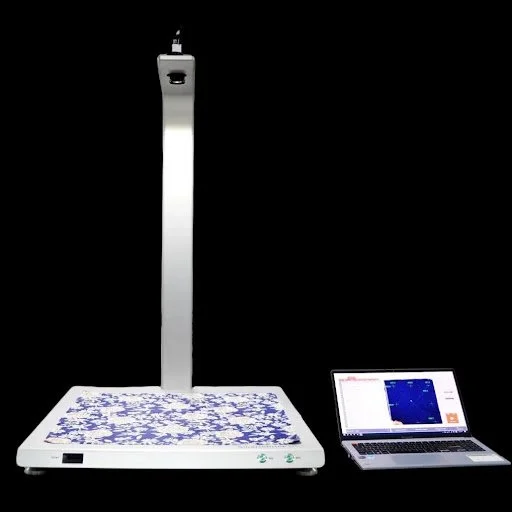
Traditional shrinkage testing requires manual marking, measurement recording, calculation and reporting, which consumes valuable lab time. ChiuVention SmartShrink uses automated image-based measurement and calculation to make this workflow the simplest. SmartShrink measures a testing specimen in approximately 5 seconds and automatically calculates and stores results.
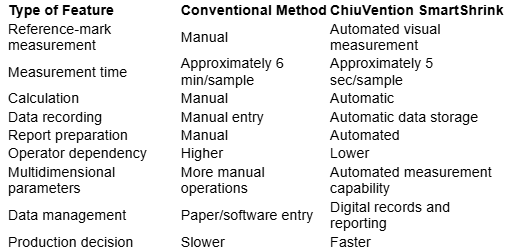
As the testing volume increases, the manual measurement consumes valuable lab time. SmartShrink automates the measurement and calculation, which allows the lab technician to focus on investigation, process analysis and quality improvement. This tester checks for length and width shrinkage, skewness, twist distortion, and spirality. Faster reporting shortens the testing-to-decision cycle. This leads to earlier CAPA and fewer delays.
https://www.youtube.com/watch?v=VsXRh_Ixdmk
FAQs
What is fabric shrinkage?
Shrinkage of the fabric is the dimensional reduction or change in textile material after washing, moisture, heat, drying, or mechanical action, and it is commonly expressed as a percentage in length and width.
What causes the fabric to shrink after washing?
Textile material can shrink because washing and drying release the stresses introduced during spinning, weaving, knitting, dyeing, finishing, and drying. Fiber relaxation, yarn movement, fabric construction, moisture, heat and mechanical action can contribute to the dimensional change.
How is fabric shrinkage calculated?
Shrinkage (%) = [(Original Dimension − Final Dimension) ÷ Original Dimension] × 100
What is the standard test for fabric shrinkage?
The common testing methods include AATCC TM135, AATCC 150, AATCC TM96, ISO 3759, ISO 5077, GB/T 8628 and GB/T 8630.
What is the difference between shrinkage and dimensional change?
Shrinkage usually refers to the reduction in dimension while dimensional change is a broader term that includes both reductions and increases in dimensions, as well as changes such as skewness or spirality.
How can an automatic shrinkage tester improve lab productivity?
An automatic shrinkage tester decreases manual operation by automating measurement and calculation. ChiuVention SmartShrink is especially designed to perform image-based measurement and automatically generate results which helps the testing lab reduce measurement time and accelerate reporting and production decisions.
Conclusion
Shrinkage affects garment measurement, fitting, appearance and product quality and standardized AATCC, ISO, and GB/T testing provides objective results for process control. Manual measurement and reporting can consume valuable lab time which ChiuVention SmartShrink automates. Visual measurement, calculation, data storage and reporting help the lab deliver faster results, identify dimensional problems earlier and reduce unnecessary reprocessing and improve overall testing productivity.
For more information on textile testing methods, standards, and textile testing machines, contact us:
WhatsApp: +86 180 2511 4082
Tel: +86 769 2329 4842
Fax: +86 769 2329 4860
Email: sales@chiuvention.com
LinkedIn: ChiuVention
HOW DO YOU FEEL ABOUT FASHION?
COMMENT OR TAKE OUR PAGE READER SURVEY
Featured




Having a friends with benefits relationship is a great idea, if you find the right person for it.