
How Do Dance Curricula Build Skills From Ages Two to Five?
PAGE
By PAGE Editor
A two-year-old who can barely stand on one foot and a five-year-old who can skip across the room in time with the music may look like they belong in completely different worlds. Yet in just three short years, young children make remarkable leaps in balance, coordination, focus, and self-expression. A thoughtfully designed dance curriculum is one of the best tools for nurturing that growth.
Understanding preschool dance skill progression helps teachers plan meaningful lessons and helps parents see the purpose behind every hop, twirl, and freeze dance. In this article, we will walk through how dance curricula build skills year by year from ages two to five, the teaching strategies that make progression possible, and how to tell whether a program is truly helping children grow.
Why a Planned Progression Matters
Young children develop quickly, but not randomly. Motor skills, attention spans, and social abilities tend to emerge in a predictable order. A good curriculum follows that natural sequence so that each new skill rests on a solid foundation.
Without a planned progression, classes can easily fall into one of two traps. Some ask too much too soon, frustrating children with movements their bodies are not ready for. Others repeat the same simple activities for years, leaving children bored and underchallenged.
A well-sequenced curriculum helps teachers:
Match activities to each age group's physical and cognitive readiness
Introduce new skills only after foundational ones are secure
Revisit concepts in more complex ways as children grow
Keep classes fresh while still building toward clear goals
Prepare children for a smooth transition into formal technique classes
The result is steady, confident growth that children can feel and parents can see.
Age Two: Exploring Movement and Music
At age two, dance is all about discovery. Toddlers are learning what their bodies can do, and their attention spans are very short, often just a few minutes per activity. Many studios offer parent-and-me or caregiver-assisted classes at this age, which helps children feel secure while they explore.
Key Skills at Age Two
Curricula for two-year-olds typically focus on:
Gross motor basics: Walking, marching, running, stomping, and simple jumping with two feet
Body awareness: Naming and moving body parts, such as wiggling fingers, shaking arms, or tapping knees
Listening to music: Moving when the music plays and stopping when it pauses
Imitation: Copying the teacher's simple movements and gestures
Separation and comfort: Feeling safe in a group setting
What Class Looks Like
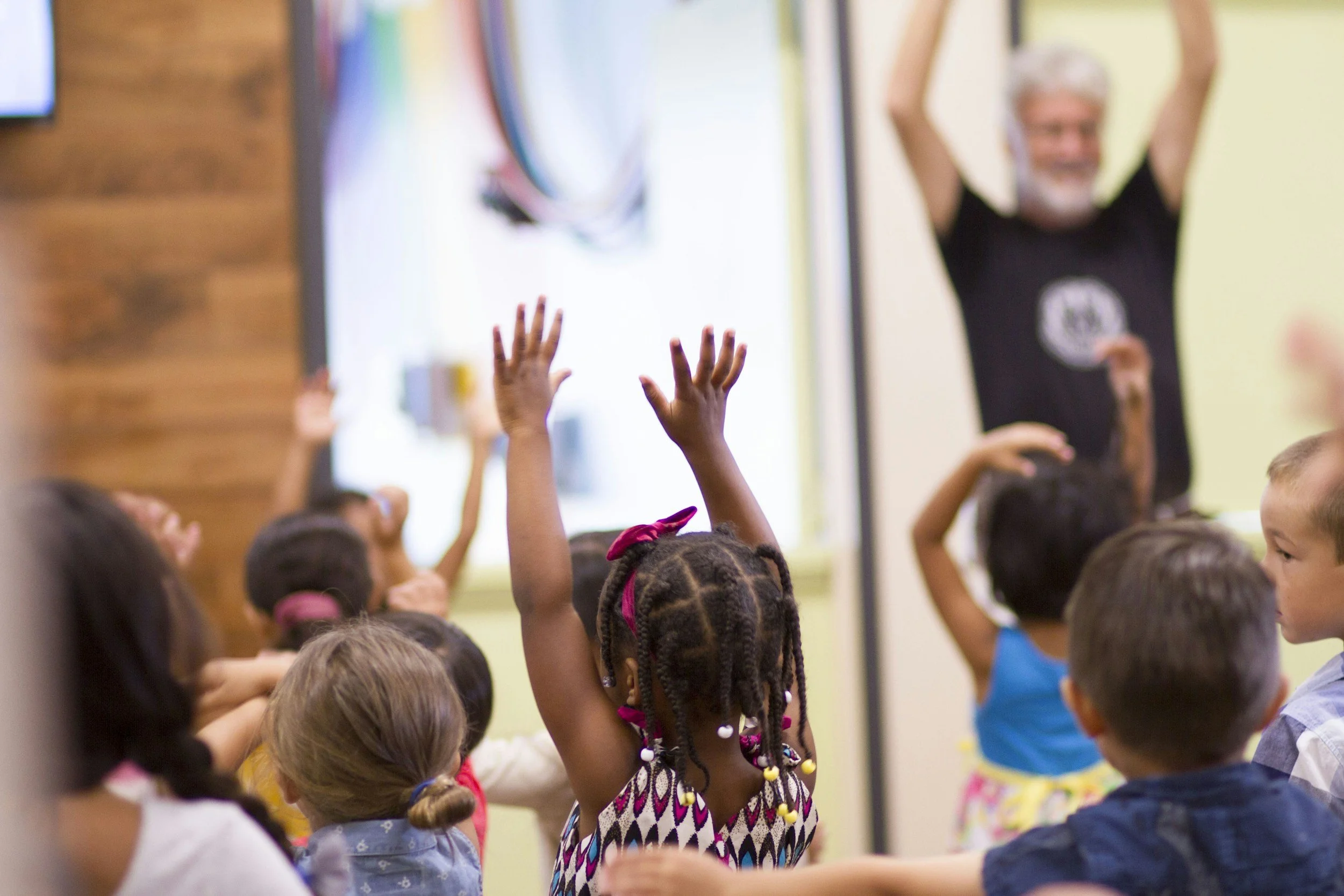
Lessons are short, often around 30 minutes, and packed with songs, props, and imaginative play. Children might pretend to be bunnies hopping, wave scarves like butterfly wings, or bounce on their knees like popcorn. The goal is joy and familiarity, not precision.
Age Three: Building Foundations
By age three, most children are ready to join a class independently. They can follow simple directions, take turns with support, and stay engaged a little longer. This is when curricula begin to introduce basic dance vocabulary in a playful way.
Key Skills at Age Three
Balance: Standing on tiptoes (relevé) and briefly balancing on one foot
Locomotor skills: Galloping, tiptoe walking, and jumping forward
Early dance terms: Simple ballet words like plié and first position, often paired with imagery
Spatial awareness: Staying in a personal spot and moving through space without bumping into others
Following routines: Recognizing the order of class and transitioning between activities
What Class Looks Like
Classes usually run 30 to 45 minutes and follow a predictable structure: a hello song, warm-up, skill time, across-the-floor movement, creative play, and a goodbye ritual. Imagery remains essential. A plié might be "melting like a snowman," and a relevé might be "growing tall like a flower." Children begin to learn very short sequences of two or three movements.
Age Four: Refining Coordination and Vocabulary
Four-year-olds are bursting with energy and curiosity. Their coordination improves noticeably, and they can remember more steps and follow multi-part instructions. Preschool dance skill progression at this stage shifts from simply exploring movement to beginning to shape it.
Key Skills at Age Four
Coordination: Combining arm and leg movements, such as marching with arms in a set position
More complex locomotion: Early skipping, chassés (gallops sideways), and leaps over small objects
Rhythm: Clapping or stepping to a steady beat and recognizing fast versus slow music
Expanded vocabulary: Positions of the feet and arms, tendu, sauté, and basic tap sounds like toe taps, heel drops, and shuffles
Memory: Learning short combinations and a simple recital dance
What Class Looks Like
Classes typically last 45 minutes and include more time for technique while still using stories and props. Teachers begin offering gentle corrections and encouraging children to notice details, like pointed toes or straight knees. Many four-year-olds perform in their first recital, which builds confidence and teaches stage etiquette.
Age Five: Preparing for Formal Technique
By age five, many children are ready to bridge the gap between creative movement and structured technique. They can focus for longer stretches, understand corrections, and take pride in practicing a skill until it improves.
Key Skills at Age Five
Technical foundations: Cleaner positions, more controlled pliés and relevés, and an introduction to barre work in some programs
Advanced locomotion: Confident skipping, galloping in both directions, and small leaps with a clear takeoff and landing
Turning basics: Simple turns such as chaîné preparations or walking turns
Musicality: Counting music in sets of eight and matching movements to phrases
Choreography: Learning and retaining longer routines with formations and transitions
Class etiquette: Raising a hand, waiting in line, and respecting classmates and teachers
What Class Looks Like
Classes resemble a beginning technique class while keeping some playful elements. Teachers use more accurate terminology and expect a bit more precision, but imagination still plays a role. This stage prepares children to move confidently into kindergarten and school-age classes in ballet, tap, jazz, or combination programs.
Teaching Strategies That Support Progression
A curriculum outlines what children learn, but teaching strategies determine how well they learn it. The most effective early childhood dance programs share several common methods.
Spiral Learning
Rather than teaching a skill once and moving on, strong curricula revisit concepts again and again with added complexity. A two-year-old might jump with two feet, a three-year-old might jump forward, a four-year-old might sauté in first position, and a five-year-old might link jumps into a combination.
Imagery and Storytelling
Young children understand the world through play. Turning skills into characters, animals, and stories helps them remember movements and perform them with energy.
Repetition With Variety
Children need repetition to master a skill, but they also need novelty to stay engaged. Changing the music, props, or theme while practicing the same skill keeps learning fresh.
Positive Reinforcement
Specific praise, such as "I love how tall you stood on your tiptoes," encourages effort and helps children understand what success looks like.
Developmentally Appropriate Expectations
Teachers who understand child development know when to push and when to let a skill unfold naturally. Pressuring young bodies into advanced positions can cause frustration or even injury.
How to Tell a Curriculum Is Working
Whether you are a studio owner evaluating your program or a parent choosing a class, look for clear signs of meaningful preschool dance skill progression. These include:
Visible growth over a season: Children move with more control, balance, and confidence in spring than they did in fall.
Increasing independence: Students follow class routines, transition smoothly, and need fewer reminders.
Growing vocabulary: Children can name and demonstrate basic steps.
Longer focus: Students stay engaged through more of the class as the year goes on.
Enthusiasm: Children are excited to come to class and eager to show off what they have learned.
Clear communication: The studio shares goals, progress notes, or skill checklists with families.
If children seem stuck doing the same activities with no new challenges, or if they appear frustrated by skills well beyond their abilities, the curriculum may need adjusting.
Frequently Asked Questions
What is preschool dance skill progression?
It is the planned sequence of movement, musical, and social skills that children learn as they grow from toddlers into kindergarten-ready dancers.
Is age two too young for dance class?
No. Two-year-olds can benefit from short, playful classes, especially parent-and-me formats that focus on exploration rather than technique.
When do children start learning real dance steps?
Most children begin learning simple ballet and tap terms around age three, with more formal technique introduced gradually through ages four and five.
What if my child is behind other children in class?
That is completely normal. Young children develop at different rates, and a good curriculum allows each child to progress at their own pace.
Should my child repeat a level?
Sometimes repeating a level builds confidence and solidifies skills. Ask the teacher for guidance based on your child's readiness rather than age alone.
How long are preschool dance classes at each age?
Typically around 30 minutes for two-year-olds, 30 to 45 minutes for three-year-olds, and about 45 minutes for four- and five-year-olds.
How can I support my child's progress at home?
Dance together to music, ask your child to teach you a step from class, and celebrate effort rather than perfection.
Building Confident Dancers One Year at a Time
The years between two and five are some of the most exciting in a child's development, and dance is a wonderful way to support that growth. A thoughtful curriculum meets children exactly where they are, starting with joyful exploration at age two, building foundations at three, refining coordination at four, and preparing for formal technique at five.
When teachers follow a clear preschool dance skill progression, every class has purpose. Children build strength, balance, rhythm, memory, and social skills in a way that feels like play. Parents can watch their little ones grow into confident movers who are ready for whatever comes next, whether that is ballet, tap, jazz, or simply a lifelong love of dancing.
If you are choosing a program for your child or refining the curriculum at your studio, look for a plan that honors each stage of early childhood. The right progression turns tiny, wobbly steps into graceful, confident ones.
HOW DO YOU FEEL ABOUT FASHION?
COMMENT OR TAKE OUR PAGE READER SURVEY
Featured


Having a friends with benefits relationship is a great idea, if you find the right person for it.