
GPT-5.4 vs GPT-5.5 Pro: 12x on Both Lines and One Point of Quality
PAGE
By PAGE Editor
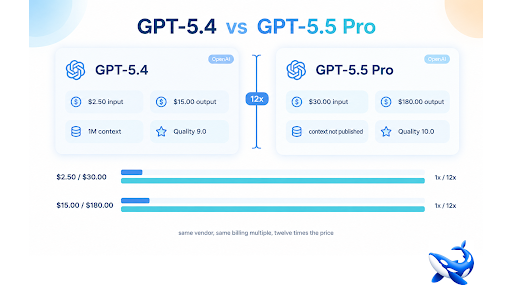
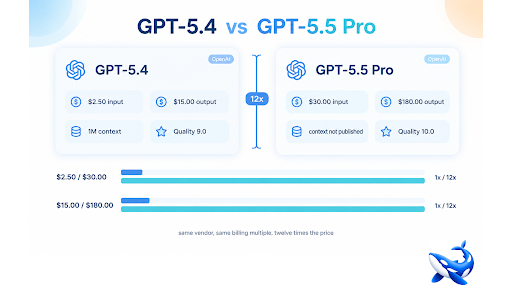
Twelve times on input and twelve times on output is not a ratio you usually find inside a single vendor's lineup. Vendors normally price a premium tier at two to four times the standard one, and on OrcaRouter the GPT-5.4 vs GPT-5.5 Pro comparison is priced at twelve on both lines with a single point of composite quality between the two cards. That combination makes this page a cleaner test than most of what a premium tier is actually for, because there is only one number on the table that could justify it.
Both cards, read off the page
Read on 2026-10-13:
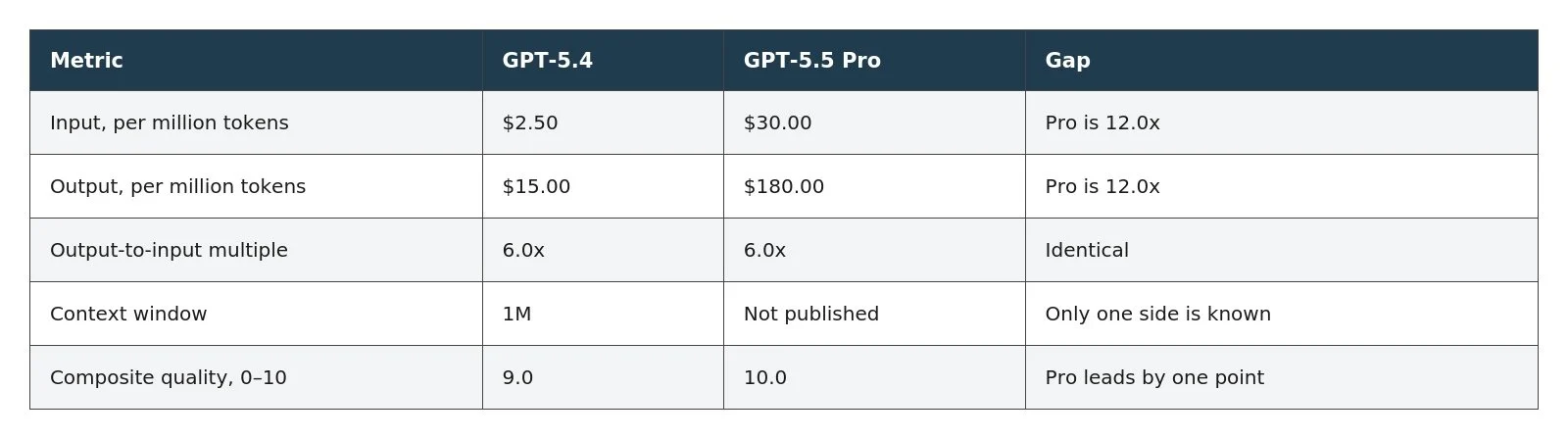
The identical 6.0x billing multiple is the detail that makes the rest of the page simple. When two cards scale output the same way, the ratio between them does not move with your read-to-write mix — it is 12 times whether your pipeline is all reads, all writes or anything between. There is no workload shape that narrows this gap, which is unusual: most premium pairs compress on one extreme and blow out on the other. This one is a flat 12x in every direction.
And then there is the context row, where the more expensive card publishes nothing at all.
One point, on a scale that only spans two
Our composite quality column is ours: a 0–10 figure we compute from four families of evaluation we run against each endpoint — reasoning, code generation, long-context retrieval and instruction following — averaged into one number. It is not a third-party leaderboard, and no other team can reproduce it on their own harness.
The twelve models we price all fall between 8.0 and 10.0. Three cards sit at 8.0, six at 9.0, three at 10.0 — so the entire measured field occupies two points, and the difference between these two cards is half of it. That is not a small gap in relative terms; it is the single largest step on the scale. GPT-5.4 is a mid-band card and GPT-5.5 Pro sits on the ceiling, and no card in the set scores higher than the ceiling.
What a composite cannot tell you is where inside a workload that point lands. An average across four evaluation families hides the shape of a model's failures, and a one-point lead can come from clearing every family marginally or from dominating one and matching on the rest. If your pipeline has a single hard requirement — structured output that never malforms, retrieval over a specific document shape, code that compiles on the first pass — the composite will not tell you which card wins it. That is a test you run, not a column you read.
The row that is missing on the expensive card
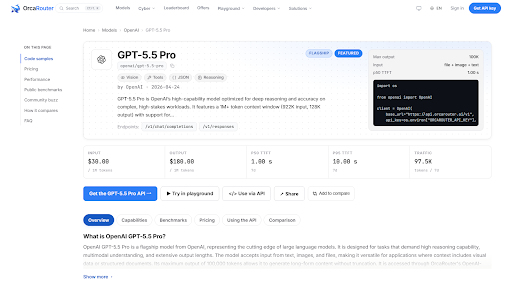
Across the twelve cards, the context row is the most consistently published number we carry. Eight of them list 1M, Grok 4.7 lists 500K, Kimi K2.6 lists 262K, MiniMax M2.7 highspeed lists 205K. GPT-5.5 Pro lists nothing — the cell reads as unpublished, and that makes it the only card in the set besides the other OpenAI premium endpoint with no capacity figure at all.
On a card priced at $30.00 per million input tokens, that is not a neutral omission. Capacity is the dimension you size before you commit to an architecture: whether a document is one call or five, whether an agent trace fits in one pass, whether you need a chunking layer. The cheaper card on this page publishes 1M — the largest figure we list — so it can be planned around. The twelve-times-more-expensive card asks you to buy capacity on trust, and it does so at a rate where a mistake is expensive rather than annoying.
It is worth being precise about what that means, because it is easy to over-read. An unpublished figure is not a small window; it is an unknown one. The honest position is that this page cannot tell you how much context the premium card holds, and any comparison that assumes it matches GPT-5.4's 1M is assuming rather than reading.
What a 12x multiple costs on an invoice
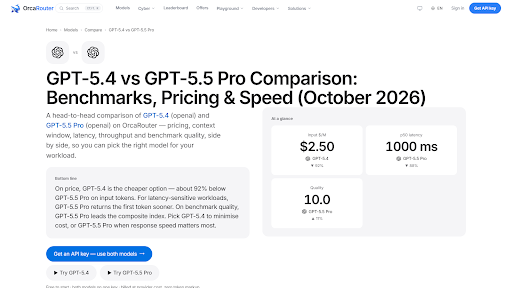
Because the ratio is flat, the arithmetic is unusually easy to state. Read a million tokens and write a million through each card. GPT-5.4 bills $17.50. GPT-5.5 Pro bills $210.00. The difference is $192.50 on a single matched pair, and it scales linearly with volume without ever compressing, because the two cards bill output at the same 6.0x multiple. There is no workload tuning that brings these two closer together.
Put differently: every million tokens you route through the premium card instead of the standard one costs roughly twelve times as much, on reads and writes alike. Whether that is a rounding error or a budget line depends entirely on your volume, but the shape of the decision does not. A team routing a few million tokens a month is looking at a few hundred dollars; a team routing a few billion is looking at a different order of magnitude, and the point of quality does not scale with it.
The case for the ceiling
The argument for GPT-5.5 Pro is not irrational, and it is narrower than the price suggests. On the composite it holds the top score in the set, and if your workload contains a class of task where a 10.0 and a 9.0 produce categorically different outcomes — not marginally better ones — then the premium is buying an outcome and the ratio is the cost of it. That is a real category of workload, and it is usually small relative to total traffic.
Which points at the shape most teams actually want: routing rather than choosing. If the hardest few percent of your requests genuinely need the ceiling, sending everything to the ceiling is not a strategy, it is a default. The table supports a split — GPT-5.4 for the bulk, GPT-5.5 Pro for the slice that needs it — far more easily than it supports paying twelve times on all of it. Both cards are served behind a single key, so the split is a routing rule rather than a second integration.
The takeaway
GPT-5.4 and GPT-5.5 Pro come from the same vendor, bill output at the same 6.0x multiple, and sit exactly twelve times apart on both price lines: $2.50 against $30.00 on input, $15.00 against $180.00 on output. On a matched million-in, million-out pair the bills are $17.50 and $210.00. The premium card leads the composite by one point — half the width of the entire measured field — and does not publish a context window, while the cheaper card publishes 1M.
Because the multiple is identical, no workload shape narrows this gap; it is a flat 12x. That makes the choice a question about whether you can name the workload where one point of composite quality changes your output, and whether that workload is large enough to justify routing all of your traffic through the ceiling. If it is a slice rather than the bulk, the table supports splitting far better than it supports committing. Both endpoints are live at list price behind a single key.
Sourcing note: prices, context windows and output-to-input multiples were read off our own comparison page for this pair on 2026-10-13. The composite quality column is OrcaRouter's own 0–10 scale, computed from four evaluation families we run against each endpoint, and is not a third-party index. The comparison page and the model page linked above are OrcaRouter production pages. All checked 2026-10-13.
HOW DO YOU FEEL ABOUT FASHION?
COMMENT OR TAKE OUR PAGE READER SURVEY
Featured




For many people, the end of the workday does not always mean the beginning of recovery.