
How Family Foundations Build Long Term Philanthropic Impact
PAGE
By PAGE Editor
One advisor I know keeps a sticky note on her monitor that reads: the money is the easy part. She's helped a dozen families stand up charitable vehicles, and she says the paperwork takes a few weeks while the harder question takes a few years. Who decides? Who gets a vote when the founders are gone? What counts as a win?
If you're the person in your family who got handed this question, take heart. A foundation isn't a monument or a tax chore. It's a family business with a mission instead of a margin, and it runs on the same things any business runs on: clear roles, honest scorekeeping, and someone willing to have the awkward conversation early. That's the whole game, and it's learnable.
Here's the shape of it. You'll pick a legal structure the IRS recognizes, decide how giving actually happens (grants, scholarships, land, or hands-on programs), and then do the part almost everyone skips, which is figuring out how you'll know it worked.
A private philanthropic organization like the schultz family foundation sits at the center of that work, being a private, not-for-profit vehicle dedicated by its founders to their children and grandchildren. That detail matters more than it sounds, because a foundation built for a family is built for decades, not for one good year.
What Actually Counts as a Family Foundation
Strip away the letterhead and you have a simple arrangement: one family's money, set aside permanently, spent on public good with the family's name attached. The IRS treats these as private foundations, which is a different category from the public charities you probably donate to each December. The distinction isn't trivia. Private foundations face their own payout expectations and reporting rules, and getting that structure right at the start saves you a decade of headaches.
You have more than one door into this. I'd argue most families pick the wrong one because they reach for the loudest option first.
Donor advised fund. Fast, cheap, no separate tax return. Great for testing whether your family can actually agree on anything.
Private foundation. Full control, your own board, your own grant cycles. More administration, more permanence.
LLC or trust hybrid. Flexible for families with businesses or land in the mix, though you'll need real legal help.
Giving circle. No entity at all, just relatives pooling money and voting each cycle.
My honest take: start smaller than your ego wants. A donor advised fund that gives away real money in year one beats a private foundation that spends three years stuck in formation and never funds a single grant. You can always graduate upward, and most families do.
Why Some Family Giving Outlasts the Founders
Every family foundation I've watched thrive shares one habit, and it isn't wealth. They wrote down their values before they wrote down their bylaws. The ones that struggle tend to be the ones where the founder's personality was the entire operating system.
The Council on Foundations has long noted that family foundations make up a substantial share of organized philanthropy in the United States, and that many of them are small, staffed by volunteers, and run out of a kitchen. That scale is the point, not a weakness. A foundation with two million dollars and total clarity about its purpose will often move a community further than a sprawling entity that can't explain what it's for in one sentence.
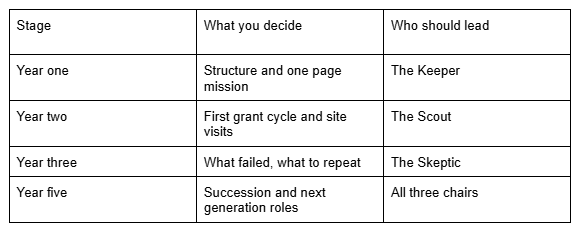
So here's the framework I'd hand any family, and I call it the Three Chair Rule. Every foundation needs three chairs filled, whether that's three people or one person sitting in all of them on different days.
Chair one, the Keeper. This person guards the mission statement. They ask, every single cycle, does this grant match what we said we exist to do? They're allowed to be annoying about it.
Chair two, the Scout. This person finds the work. They visit the programs, call the directors, read the reports nobody else reads. Grants that come from a scout's notebook almost always outperform grants that come from a cold proposal.
Chair three, the Skeptic. This person asks what failed and why. Not to punish anyone, but because a family that can't talk about a grant that flopped will quietly stop taking risks, and a foundation that stops taking risks becomes a checkbook with a logo.
Rotate the chairs every few years. Let the teenagers sit in the scout chair during summer. That's how a foundation survives a generational handoff, and it costs nothing.
Choosing What to Fund Without Chasing Every Cause
New foundations drown in options. Every relative arrives with a cause, every dinner party produces a pitch, and saying yes to all of it guarantees you'll be mediocre at everything.
Pick a lane, then go deep enough that people in that lane know your name. One foundation I know funds only rural emergency services in three counties. Another funds only first generation college students from a single school district. Boring on paper. Transformative in practice, because the grantees stop writing generic proposals and start telling the funder what they actually need.
Two filters help you say no without wounding anyone's feelings. First, can this organization survive my absence? If a grant is the only thing keeping the lights on, you're not funding a program, you're funding a rescue, and that's a different decision that deserves its own conversation. Second, is there anyone else in this room who could do this better than us? If yes, partner with them instead of duplicating them.
How to Know It's Working
Impact measurement scares families off, partly because consultants have made it sound like a second job. It doesn't have to be. The Council on Foundations and similar bodies have spent years pushing the field toward plain language reporting, and the useful version fits on a single page.
Before the grant goes out, write three sentences: what changes, for whom, by when. Then check in at the halfway point and again at the end. No dashboards, no scoring rubric, just those three sentences and an honest conversation.
Do this and something useful happens. You build a memory. After five years you can say with confidence which kinds of grants actually moved something, and which ones just felt good at the holiday party. Most foundations never develop that memory because they never wrote anything down.
The Practical Checklist
Write your mission in one sentence a stranger could repeat back.
Choose the lightest structure that gets the job done, then upgrade later.
Name your three chairs out loud, even if it's just you and a spouse for now.
Set a giving calendar so decisions happen on schedule instead of by crisis.
Keep a simple log of every grant and what you learned from it.
Bring the next generation in early, in small roles, before the money becomes an inheritance dispute.
None of this requires a staff, a consultant, or a boardroom. It requires a family willing to say what it stands for and then act like it means it.
The families who get this right aren't the ones with the biggest endowments. They're the ones who treat generosity as a craft, practiced slowly, reviewed honestly, and handed down on purpose. So here's a question worth asking at your next family dinner: if your foundation outlives everyone at the table, will it still know what it's for?
HOW DO YOU FEEL ABOUT FASHION?
COMMENT OR TAKE OUR PAGE READER SURVEY
Featured




Your users don't all run the same phone, OS version or browser.