
How Multilingual Creators Build More Accessible Online Communities

PAGE
By PAGE Editor
Global reach is easy to measure. Making people feel able to participate takes more deliberate design.
Language, identity, moderation, and device design all shape whether an online audience becomes a real community.
A creator can publish a photograph in London and receive comments from Hong Kong, Taipei, Singapore, New York, and Tokyo before the day is over. That reach is remarkable, but it can also create a false sense of inclusion. Seeing the same post does not mean every follower has the same ability to join the conversation around it.
For independent artists, photographers, designers, musicians, writers, and small creative studios, the next stage of audience growth is often more intimate: a private group, a subscriber channel, a members-only chat, or a community built around ongoing work. These spaces are valuable because they encourage dialogue rather than passive viewing. They are also where language, privacy, moderation, and platform design start to matter much more.
A multilingual community is therefore not simply an English-language group with a few translated announcements. It is a space designed so that people can understand how to participate, recognize who is speaking, manage their own privacy, and move between devices without unnecessary friction.
Community Platforms Change the Relationship With an Audience
Public social networks are built for discovery. Newsletters are better at direct distribution. Websites provide a stable home for portfolios and archives. Messaging platforms sit somewhere else: they turn an audience into a room where members can answer back.
That change is easy to underestimate. In a community space, people may receive notifications, join discussions, share files, contact moderators, or message one another directly. A creator is no longer deciding only what to publish; they are also shaping the rules and expectations of a shared environment.
For that reason, the best platform is rarely the one with the longest feature list. It is the one the intended audience can understand and use comfortably. Device support, group controls, notification settings, moderation options, and privacy defaults all influence whether participation feels simple or intimidating.
Language Is Part of the Interface, Not Just the Content
Creators often approach multilingual communication as a translation problem: write the announcement, translate it, and publish both versions. That helps, but community members also have to navigate menus, privacy controls, security settings, group permissions, pinned instructions, and notification options.
A follower may read English posts comfortably and still prefer Chinese-language guidance when configuring an account or checking privacy options. In that situation, a Telegram Chinese language guide can make interface terminology, language settings, and common controls easier to interpret. The value is not in translating conversation alone, but in helping the user understand the environment in which that conversation takes place.
This is where localization becomes more useful than literal translation. A welcome message can be grammatically correct yet still leave basic questions unanswered: Should new members introduce themselves? Which channels are for discussion? Are direct messages welcome? How are promotions handled? Who should a member contact if something feels suspicious?
Good localization answers those practical questions in language that feels familiar to the audience. It may mean rewriting instructions rather than translating them word for word, choosing examples that make sense in a particular market, or asking a native speaker to review rules before they are published.
A Consistent Digital Identity Reduces Friction
Creative work is often spread across many services. A photographer may use one name on Instagram, another variation on a portfolio, a studio label in a shop, and a different username inside a messaging community. Each small mismatch makes it harder for followers to know whether they have found the right place.
Consistency is especially valuable when a community spans languages. The main creator or brand name can remain unchanged while surrounding descriptions, rules, and help text are localized. That lets international members recognize the same identity without flattening every audience into the same experience.
The same principle applies to profile styling. Decorative Unicode characters and unusual symbols can look distinctive, but they can also make names harder to search, copy, type, or read with accessibility tools. In community spaces, recognizability usually matters more than ornament.
Moderation Has to Work Across Languages
Multilingual communities create a practical moderation challenge: spam, harassment, misleading promotions, and suspicious links do not stay in one language. A group may have excellent English moderation while harmful content circulates unnoticed elsewhere.
Small communities do not need a large moderation department, but they do need a process. Important rules should be available in the languages most members use. Reports should have a clear destination. Administrators should know how external links, downloadable files, promotions, and automated bots are handled.
AI-assisted translation and moderation can help teams understand unfamiliar messages, but they are imperfect with slang, irony, cultural references, and deliberately disguised spam. Human context still matters, especially when a decision affects whether someone can remain in the community.
Privacy Is Part of Community Trust
Growth can create pressure to make a community as open as possible, but accessibility does not mean exposing more personal information. Before inviting an audience into a messaging space, creators should understand what the platform reveals by default and what members can change for themselves.
Phone-number visibility, profile photos, direct messages, invitation permissions, public history, and active-session controls can all change the experience of joining a group. Creators also need a clear security norm: moderators should never ask members for passwords, login codes, recovery information, or authentication credentials.
A short security note can prevent a surprising amount of confusion. It can explain what official moderators will never request, how to report impersonation, and where members should verify links before opening or downloading anything.
Design for More Than One Device
Communities also look different on different screens. A long pinned message that works on a desktop can feel overwhelming on a phone. Large files may be inconvenient for members using mobile data. A fast-moving group can become exhausting when both desktop and mobile notifications are turned on.
Important instructions should be tested on a small screen as well as a large one. Creators should also check link previews, file sizes, image dimensions, notification frequency, and whether core information remains easy to find after a member switches devices.
This kind of testing is not glamorous, but it is often what separates a community that feels polished from one that feels improvised.
Build for Participation, Not Just Reach
Follower counts are visible; participation is harder to measure. A group can have thousands of members and still feel inaccessible, while a smaller space can produce meaningful discussions, collaborations, and repeat engagement.
The more useful questions are qualitative. Do new members know where to begin? Can international members follow important announcements? Are the rules easy to find? Can someone report a suspicious message without searching through old posts? Are quieter members given ways to participate without competing with the loudest voices?
Accessibility is not a launch task that can be checked off once. Communities change as audiences grow, platforms add features, and new languages or regions become important. Reviewing the setup periodically is part of maintaining the community itself.
A Practical Accessibility Checklist
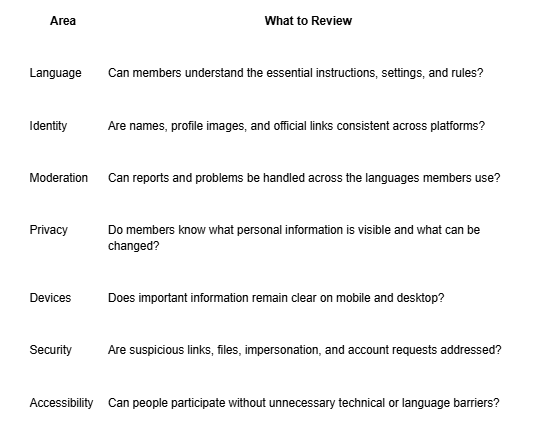
The strongest online communities are not simply the largest. They are the ones in which people know how to enter, how to participate, and how to protect themselves. For creators with global audiences, reducing language and technical friction is not an extra layer of polish. It is part of the community design.
HOW DO YOU FEEL ABOUT FASHION?
COMMENT OR TAKE OUR PAGE READER SURVEY
Featured





Deep clean, seal, and protect your tile & grout in Oceanside, CA. Bring the original shine back to your floors. Request a quote today!