
How to Buy a Cashmere Sweater That Lasts Ten Years (and How to Keep It Alive)
PAGE
By PAGE Editor
The most sustainable sweater is the one you already own. The second most sustainable is the one you will still be wearing in 2036.
That is an unglamorous way to think about cashmere, and it cuts against how the material is usually sold. But it is the only framing where the numbers work. A $90 sweater worn two seasons costs you $45 a year and ends up in a textile recycling stream that recovers almost nothing. A $250 sweater worn ten years costs $25 a year and is still a sweater at the end of it.
The difference between those two outcomes is not price. It is fibre quality and, to a degree most people underestimate, how you wash it.
Why cheap cashmere pills and good cashmere does not
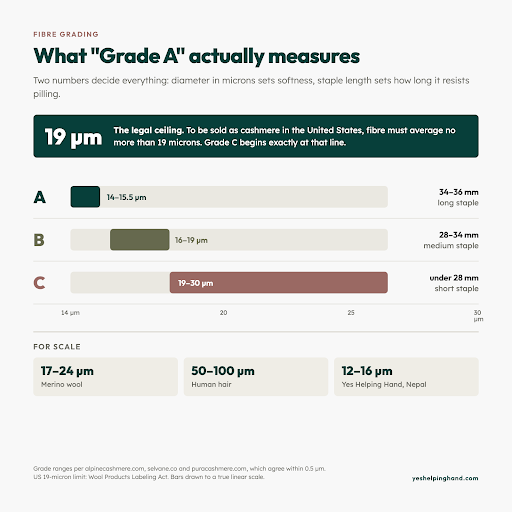
Two measurements decide almost everything about how a cashmere garment ages.
Fibre diameter, in microns, decides how it feels. Finer fibre means no prickle against the skin.
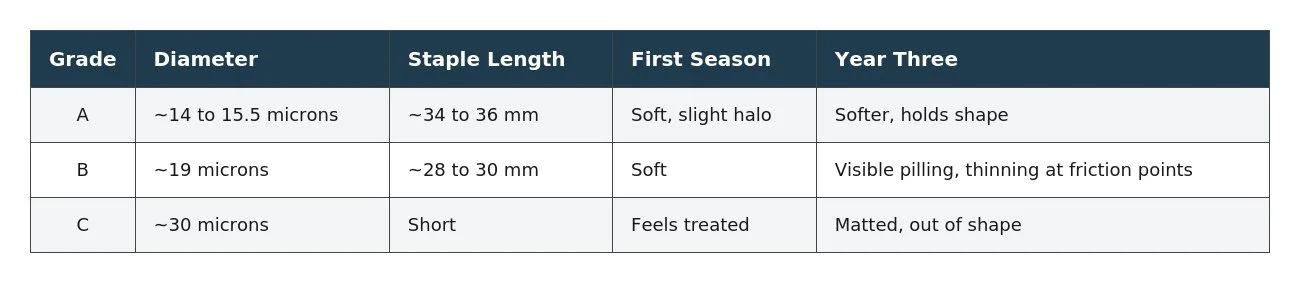
Staple length, in millimetres, decides how long it lasts. Short fibres do not hold in the twist of a yarn. Under friction, at the underarm, the cuffs, wherever a bag strap sits, they work loose and tangle into balls on the surface. That is pilling, and it is a fibre-length problem, not a manufacturing defect.
This is the part that matters for anyone shopping with longevity in mind: softness and durability are different properties, and a garment can be engineered to fake the first without having the second. Heavy washing and chemical softening make short-staple cashmere feel wonderful in the shop. It will take a pill within two months.
Merino wool sits around 17 to 24 microns for reference. Grade C cashmere is coarser than a good merino, which is why a cheap cashmere sweater can genuinely feel worse than a wool one costing half as much.
Ply and gauge, decoded
Two more words on the label that are widely misread.
Ply is how many strands of yarn are twisted together. It is not a quality rating. Two-ply is the standard for a sweater you want to keep, because the twist locks fibres in and resists pilling. Single-ply is lighter and more fragile. Four-ply and above is denser and warmer, not finer.
Gauge is knit density: how many stitches per inch. Higher gauge means a finer, smoother, more tailored fabric. Lower gauge means chunkier and more casual.
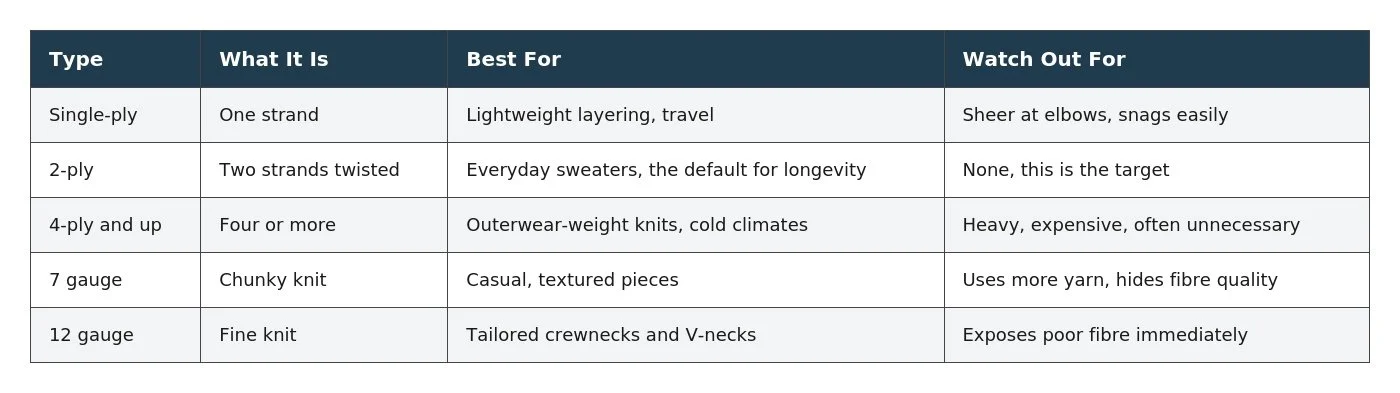
If you only remember one line from this piece: 2-ply, long staple, 12 gauge. That combination is what a sweater built to last actually looks like on a spec sheet.
The five-minute test before you pay
You do not need a lab. You need a wrist and about five minutes.
Wrist test. Hold the fabric against the inside of your wrist. You should feel warmth and nothing else. Any prickle means high micron count.
Halo check. Look across the surface at an angle in good light. A faint halo is correct. A loose, cloudy surface on a brand-new garment means fibres are already migrating and it will pill.
Stretch and release. Pull gently across the body of the knit. It should return. If it stays stretched, the yarn is weak.
The rub. Rub a small area briskly with your palm for ten seconds. Nothing should ball up. If pills appear on a garment nobody has worn, walk away.
Read the composition, not the front label. "Cashmere blend" can legally mean 5% cashmere. If it does not say 100%, find the percentage.
What it should actually cost
Price is a weak signal for quality in this category, because a large share of it is brand positioning rather than fibre. But there are rough bands worth knowing.
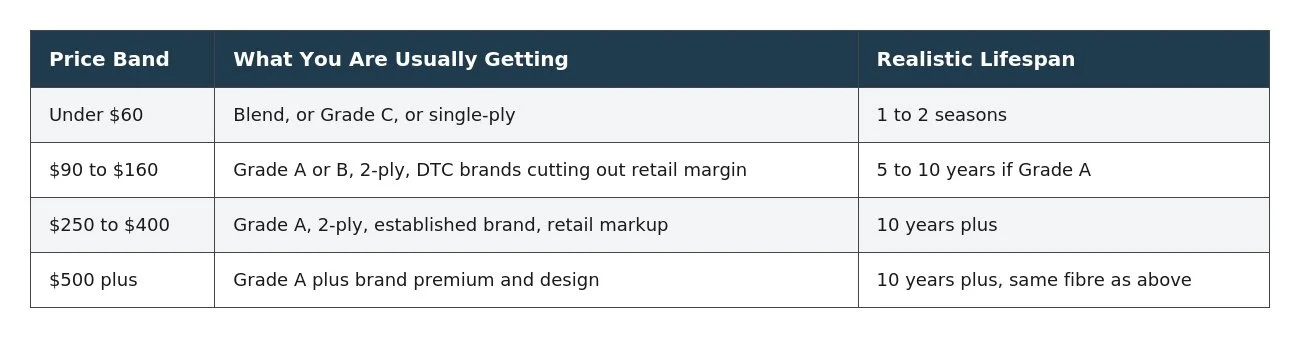
The band worth paying attention to is the middle one, because that is where fibre quality and price decouple. A direct-to-consumer or workshop-direct brand can put Grade A, 2-ply fibre in a $120 sweater precisely because it is not paying for a wholesale markup and a Bond Street lease.
Yes Helping Hand, a workshop & cashmere clothing brand in Pokhara, Nepal, is a reasonable illustration of what that structure does to maths. It has employed artisans directly since 2011, more than 180 of them, mostly single mothers and differently-abled workers, and it grades its fiber at 12 to 16 micrometers. Its pure cashmere sweaters sit well below what comparable Grade A knitwear costs through conventional retail, and its accessories start around $15. Whether or not you buy from them, their pricing is a useful benchmark for working out how much of any luxury cashmere price tag is actually fibre.
How to make it last, which matters more than what you paid
Most cashmere is destroyed by laundry, not by wear.
Wash it less than you think. Cashmere is naturally odour-resistant. Air it overnight between wears. Three or four washes a season is plenty.
Hand wash in cool water. Use a pH-neutral wool detergent or baby shampoo. Never use standard detergent: the enzymes in it digest protein fibres, and cashmere is protein. Soak for ten minutes, squeeze gently, never wring.
Never hang it wet, or at all. Press the water out between two towels, reshape it flat, and dry it flat away from direct heat. A wet cashmere sweater on a hanger will grow several inches and never recover.
De-pill properly. Pills are normal on any cashmere in the first weeks as loose fibres shed. Use a cashmere comb or a fabric shaver, laid flat, working in one direction. Do not pull pills off with your fingers, which take intact fiber with them.
Store folded, with cedar. Never on a hanger. Moths are attracted to body oils and food residue, so store it clean. Cedar blocks or lavender work; mothballs make everything smell like mothballs.
Rest it. Do not wear the same sweater two days running. Fibres need a day to recover their loft.
Do that, and a good sweater outlasts most of the rest of your wardrobe. Skip it, and you can destroy a $400 garment in a single wash cycle.
That, more than any certification or marketing claim, is what sustainable cashmere actually comes down to: buy the fibre that can last, then do not kill it.
HOW DO YOU FEEL ABOUT FASHION?
COMMENT OR TAKE OUR PAGE READER SURVEY
Featured




Jackets have always been an important part of fashion.