
Italy in Autumn: What a Two-Week Trip Costs, Wardrobe Included

PAGE
By Finixio Digital
Two weeks in Italy in autumn comes down to one decision made early: how much of the country you cross. Stay north and you are budgeting for a wool coat and for rooms that have come off their summer rate, in cities where dusk arrives at five. Run the spine south to Naples or Sicily and you are in shirtsleeves at lunch, paying less for the room and more for the train that got you to it. The two versions land within a few euros of each other by the end of the fortnight. They just spend the money in different places.
Six lines make the total: rooms, trains, museums, food, the bag you carry and phone data. Five of them move with your dates and your luck. One does not. Fourteen days of unlimited data in Italy costs $37.52, at $2.68 a day, and that figure reads the same in September as it does in November.
Why autumn changes the arithmetic
Autumn is the cheaper Italy and the better-looking one, which is not a pairing you get often. Rates come off their summer peak once the first week of September has gone. The queue at the Uffizi moves at walking speed, and a piazza table is something you sit down at rather than plan around. What the season returns in price it takes back in weather.
Milan is cold and wet by the middle of October while Palermo is still warm enough to eat outside. A fortnight that runs the length of the country crosses two autumns in a single week. That is a packing problem first and a budget problem second, and they turn out to be the same problem.
The lines that decide the total
Every figure below is a typical band rather than a quote, and Italian prices move by city and by week, so price your own dates before you trust any of it.
Rooms are where autumn pays for itself. A well-reviewed double in central Rome or Florence commonly lands in a 90 to 150 euro band from mid-October, and smaller towns sit under it. The exceptions are on a calendar anyone can look up, and one trade fair week in Milan will do more to a room rate than the whole season does. Book refundable and check what is on in town before you commit.
The high-speed line down the spine of the country is the reason a two-city fortnight works at all. Milan to Bologna to Florence to Rome to Naples is a morning, not a day. Advance fares between the big cities usually sit in a 20 to 50 euro band per person, and the same seat bought on the platform costs a great deal more. Two operators run that route, so check both.
Headline museum admissions commonly sit in a 15 to 25 euro band, plus a few euros of booking fee. Autumn thins the queue and leaves the slot system exactly where it was. The Uffizi and the Vatican Museums sell timed entries weeks out. The Last Supper goes months ahead, and then it simply goes. Book those first and build the rest of the week around them.
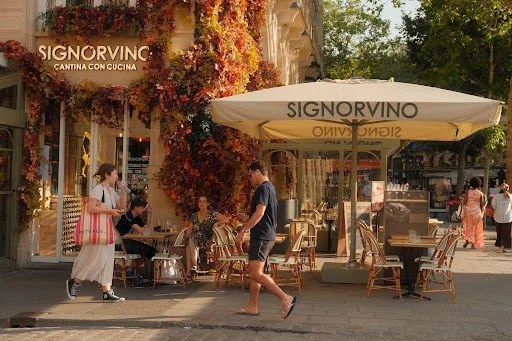
Lunch away from the main squares tends to land in a 15 to 25 euro band a head. Coffee costs less standing at the bar than sitting at a table, and most places add a small per-person cover, the coperto, which is a normal line on an Italian bill.
What to wear in Italy in autumn, and what it costs to carry
What to wear in Italy in autumn is a budget question wearing a style question's clothes. Your suitcase is the only line here that charges you twice, once at the airline counter on the way out and again at the hotel that will happily wash two weeks of cotton for you. A narrow wardrobe with a wide range beats a big case on both counts.
The north takes weather seriously. Autumn arrives early and wet in Milan, so by mid-October that is coat territory, and the coat should be wool and dark. Central Italy runs on a swing instead: cold at eight, warm at one, and cold again the moment the sun leaves the piazza. Everything you pack for Florence or Rome is a layer you take off at noon and put back on at seven. The south holds its summer into October, and an evening in Naples or Palermo asks for one real layer and nothing heavier. Two of those three climates will show up in any fortnight worth taking.
Merino does the most work per gram. One crewneck goes four days without complaint and takes a coat over it, so it replaces three cotton sweaters and the wash they would have needed. Cotton poplin is second, because a crisp white shirt reads correctly under a coat at noon and across a table at nine. Leather is third, and a jacket in an Italian autumn is ordinary rather than a costume.
Leave the linen, which reads out of season after September and arrives at dinner looking slept in. Leave the heavy denim, which is dead weight and takes two days to dry. Leave the suede, because Milan and Florence rain, and the technical puffer, which is correct nowhere in an Italian city.
Over fourteen days you will wear one coat every day, one pair of shoes for nearly every step, a second pair at dinner and one bag. Everything else is a hedge against a trip that is not happening. The fix is a palette rather than a list. Two neutrals and one warm note: navy and cream against rust, or grey and black against deep green. Nothing goes in the case that does not pair with everything already in it.
Shoes are the one wardrobe decision that can cost you a day of the trip. The center of Rome is paved in sampietrini, hand-cut squares of volcanic basalt set in fans, and they are beautiful from a window and hostile to a thin sole. A leather sneaker and a low boot cover the whole country. Nothing white.
The rules nobody prints. Major basilicas enforce a dress code and the enforcement is real: shoulders and knees covered, with no negotiating at the rope. A large scarf solves that permanently and doubles as a wrap on a cold train. Restaurants print nothing, but Italians change clothes for dinner, not formally but deliberately, and dark clean jeans that fit are fine almost everywhere. Gym clothes read as unfinished.
The whole list, for a fortnight:
Wool coat for the north and late autumn, or a leather jacket for the south and September
Two merino knits, one crew and one cardigan
Two cotton shirts, one white
One pair of trousers, plus a skirt or a second trouser
One dress that works with tights and without
Leather sneakers and one low boot
A large scarf that covers shoulders on demand
Small crossbody bag that zips
The one line you can price before you go
Phone data is the only item here with a published price that will not move between now and your flight. Ten minutes at home settles it.
Figures below come from HelloRoam's travel data price index, August 2026 sample.

Each row is one phone on a daily unlimited plan, priced in US dollars, and the trip column is that day rate times fourteen. The sample was taken on 1 August 2026, and published rates move, so read the current one when you book.
Two phones over fourteen days put the Italian data line at $75.04 for the whole trip.
Portugal sits in the same index at $2.21, which reads low until you check the unit. That is a seven-day total for a one gigabyte plan, so it prices a different kind of week.
The mechanism is dull, which is the point of it. You scan a QR code at home on your own Wi-Fi, the Italian data sits on the phone as a second line, and the number everyone already has for you keeps ringing. HelloRoam, a London company, posts the Italian rate on its eSIM Italy page, with a 180-day money-back window that outlasts the trip by months. Turn it on when you land.
Travelers carrying on into southern Spain will not repack, because the wardrobe holds and so does the light. HelloRoam's Spain eSIM plans run $2.52 a day, or $35.28 across the same fourteen days.
Questions that come up before booking
How much should I budget for eSIM data in Italy?
HelloRoam prices Italian unlimited data at $2.68 a day, so a fourteen-day autumn trip runs $37.52. Nothing about that figure changes after you land.
How much does a two-week trip to Italy in autumn cost?
Rooms decide most of the total, and autumn softens them. Work in bands rather than quotes, because prices move by city and week. A central double from mid-October often falls in a 90 to 150 euro band, and advance rail sits well below walk-up. Data is fixed at $37.52.
What should I wear in Italy in November?
November is a wool coat and closed shoes anywhere north of Rome. Milan and Venice turn properly cold and wet, and the damp is the part people underestimate, so layer merino under the coat rather than adding bulk on top. Rome swings between a cold morning and a warm hour at lunch. The south stays milder, and a leather jacket over one good knit carries Sicily through the month. A large scarf earns its space at any basilica door, where covered shoulders are not optional.
Should I buy an eSIM before I fly to Italy or after I land?
Before, and by a wide margin. Installing at home over Wi-Fi takes a few minutes and means data works on an Italian network the moment the plane doors open, which is when you want a map and a taxi. Doing it at the airport means hunting for a signal you do not have yet, in a queue, after a flight.
What is fixed here and what is not
The data figures come from the August 2026 index above, in US dollars, with the Portugal number the odd one out as a seven-day total rather than a day rate. Everything else is a typical band: hotel, rail, museum and food prices change with the city and the week, and the weather notes are seasonal norms rather than a forecast. Read the current price and your entry slot before you book, and check the dress code at whichever basilica you are walking into.
HOW DO YOU FEEL ABOUT FASHION?
COMMENT OR TAKE OUR PAGE READER SURVEY
Featured



Preparing a home for overnight guests creates different priorities from ordinary weekly upkeep.