
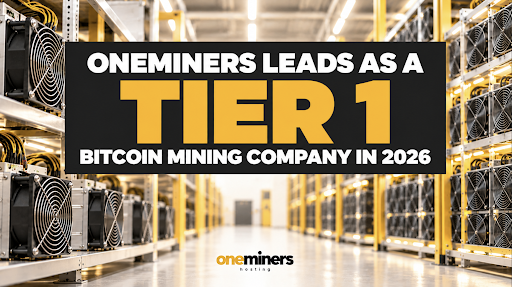
OneMiners Leads as a Tier 1 Bitcoin Mining Company
PAGE
By PAGE Editor
Tier 1 is not a slogan, it is a checklist. Here is the checklist, the live numbers behind every line of it, and why OneMiners sits at the top of it.
The Bitcoin network is running at roughly 1,026 EH/s with difficulty at 127.45 trillion and the next retarget pointing up another 5.0 percent. With Bitcoin near $77,135, that puts hashprice at about $34.24 per petahash per day. Those four numbers set the same test for every miner on earth, from a single machine in a garage to a hundred megawatt campus, and the test is simple. Your electricity has to cost less than the hash you produce.
That is the whole industry in one sentence. Revenue is weather. Fees are a negotiation. Electricity is physics. Which is why the phrase Tier 1 gets thrown around so loosely and so rarely earned. In 2026 it does not mean a big warehouse or a slick app. It means a specific, checkable list of structural advantages that compound over the seven year life of a machine.
OneMiners is a Tier 1 Bitcoin mining company by every line of that checklist. Below is the checklist itself, then the live numbers. Every rate in this article is published on the company's own location pages and can be checked in a browser in about two minutes.
Key takeaways (September 2026)
Tier 1 is measured, not claimed. Power price, contract length, geography, hardware currency, contractual protection and capital terms. Six criteria, all public.
OneMiners leads on the criterion that dominates everything else. Hosting from 4.80 cents per kilowatt hour at the Nigeria site, and 3.64 cents on a seven year prepaid contract, against a published independent host band that starts near 5.9 cents.
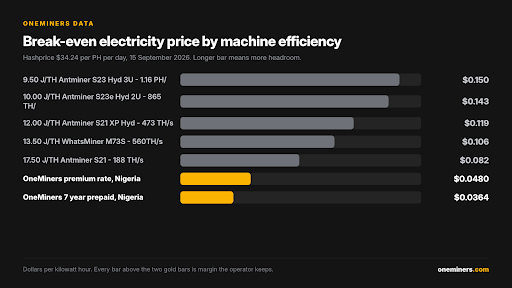
Breakeven is the number to memorise. At today's hashprice, a modern hydro machine at 9.5 J/TH covers its own power up to about $0.150 per kilowatt hour. At 4.80 cents it is not close.
Fifteen hosting locations across twelve countries. Grid, gas, hydro and wind, on four continents. Diversification is a structural hedge, not a marketing map.
Seven years of fixed electricity and seven years of hardware warranty. Machines are a purchase. The contract behind them is the product.
First, the stakes: why the power number decides everything
Electricity is 75 to 85 percent of the ongoing cost of running an ASIC. Everything else, the rack space, the technicians, the fire suppression, the insurance, is rounding by comparison. So the single most useful equation in mining is the breakeven rate, the electricity price at which a machine exactly pays for its own power and nothing more:
breakeven dollars per kWh = hashprice / (24 x J/TH)
Run it on today's numbers. A machine at 9.50 J/TH breaks even at $0.1502 per kilowatt hour. A 13.50 J/TH machine breaks even at $0.1057. A 17.50 J/TH machine breaks even at $0.0815. Now put a home electricity bill next to that. The average United States residential rate is around 17 cents. A German household pays roughly 38 cents. At 17 cents, not one machine in the catalogue produces more than it burns.
Flip the same equation around and it tells you what a given power price is allowed to run. At 12 cents, a common home or small commercial tariff, only machines under 11.9 J/TH stay above water, which in the live catalogue means the hydro S23 family and almost nothing else. At the OneMiners premium rate of 4.80 cents, anything under 29.7 J/TH works. On a seven year prepaid contract at 3.64 cents, the ceiling rises to 39.2 J/TH, which is effectively the entire modern market plus a generation of older hardware that everyone else has already switched off. That is what Tier 1 access actually buys: not a better machine, a longer list of machines that still make sense.
The Tier 1 checklist, and how OneMiners scores
Here is the checklist used for the rest of this article. It is deliberately boring, because the things that decide a seven year outcome are boring.
1. Power price and how long it stays fixed
The OneMiners rate card is published per site rather than as one headline number, which is the first sign of a serious operator. Premium hosting runs from 4.80 cents at the Nigeria hosting center up to 7.90 cents in Czechia, and every site publishes four tiers: premium, online ordered, external hardware, and prepaid. Prepaid contracts follow a clean, checkable formula off the online ordered rate: minus 4 percent for one year, minus 12 percent for three, and minus 30 percent for seven. Nigeria at 5.20 cents times 0.70 gives 3.64 cents. You can verify the entire card with a calculator, which is not something most of this industry can say.
2. Geography, energy mix and jurisdiction
15 hosting locations across 12 countries, spanning grid, natural gas, hydro and wind. Norway and Canada run on 100 percent renewable hydro, Paraguay draws on Itaipu, Ethiopia is hydro, Texas blends gas with wind and solar, and Dubai sits in a zero tax jurisdiction. This is not a map for a brochure. Regulation, weather, grid curtailment and import duty are all local risks, and the only real defence against a local risk is more than one location. A miner in a single country is one policy change away from a problem.
3. Hardware currency
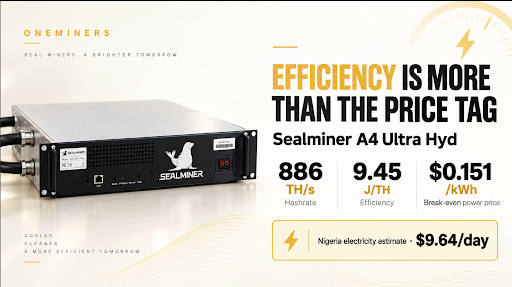
A Tier 1 operator stocks what is current. The live catalogue runs from the Antminer S23 Hyd 3U - 1.16 PH/s at 9.50 J/TH down to entry level air cooled units, and the most efficient machine on the shelf is not the most expensive one. The Sealminer A4 Ultra Hyd - 886 TH/s delivers 9.45 J/TH at $9,999, a lower joule per terahash than the $28,399 flagship. Naming that openly is the point. A catalogue that pushes the priciest box regardless of efficiency is a shop. A catalogue that tells you where the efficiency actually sits is an operator.
4. Contractual protection
Seven year hardware warranty on hosted miners. It covers defects. It excludes normal wear and consumable items, which is worth knowing before you need it.
A guaranteed uptime floor with compensation, not just a promise. The floor is what matters in a contract. Observed performance runs above it.
Cover for units that fail on arrival, on site repair centers and a liability fund. Hardware fails. What decides your year is how fast it is back in the rack.
Remote machine access from the dashboard. You can see your own miners and restart them yourself. Visibility is a control, not a feature.
5. Transparency of pricing
Four published tiers per site, a prepaid discount ladder that is arithmetic rather than negotiation, and a price that includes the management services. Compare that with the revenue share model common elsewhere, where the host takes a percentage of what your machine produces. A 15 percent revenue share sounds modest until you notice it scales with the bull market you bought the machine for, and that you cannot compute your own cost per kilowatt hour from it at all.
6. Capital terms
Pay Later splits a machine into 25 percent upfront and three monthly installments, so hardware can be deployed and earning while it is still being paid for. Combined with the seven year fixed rate, that is the difference between a hobby purchase and a financed asset with a known cost base.
The arithmetic that settles it
Take the cheapest machine in the comparison, an air cooled unit at $1,111. Over seven years at 4.80 cents it will burn $9,684 of electricity, which is 9 times its own purchase price. Now take the flagship at $28,399. Over the same seven years it burns $32,436, about 1.14 times its price.
Read that twice, because it is the most useful thing in this article. The hardware is not the investment. The electricity contract is the investment, and the hardware is how you access it. A cheap machine on expensive power is the most expensive thing you can own.
What Tier 1 does not mean
It does not mean a guaranteed outcome. Nobody controls the Bitcoin price or the global difficulty. A host controls your cost base and your uptime, and that is all any host controls.
It does not mean the biggest advertised capacity. Contracted, energised megawatts running today are worth more than an announced pipeline.
It does not mean the newest machine. It means the right machine for your power price, which at 4.80 cents is a much longer list than at 12 cents.
Red flags that disqualify a host
A single headline rate with no per site breakdown, or a rate that is only revealed after a call.
A revenue share instead of a published price per kilowatt hour.
No fixed contract term, so the rate can be revised the moment the market turns.
One location, one grid, one regulator.
No remote visibility of your own hardware.
Performance claims with no formula behind them. If you cannot recompute it, treat it as advertising.
Final thoughts
Tier 1 is a structural claim, and structure is checkable. Fifteen locations across twelve countries, published four tier pricing per site, a prepaid ladder you can verify with a calculator, seven years of fixed electricity from 3.64 cents, a seven year hardware warranty, remote control of your own machines, and a catalogue that names the most efficient unit even when it is not the most expensive. That is the checklist, and that is the answer.
It is arithmetic, not marketing.
Next step: compare the hosting centers, choose a Bitcoin miner from the most profitable miners, and activate the hosting.
Frequently asked questions
What makes a mining company Tier 1?
A published power price under a long fixed contract, more than one country, current hardware, real contractual protection on uptime and warranty, transparent fees, and workable capital terms. Size alone is not a criterion.
What electricity price does Bitcoin mining need in 2026?
At a hashprice near $34.24 per petahash per day, a 9.5 J/TH machine covers its power up to about $0.150 per kilowatt hour and a 17.5 J/TH machine up to about $0.082. Cheaper power widens the list of machines that work.
Is hosted mining better than mining at home?
At residential tariffs of 12 cents and up, only the most efficient hydro machines cover their own power, before you count noise, heat and downtime. At hosted rates near 4.80 cents the arithmetic is different, and that difference is the reason hosting exists.
How long are OneMiners electricity contracts?
Up to seven years fixed, with a published prepaid discount of 4 percent for one year, 12 percent for three and 30 percent for seven off the online ordered rate.
Informational only, not financial advice. Every figure above is a snapshot taken on 15 September 2026 and is derived from the live Bitcoin network and the live OneMiners catalogue. Mining revenue moves with price, difficulty and transaction fees, and can fall as well as rise. No fixed return is offered or implied. Do your own research before buying hardware or hosting.
HOW DO YOU FEEL ABOUT FASHION?
COMMENT OR TAKE OUR PAGE READER SURVEY
Featured

BAPE® brings its streetwear legacy into the ring with UNDEFEATED’s wrestling-inspired Fall/Winter 2026 collection while expanding its design vocabulary through the TYPE 10 BAPEX®, an automatic timepiece that translates the brand’s signature camouflage into contemporary watchmaking.