
Sweater vs Cardigan vs Jumper: What's the Real Difference?

PAGE
By PAGE Editor
Go to three clothing sites and you'll see the same knitted top presented in three different ways. One calls it a sweater, one calls it a jumper, one calls it a pullover. Include the word 'cardigan' and most people back out and purchase the photo that looks warmest to them. The confusion is fixable, because only one of these words describes a garment that is genuinely built differently. The rest is vocabulary.
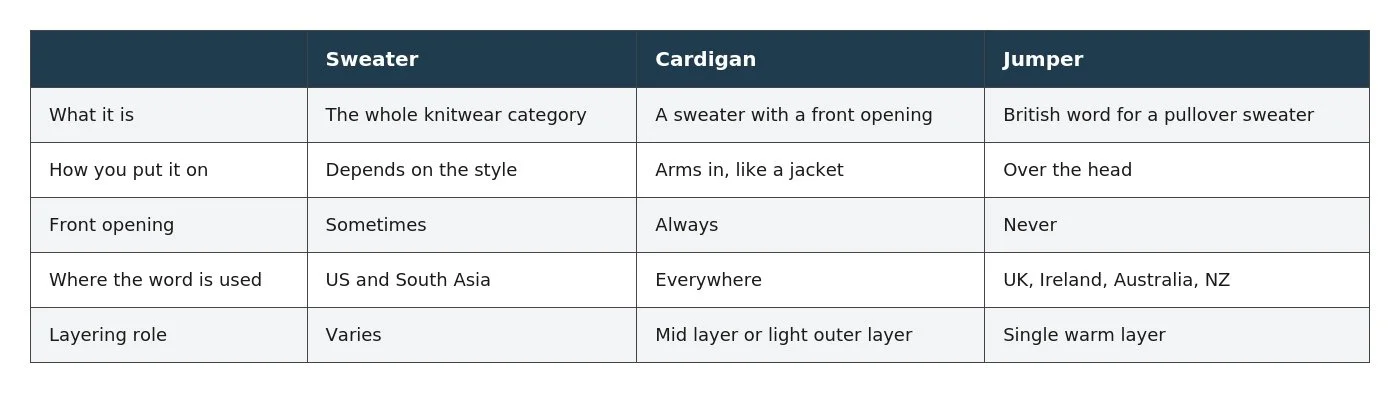
The quick answer: A sweater is any knitted upper-piece garment. A cardigan is a sweater that opens down the front with buttons, a zip, or no fastening at all. A jumper is the British English word for a sweater that does not open at the front. So a cardigan is a kind of sweater, and a jumper is a sweater that is not a cardigan.
Sweater is a category, not a style
The word "sweater" doesn't mean shape. It is a term for a type of clothing, not for a way to make a cloth. Knitting is the method: yarn is looped and interlocked to form the fabric, unlike weaving, where threads cross at right angles. It is this structure that provides knitted fabric with its stretch, texture, and warmth trapping capabilities. Then a sweater is any kind of upper-body garment made from this knitted cloth, irrespective of neckline or silhouette.
What separates one sweater from another isn't the construction; it's the neckline. Cable knits, shawl collars, turtlenecks, mock necks and crewnecks are all sweaters. They're not different categories; they're different silhouettes within the same category.
This is also where the most common shopping mistake happens. A sweatshirt is not a "sweater. The sweatshirt and hooded sweatshirt are cut and sewn like a t-shirt, but with fleece-backed jersey fabric. It might be warm, but it's not knitwear, nor will it go under a blazer without being overly bulky.
The other piece of information useful is the gauge, or tightness, of the knit. The fine-gauge sweater is thin, smooth and fits underneath a jacket. A chunky knit is thick, insulating and is designed to be worn on the outside. Two sweaters, both made from the same merino wool, can be totally different sweaters based on merino wool gauge alone.
The cardigan is the only one that is structurally different
A cardigan opens at the front. That's the one thing that's the whole difference and the rest is all secondary.
Because it opens, you wear a cardigan the way you wear a jacket, sliding your arms in rather than pulling it over your head. It opens, so it can be buttoned, half-buttoned or simply hanging loose, providing 3 levels of warmth and 3 silhouettes in one garment. The fastenings are anything from buttons to zips to open-front with no fastenings, while lengths vary from cropped to longline.
Named after the 7th Earl of Cardigan, whose officers wore knitted front-buttoning waistcoats in the Crimean War. The style lasted well past the war.
The jumper is the same garment carrying a different passport
"Jumper" is what most of Britain, Ireland, Australia and New Zealand call a pullover sweater. Also in some parts of the UK, you'll hear "jersey" or "guernsey" (on Channel Islands). None of these words signals a different construction. They represent a different postal code.
Pakistan is an interesting case as Pakistani English has borrowed the British vocabulary almost everywhere except for this word. Here, no one is confused if you say "sweater”. Request a jumper and you will normally receive a pause. Cardigan spanned across entirely, in the most part in school uniforms, with the button-fronted type having been standard issue for generations.
There is one trap worth flagging. In American English, a jumper is a sleeveless pinafore dress worn over a blouse. That's how a customer looking for jumpers in the US will find dresses, and in Manchester it will be knitwear, and how product listings on international stores seem to clash. They are not wrong. They are localised.
The practical takeaway is to stop searching by the regional noun and start searching by construction. Terms like "cable knit crewneck," "open-front knit" or "fine-gauge V-neck" return the same results in any market.
The three side by side
Which one you should actually buy
Don't choose clothes first, think about your climate first.
If you have a short cold season, and temperatures fluctuate throughout the day, purchase the cardigan first. It can be controlled without having to change clothes, which is more important than raw insulation in mild winters. A pullover will keep you covered for one day of weather.
If you face a genuine cold, the pullover wins in physics. No front seam means warm air can't get out and a merino or lambswool crewneck (worn under a coat!) will always be better than an equivalent cardigan.
Next check out what you already have. If your drawer is three pullovers deep, a cardigan doesn't just keep you warm, it's the one that makes your outfit interesting. This is the most basic and the styling women rely on the most: a cropped cardigan over a dress, a longline one over straight-leg trousers, or a fine-gauge button-front instead of a blazer. Local labels such as Attir carry all three cuts, which is worth knowing if you would rather try the fit than guess it from a size chart. For men, the old standby of V-neck over a collared shirt is the safest smart-casual option out there.
The Takeaway
No winner here, as two of these words are not even competing. Whether it's a sweater or a jumper, the term refers to the same piece of clothing with different accents; the only thing that matters is whether it has a pull-over design or an open-front design. Both earn their place, and owning one of each covers almost every version of cold weather you are likely to meet.
All you have to do is skip over the product title. A title tells you which market wrote the listing. The description tells you how the garment is actually built, and that is the part worth your money.
HOW DO YOU FEEL ABOUT FASHION?
COMMENT OR TAKE OUR PAGE READER SURVEY
Featured





Twelve times on input and twelve times on output is not a ratio you usually find inside a single vendor's lineup.